• 文献检索
  • 文档翻译
  • 深度研究
  • 学术资讯
  • Suppr Zotero 插件Zotero 插件
  • 邀请有礼
  • 套餐&价格
  • 历史记录
应用&插件
Suppr Zotero 插件Zotero 插件浏览器插件Mac 客户端Windows 客户端微信小程序
定价
高级版会员购买积分包购买API积分包
服务
文献检索文档翻译深度研究API 文档MCP 服务
关于我们
关于 Suppr公司介绍联系我们用户协议隐私条款
关注我们

Suppr 超能文献

核心技术专利:CN118964589B侵权必究
粤ICP备2023148730 号-1Suppr @ 2026

文献检索

告别复杂PubMed语法,用中文像聊天一样搜索,搜遍4000万医学文献。AI智能推荐,让科研检索更轻松。

立即免费搜索

文件翻译

保留排版,准确专业,支持PDF/Word/PPT等文件格式,支持 12+语言互译。

免费翻译文档

深度研究

AI帮你快速写综述,25分钟生成高质量综述,智能提取关键信息,辅助科研写作。

立即免费体验

使用非靶向代谢组学分析氧化铜纳米颗粒的毒性

Copper oxide nanoparticle toxicity profiling using untargeted metabolomics.

作者信息

Boyles Matthew S P, Ranninger Christina, Reischl Roland, Rurik Marc, Tessadri Richard, Kohlbacher Oliver, Duschl Albert, Huber Christian G

机构信息

Department of Molecular Biology, Division of Allergy and Immunology, University of Salzburg, Hellbrunner Strasse 34, 5020, Salzburg, Austria.

Department of Molecular Biology, Division of Chemistry and Bioanalytics, University of Salzburg, Hellbrunner Strasse 34, 5020, Salzburg, Austria.

出版信息

Part Fibre Toxicol. 2016 Sep 8;13(1):49. doi: 10.1186/s12989-016-0160-6.

DOI:10.1186/s12989-016-0160-6
PMID:27609141
原文链接:https://pmc.ncbi.nlm.nih.gov/articles/PMC5017021/
Abstract

BACKGROUND

The rapidly increasing number of engineered nanoparticles (NPs), and products containing NPs, raises concerns for human exposure and safety. With this increasing, and ever changing, catalogue of NPs it is becoming more difficult to adequately assess the toxic potential of new materials in a timely fashion. It is therefore important to develop methods which can provide high-throughput screening of biological responses. The use of omics technologies, including metabolomics, can play a vital role in this process by providing relatively fast, comprehensive, and cost-effective assessment of cellular responses. These techniques thus provide the opportunity to identify specific toxicity pathways and to generate hypotheses on how to reduce or abolish toxicity.

RESULTS

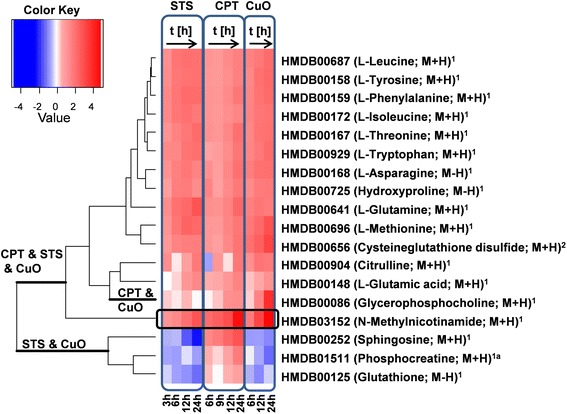
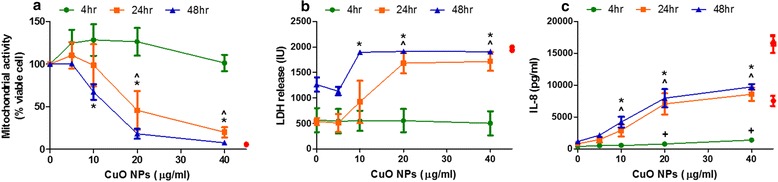
We have used untargeted metabolome analysis to determine differentially expressed metabolites in human lung epithelial cells (A549) exposed to copper oxide nanoparticles (CuO NPs). Toxicity hypotheses were then generated based on the affected pathways, and critically tested using more conventional biochemical and cellular assays. CuO NPs induced regulation of metabolites involved in oxidative stress, hypertonic stress, and apoptosis. The involvement of oxidative stress was clarified more easily than apoptosis, which involved control experiments to confirm specific metabolites that could be used as standard markers for apoptosis; based on this we tentatively propose methylnicotinamide as a generic metabolic marker for apoptosis.

CONCLUSIONS

Our findings are well aligned with the current literature on CuO NP toxicity. We thus believe that untargeted metabolomics profiling is a suitable tool for NP toxicity screening and hypothesis generation.

摘要

背景

工程纳米颗粒(NPs)以及含有NPs的产品数量迅速增加,引发了对人类接触和安全性的担忧。随着NPs种类不断增加且不断变化,及时充分评估新材料的潜在毒性变得越来越困难。因此,开发能够提供生物反应高通量筛选的方法很重要。包括代谢组学在内的组学技术,通过对细胞反应提供相对快速、全面且经济高效的评估,可在这一过程中发挥至关重要的作用。这些技术因此提供了识别特定毒性途径并就如何降低或消除毒性提出假设的机会。

结果

我们使用非靶向代谢组分析来确定暴露于氧化铜纳米颗粒(CuO NPs)的人肺上皮细胞(A549)中差异表达的代谢物。然后根据受影响的途径生成毒性假设,并使用更传统的生化和细胞试验进行严格测试。CuO NPs诱导了参与氧化应激、高渗应激和细胞凋亡的代谢物的调节。氧化应激的参与比细胞凋亡更容易阐明,细胞凋亡涉及对照实验以确认可作为细胞凋亡标准标志物的特定代谢物;基于此,我们初步提出甲基烟酰胺作为细胞凋亡的通用代谢标志物。

结论

我们的研究结果与当前关于CuO NP毒性的文献高度一致。因此,我们认为非靶向代谢组学分析是NP毒性筛选和假设生成的合适工具。

https://cdn.ncbi.nlm.nih.gov/pmc/blobs/4d8e/5017021/d6ec79305089/12989_2016_160_Fig8_HTML.jpg
https://cdn.ncbi.nlm.nih.gov/pmc/blobs/4d8e/5017021/17caede7b3bc/12989_2016_160_Fig1_HTML.jpg
https://cdn.ncbi.nlm.nih.gov/pmc/blobs/4d8e/5017021/10ee4631a5d5/12989_2016_160_Fig2_HTML.jpg
https://cdn.ncbi.nlm.nih.gov/pmc/blobs/4d8e/5017021/e54532e46a3c/12989_2016_160_Fig3_HTML.jpg
https://cdn.ncbi.nlm.nih.gov/pmc/blobs/4d8e/5017021/a77f47325532/12989_2016_160_Fig4_HTML.jpg
https://cdn.ncbi.nlm.nih.gov/pmc/blobs/4d8e/5017021/71434df5b009/12989_2016_160_Fig5_HTML.jpg
https://cdn.ncbi.nlm.nih.gov/pmc/blobs/4d8e/5017021/bd03cba1eb6e/12989_2016_160_Fig6_HTML.jpg
https://cdn.ncbi.nlm.nih.gov/pmc/blobs/4d8e/5017021/e1cf7d662341/12989_2016_160_Fig7_HTML.jpg
https://cdn.ncbi.nlm.nih.gov/pmc/blobs/4d8e/5017021/d6ec79305089/12989_2016_160_Fig8_HTML.jpg
https://cdn.ncbi.nlm.nih.gov/pmc/blobs/4d8e/5017021/17caede7b3bc/12989_2016_160_Fig1_HTML.jpg
https://cdn.ncbi.nlm.nih.gov/pmc/blobs/4d8e/5017021/10ee4631a5d5/12989_2016_160_Fig2_HTML.jpg
https://cdn.ncbi.nlm.nih.gov/pmc/blobs/4d8e/5017021/e54532e46a3c/12989_2016_160_Fig3_HTML.jpg
https://cdn.ncbi.nlm.nih.gov/pmc/blobs/4d8e/5017021/a77f47325532/12989_2016_160_Fig4_HTML.jpg
https://cdn.ncbi.nlm.nih.gov/pmc/blobs/4d8e/5017021/71434df5b009/12989_2016_160_Fig5_HTML.jpg
https://cdn.ncbi.nlm.nih.gov/pmc/blobs/4d8e/5017021/bd03cba1eb6e/12989_2016_160_Fig6_HTML.jpg
https://cdn.ncbi.nlm.nih.gov/pmc/blobs/4d8e/5017021/e1cf7d662341/12989_2016_160_Fig7_HTML.jpg
https://cdn.ncbi.nlm.nih.gov/pmc/blobs/4d8e/5017021/d6ec79305089/12989_2016_160_Fig8_HTML.jpg

相似文献

1
Copper oxide nanoparticle toxicity profiling using untargeted metabolomics.使用非靶向代谢组学分析氧化铜纳米颗粒的毒性
Part Fibre Toxicol. 2016 Sep 8;13(1):49. doi: 10.1186/s12989-016-0160-6.
2
A global metabolomic insight into the oxidative stress and membrane damage of copper oxide nanoparticles and microparticles on microalga Chlorella vulgaris.铜氧化物纳米颗粒和微颗粒对小球藻的氧化应激和膜损伤的全局代谢组学研究。
Environ Pollut. 2020 Mar;258:113647. doi: 10.1016/j.envpol.2019.113647. Epub 2019 Nov 27.
3
Dose-dependent genotoxicity of copper oxide nanoparticles stimulated by reactive oxygen species in human lung epithelial cells.活性氧在人肺上皮细胞中刺激产生的氧化铜纳米颗粒的剂量依赖性遗传毒性。
Toxicol Ind Health. 2016 May;32(5):809-21. doi: 10.1177/0748233713511512. Epub 2013 Dec 5.
4
Copper(II) oxide nanoparticles penetrate into HepG2 cells, exert cytotoxicity via oxidative stress and induce pro-inflammatory response.氧化铜纳米颗粒穿透 HepG2 细胞,通过氧化应激发挥细胞毒性作用,并诱导促炎反应。
Nanoscale. 2012 Nov 21;4(22):7168-84. doi: 10.1039/c2nr31785k.
5
Lipidomics reveals insights on the biological effects of copper oxide nanoparticles in a human colon carcinoma cell line.脂质组学揭示了氧化铜纳米颗粒在人结肠癌细胞系中的生物学效应的见解。
Mol Omics. 2019 Feb 11;15(1):30-38. doi: 10.1039/c8mo00162f.
6
High-resolution mass spectrometry-based metabolomics reveal the disruption of jasmonic pathway in Arabidopsis thaliana upon copper oxide nanoparticle exposure.基于高分辨率质谱的代谢组学揭示了铜氧化物纳米颗粒暴露后拟南芥中茉莉酸途径的破坏。
Sci Total Environ. 2019 Nov 25;693:133443. doi: 10.1016/j.scitotenv.2019.07.249. Epub 2019 Jul 18.
7
Dietary Antioxidant Curcumin Mitigates CuO Nanoparticle-Induced Cytotoxicity through the Oxidative Stress Pathway in Human Placental Cells.膳食抗氧化剂姜黄素通过氧化应激途径减轻人胎盘细胞中氧化铜纳米颗粒诱导的细胞毒性。
Molecules. 2022 Oct 30;27(21):7378. doi: 10.3390/molecules27217378.
8
Validation of metallothionein, interleukin-8, and heme oxygenase-1 as markers for the evaluation of cytotoxicity caused by metal oxide nanoparticles.验证金属硫蛋白、白细胞介素-8 和血红素加氧酶-1 作为评估金属氧化物纳米颗粒细胞毒性的标志物。
Toxicol Mech Methods. 2018 Oct;28(8):630-638. doi: 10.1080/15376516.2018.1486931. Epub 2018 Aug 15.
9
Toxicity and Gene Expression Profiling of Copper- and Titanium-Based Nanoparticles Using Air-Liquid Interface Exposure.采用气液界面暴露法研究铜基和钛基纳米粒子的毒性和基因表达谱
Chem Res Toxicol. 2020 May 18;33(5):1237-1249. doi: 10.1021/acs.chemrestox.9b00489. Epub 2020 Apr 28.
10
Copper oxide nanoparticles trigger macrophage cell death with misfolding of Cu/Zn superoxide dismutase 1 (SOD1).氧化铜纳米颗粒通过错误折叠铜锌超氧化物歧化酶 1(SOD1)引发巨噬细胞死亡。
Part Fibre Toxicol. 2022 May 10;19(1):33. doi: 10.1186/s12989-022-00467-w.

引用本文的文献

1
Advancing Nanomaterial Toxicology Screening Through Efficient and Cost-Effective Quantitative Proteomics.通过高效且经济高效的定量蛋白质组学推进纳米材料毒理学筛查
Small Methods. 2024 Dec;8(12):e2400420. doi: 10.1002/smtd.202400420. Epub 2024 May 30.
2
Adverse Responses following Exposure to Subtoxic Concentrations of Zinc Oxide and Nickle Oxide Nanoparticles in the Raw 264.7 Cells.在Raw 264.7细胞中暴露于亚毒性浓度的氧化锌和氧化镍纳米颗粒后的不良反应。
Toxics. 2023 Aug 6;11(8):674. doi: 10.3390/toxics11080674.
3
Metabolomics: a promising tool for deciphering metabolic impairment in heavy metal toxicities.

本文引用的文献

1
Approaches to Develop Alternative Testing Strategies to Inform Human Health Risk Assessment of Nanomaterials.制定替代测试策略以指导纳米材料对人类健康风险评估的方法。
Risk Anal. 2016 Aug;36(8):1538-50. doi: 10.1111/risa.12645. Epub 2016 Jun 10.
2
Expert consensus on an in vitro approach to assess pulmonary fibrogenic potential of aerosolized nanomaterials.关于评估雾化纳米材料肺纤维化潜能的体外方法的专家共识
Arch Toxicol. 2016 Jul;90(7):1769-83. doi: 10.1007/s00204-016-1717-8. Epub 2016 Apr 27.
3
A combined proteomics and metabolomics approach to assess the effects of gold nanoparticles in vitro.
代谢组学:一种用于解读重金属毒性中代谢损伤的有前景的工具。
Front Mol Biosci. 2023 Jul 6;10:1218497. doi: 10.3389/fmolb.2023.1218497. eCollection 2023.
4
Nanoparticles-induced potential toxicity on human health: Applications, toxicity mechanisms, and evaluation models.纳米颗粒对人体健康的潜在毒性:应用、毒性机制及评估模型。
MedComm (2020). 2023 Jul 14;4(4):e327. doi: 10.1002/mco2.327. eCollection 2023 Aug.
5
The toxicity of nanoparticles and their interaction with cells: an metabolomic perspective.纳米颗粒的毒性及其与细胞的相互作用:代谢组学视角
Nanoscale Adv. 2023 Jan 30;5(10):2674-2723. doi: 10.1039/d2na00534d. eCollection 2023 May 16.
6
The State of the Art and Challenges of In Vitro Methods for Human Hazard Assessment of Nanomaterials in the Context of Safe-by-Design.设计安全背景下纳米材料人体危害评估体外方法的现状与挑战
Nanomaterials (Basel). 2023 Jan 24;13(3):472. doi: 10.3390/nano13030472.
7
Pulmonary Toxicity and Proteomic Analysis in Bronchoalveolar Lavage Fluids and Lungs of Rats Exposed to Copper Oxide Nanoparticles.铜氧化物纳米颗粒染毒大鼠支气管肺泡灌洗液和肺组织的肺毒性及蛋白质组学分析
Int J Mol Sci. 2022 Oct 31;23(21):13265. doi: 10.3390/ijms232113265.
8
Metabolomic Study of Urine from Workers Exposed to Low Concentrations of Benzene by UHPLC-ESI-QToF-MS Reveals Potential Biomarkers Associated with Oxidative Stress and Genotoxicity.通过超高效液相色谱-电喷雾电离-四极杆飞行时间质谱对低浓度苯暴露工人尿液进行代谢组学研究,揭示了与氧化应激和遗传毒性相关的潜在生物标志物。
Metabolites. 2022 Oct 16;12(10):978. doi: 10.3390/metabo12100978.
9
Particle Safety Assessment in Additive Manufacturing: From Exposure Risks to Advanced Toxicology Testing.增材制造中的颗粒安全性评估:从暴露风险到先进的毒理学测试
Front Toxicol. 2022 Apr 25;4:836447. doi: 10.3389/ftox.2022.836447. eCollection 2022.
10
Copper oxide nanoparticles trigger macrophage cell death with misfolding of Cu/Zn superoxide dismutase 1 (SOD1).氧化铜纳米颗粒通过错误折叠铜锌超氧化物歧化酶 1(SOD1)引发巨噬细胞死亡。
Part Fibre Toxicol. 2022 May 10;19(1):33. doi: 10.1186/s12989-022-00467-w.
一种结合蛋白质组学和代谢组学的方法来评估金纳米颗粒的体外效应。
Nanotoxicology. 2016 Aug;10(6):736-48. doi: 10.3109/17435390.2015.1121412. Epub 2016 Feb 10.
4
Nanotechnology in the real world: Redeveloping the nanomaterial consumer products inventory.现实世界中的纳米技术:重新编制纳米材料消费品清单。
Beilstein J Nanotechnol. 2015 Aug 21;6:1769-80. doi: 10.3762/bjnano.6.181. eCollection 2015.
5
Copper status of exposed microorganisms influences susceptibility to metallic nanoparticles.暴露微生物的铜状态会影响其对金属纳米颗粒的敏感性。
Environ Toxicol Chem. 2016 May;35(5):1148-58. doi: 10.1002/etc.3254. Epub 2016 Mar 9.
6
Metabolomics techniques for nanotoxicity investigations.用于纳米毒性研究的代谢组学技术
Bioanalysis. 2015;7(12):1527-44. doi: 10.4155/bio.15.83.
7
Multi-walled carbon nanotube induced frustrated phagocytosis, cytotoxicity and pro-inflammatory conditions in macrophages are length dependent and greater than that of asbestos.多壁碳纳米管在巨噬细胞中诱导的吞噬受挫、细胞毒性和促炎状态具有长度依赖性,且比石棉更严重。
Toxicol In Vitro. 2015 Oct;29(7):1513-28. doi: 10.1016/j.tiv.2015.06.012. Epub 2015 Jun 15.
8
Nephron Toxicity Profiling via Untargeted Metabolome Analysis Employing a High Performance Liquid Chromatography-Mass Spectrometry-based Experimental and Computational Pipeline.通过基于高效液相色谱-质谱的实验和计算流程,利用非靶向代谢组学分析进行肾毒性谱分析。
J Biol Chem. 2015 Jul 31;290(31):19121-32. doi: 10.1074/jbc.M115.644146. Epub 2015 Jun 8.
9
LC-MS untargeted metabolomic analysis of drug-induced hepatotoxicity in HepG2 cells.HepG2细胞中药物诱导肝毒性的液相色谱-质谱非靶向代谢组学分析
Electrophoresis. 2015 Sep;36(18):2294-2302. doi: 10.1002/elps.201500095. Epub 2015 Jul 22.
10
Alteration of metabolomic profiles by titanium dioxide nanoparticles in human gingivitis model.二氧化钛纳米颗粒对人牙龈炎模型代谢组学图谱的改变。
Biomaterials. 2015 Jul;57:33-40. doi: 10.1016/j.biomaterials.2015.03.059. Epub 2015 Apr 22.