Nurek Martine, Kostopoulou Olga
Department of Primary Care & Public Health Sciences, Faculty of Life Sciences & Medicine, King's College London, London, United Kingdom.
Department of Surgery & Cancer, Faculty of Medicine, Imperial College London, London, United Kingdom.
PLoS One. 2016 Sep 14;11(9):e0162562. doi: 10.1371/journal.pone.0162562. eCollection 2016.
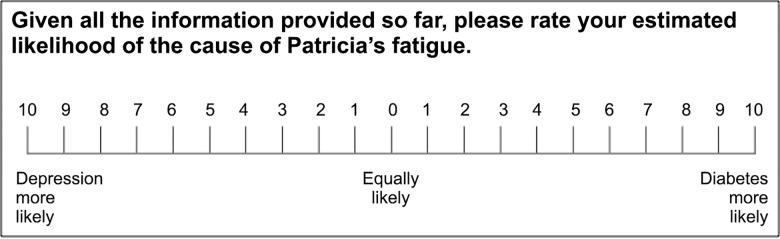
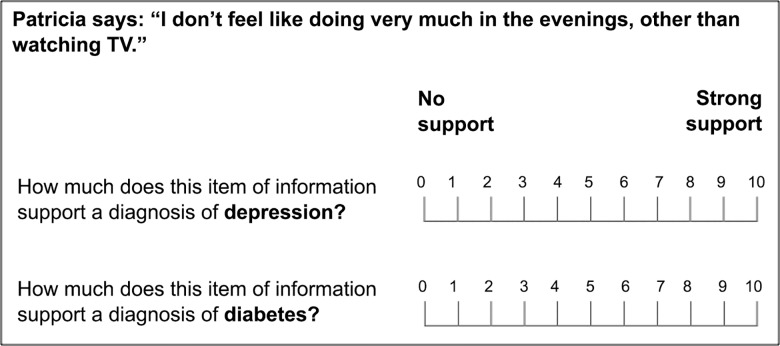
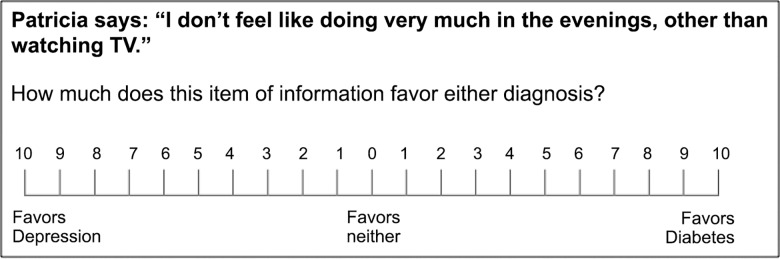
"Predecisional information distortion" occurs when decision makers evaluate new information in a way that is biased towards their leading option. The phenomenon is well established, as is the method typically used to measure it, termed "stepwise evolution of preference" (SEP). An inadequacy of this method has recently come to the fore: it measures distortion as the total advantage afforded a leading option over its competitor, and therefore it cannot differentiate between distortion to strengthen a leading option ("proleader" distortion) and distortion to weaken a trailing option ("antitrailer" distortion). To address this, recent research introduced new response scales to SEP. We explore whether and how these new response scales might influence the very proleader and antitrailer processes that they were designed to capture ("reactivity"). We used the SEP method with concurrent verbal reporting: fifty family physicians verbalized their thoughts as they evaluated patient symptoms and signs ("cues") in relation to two competing diagnostic hypotheses. Twenty-five physicians evaluated each cue using the response scale traditional to SEP (a single response scale, returning a single measure of distortion); the other twenty-five did so using the response scales introduced in recent studies (two separate response scales, returning two separate measures of distortion: proleader and antitrailer). We measured proleader and antitrailer processes in verbalizations, and compared verbalizations in the single-scale and separate-scales groups. Response scales did not appear to affect proleader processes: the two groups of physicians were equally likely to bolster their leading diagnosis verbally. Response scales did, however, appear to affect antitrailer processes: the two groups denigrated their trailing diagnosis verbally to differing degrees. Our findings suggest that the response scales used to measure information distortion might influence its constituent processes, limiting their generalizability across and beyond experimental studies.
当决策者以偏向其首选选项的方式评估新信息时,就会出现“决策前信息扭曲”。这种现象已得到充分证实,用于测量它的典型方法也是如此,即所谓的“偏好逐步演变”(SEP)。最近,这种方法的一个不足之处凸显出来:它将扭曲衡量为首选选项相对于其竞争对手所获得的总优势,因此无法区分强化首选选项的扭曲(“支持领导者”扭曲)和削弱落后选项的扭曲(“反对落后者”扭曲)。为了解决这个问题,最近的研究为SEP引入了新的反应量表。我们探讨这些新的反应量表是否以及如何可能影响它们旨在捕捉的支持领导者和反对落后者的过程(“反应性”)。我们使用SEP方法并同时进行口头报告:五十位家庭医生在评估与两种相互竞争的诊断假设相关的患者症状和体征(“线索”)时说出他们的想法。二十五位医生使用SEP传统的反应量表(单一反应量表,返回单一的扭曲度量)评估每个线索;另外二十五位医生则使用最近研究中引入的反应量表(两个单独的反应量表,返回两个单独的扭曲度量:支持领导者和反对落后者)进行评估。我们在口头表达中测量了支持领导者和反对落后者的过程,并比较了单量表组和分量表组的口头表达。反应量表似乎并未影响支持领导者的过程:两组医生在口头支持其首选诊断方面的可能性相同。然而,反应量表似乎确实影响了反对落后者的过程:两组在口头诋毁其落后诊断方面的程度不同。我们的研究结果表明,用于测量信息扭曲的反应量表可能会影响其组成过程,从而限制了它们在实验研究内外的通用性。