Bouchet Anne-Sophie, Laperche Anne, Bissuel-Belaygue Christine, Baron Cécile, Morice Jérôme, Rousseau-Gueutin Mathieu, Dheu Jean-Eric, George Pierre, Pinochet Xavier, Foubert Thomas, Maes Olivier, Dugué Damien, Guinot Florent, Nesi Nathalie
INRA, UMR 1349 IGEPP, BP 35327, 35650, le Rheu, France.
AGROCAMPUS OUEST, UMR 1349 IGEPP, BP 35327, 35650, le Rheu, France.
BMC Genet. 2016 Sep 15;17(1):131. doi: 10.1186/s12863-016-0432-z.
Nitrogen use efficiency is an important breeding trait that can be modified to improve the sustainability of many crop species used in agriculture. Rapeseed is a major oil crop with low nitrogen use efficiency, making its production highly dependent on nitrogen input. This complex trait is suspected to be sensitive to genotype × environment interactions, especially genotype × nitrogen interactions. Therefore, phenotyping diverse rapeseed populations under a dense network of trials is a powerful approach to study nitrogen use efficiency in this crop. The present study aimed to determine the quantitative trait loci (QTL) associated with yield in winter oilseed rape and to assess the stability of these regions under contrasting nitrogen conditions for the purpose of increasing nitrogen use efficiency.
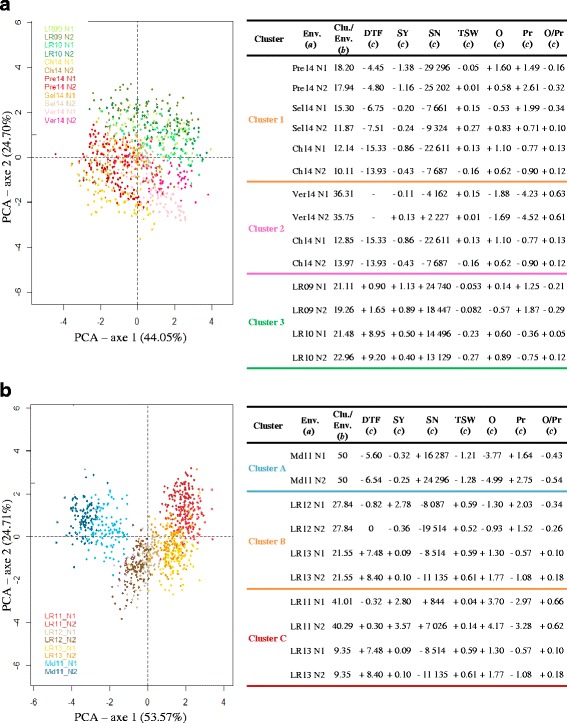
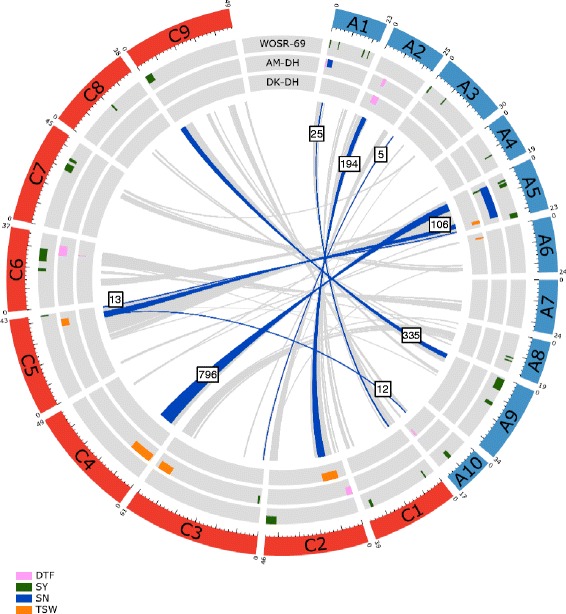
Genome-wide association studies and linkage analyses were performed on two diversity sets and two doubled-haploid populations. These populations were densely genotyped, and yield-related traits were scored in a multi-environment design including seven French locations, six growing seasons (2009 to 2014) and two nitrogen nutrition levels (optimal versus limited). Very few genotype × nitrogen interactions were detected, and a large proportion of the QTL were stable across nitrogen nutrition conditions. In contrast, strong genotype × trial interactions in which most of the QTL were specific to a single trial were found. To obtain further insight into the QTL × environment interactions, genetic analyses of ecovalence were performed to identify the genomic regions contributing to the genotype × nitrogen and genotype × trial interactions. Fifty-one critical genomic regions contributing to the additive genetic control of yield-associated traits were identified, and the structural organization of these regions in the genome was investigated.
Our results demonstrated that the effect of the trial was greater than the effect of nitrogen nutrition levels on seed yield-related traits under our experimental conditions. Nevertheless, critical genomic regions associated with yield that were stable across environments were identified in rapeseed.
氮素利用效率是一项重要的育种性状,可通过改良该性状来提高农业中多种作物品种的可持续性。油菜是一种主要的油料作物,其氮素利用效率较低,导致其生产高度依赖氮肥投入。人们怀疑这一复杂性状对基因型×环境互作敏感,尤其是基因型×氮素互作。因此,在密集的试验网络下对不同油菜群体进行表型分析是研究该作物氮素利用效率的有效方法。本研究旨在确定与冬油菜产量相关的数量性状位点(QTL),并评估这些区域在不同氮素条件下的稳定性,以提高氮素利用效率。
对两个多样性群体和两个双单倍体群体进行了全基因组关联研究和连锁分析。对这些群体进行了高密度基因分型,并在多环境设计中对产量相关性状进行评分,该设计包括法国的七个地点、六个生长季节(2009年至2014年)以及两种氮素营养水平(最佳与有限)。检测到的基因型×氮素互作极少,并且大部分QTL在不同氮素营养条件下是稳定的。相反,发现了强烈的基因型×试验互作,其中大多数QTL只在单个试验中出现。为了进一步深入了解QTL×环境互作,进行了生态等价性的遗传分析,以确定对基因型×氮素和基因型×试验互作有贡献的基因组区域。确定了51个对产量相关性状的加性遗传控制有贡献的关键基因组区域,并研究了这些区域在基因组中的结构组织。
我们的结果表明,在我们的实验条件下,试验对种子产量相关性状的影响大于氮素营养水平的影响。尽管如此,在油菜中鉴定出了与产量相关且在不同环境下稳定的关键基因组区域。