Li Hanmin, Zhang Lisheng
Hepatic Disease Institute, Hubei Provincial Hospital of Traditional Chinese Medicine, Wuhan, People's Republic of China.
College of Veterinary Medicine, Huazhong Agricultural University, Wuhan, People's Republic of China.
Oncotarget. 2017 Jan 3;8(1):1805-1813. doi: 10.18632/oncotarget.12101.
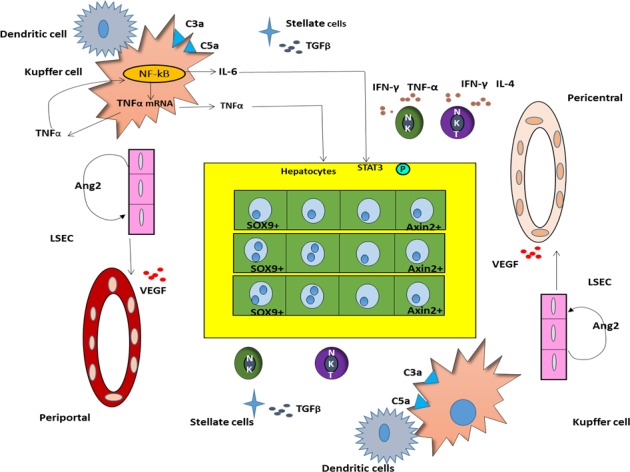
Research on liver cancer prevention and treatment has mainly focused on the liver cancer cells themselves. Currently, liver cancers are no longer viewed as only collections of genetically altered cells but as aberrant organs with a plastic stroma, matrix, and vasculature. Improving the microenvironment of the liver to promote liver regeneration and repair by affecting immune function, inflammation and vasculature can regulate the dynamic imbalance between normal liver regeneration and repair and abnormal liver regeneration, thus improving the microenvironment of liver regeneration for the prevention and treatment of liver cancer. This review addresses the basic theory of the liver regeneration microenvironment, including the latest findings on immunity, inflammation and vasculature. Attention is given to the potential design of molecular targets in the microenvironment of hepatocellular carcinoma (HCC). In an effort to improve the liver regeneration microenvironment of HCC, researchers have extensively utilized the enhancement of immunity, anti-inflammation and the vasculature niche, which are discussed in detail in this review. In addition, the authors summarize the latest pro-fibrotic transition characteristics of the vascular niche and review potential cell therapies for liver disease.
肝癌防治研究主要聚焦于肝癌细胞本身。目前,肝癌不再仅仅被视为基因改变细胞的集合,而是具有可塑性基质、基质和脉管系统的异常器官。通过影响免疫功能、炎症和脉管系统来改善肝脏微环境以促进肝脏再生和修复,可以调节正常肝脏再生修复与异常肝脏再生之间的动态失衡,从而改善肝脏再生微环境以防治肝癌。本综述阐述了肝脏再生微环境的基础理论,包括免疫、炎症和脉管系统的最新研究结果。关注肝细胞癌(HCC)微环境中分子靶点的潜在设计。为改善HCC的肝脏再生微环境,研究人员广泛利用了免疫增强、抗炎和脉管系统微环境,本综述将对此进行详细讨论。此外,作者总结了脉管系统微环境最新的促纤维化转变特征,并综述了肝病潜在的细胞治疗方法。