Lee Seung Heon
Division of Pulmonary, Sleep, and Critical Care Medicine, Department of Internal Medicine, Korea University Ansan Hospital, Korea University College of Medicine, Ansan, Korea.
Tuberc Respir Dis (Seoul). 2016 Oct;79(4):201-206. doi: 10.4046/trd.2016.79.4.201. Epub 2016 Oct 5.
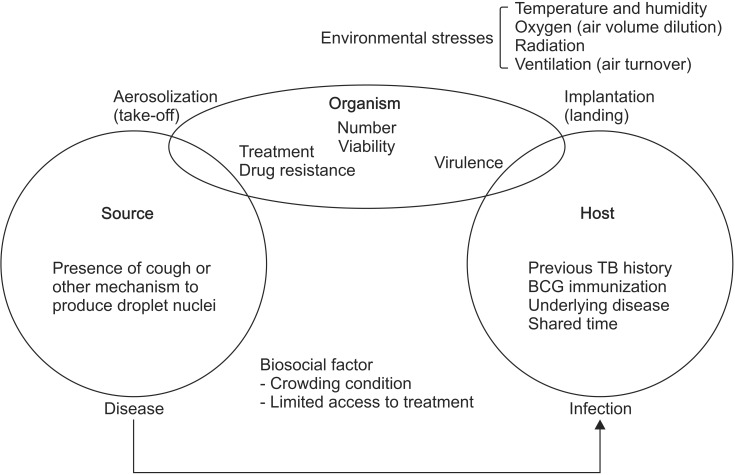
Active tuberculosis (TB) has a greater burden of TB bacilli than latent TB and acts as an infection source for contacts. Latent tuberculosis infection (LTBI) is the state in which humans are infected with without any clinical symptoms, radiological abnormality, or microbiological evidence. TB is transmissible by respiratory droplet nucleus of 1-5 µm in diameter, containing 1-10 TB bacilli. TB transmission is affected by the strength of the infectious source, infectiousness of TB bacilli, immunoresistance of the host, environmental stresses, and biosocial factors. Infection controls to reduce TB transmission consist of managerial activities, administrative control, engineering control, environmental control, and personal protective equipment provision. However, diagnosis and treatment for LTBI as a national TB control program is an important strategy on the precondition that active TB is not missed. Therefore, more concrete evidences for LTBI management based on clinical and public perspectives are needed.
活动性结核病(TB)的结核杆菌负担比潜伏性结核病更重,并且是接触者的感染源。潜伏性结核感染(LTBI)是指人体感染结核杆菌但无任何临床症状、影像学异常或微生物学证据的状态。结核病可通过直径为1-5微米、含有1-10个结核杆菌的呼吸道飞沫核传播。结核病传播受传染源强度、结核杆菌传染性、宿主免疫抵抗力、环境压力和生物社会因素影响。减少结核病传播的感染控制措施包括管理活动、行政控制、工程控制、环境控制和提供个人防护设备。然而,作为国家结核病控制规划的一部分,对LTBI进行诊断和治疗是一项重要策略,前提是不能漏诊活动性结核病。因此,需要从临床和公共角度为LTBI管理提供更具体的证据。