Lin Yong Ping, Yang Zi Feng, Liang Ying, Li Zheng Tu, Bond Helen S, Chua Huiying, Luo Ya Sha, Chen Yuan, Chen Ting Ting, Guan Wen Da, Lai Jimmy Chun Cheong, Siu Yu Lam, Pan Si Hua, Peiris J S Malik, Cowling Benjamin J, Mok Chris Ka Pun
Department of Laboratory Medicine, The First Affiliated Hospital of Guangzhou Medical University, Guangdong, China.
Research Centre of Translational Medicine, The First Affiliated Hospital of Guangzhou Medical University, Guangdong, China.
BMC Infect Dis. 2016 Nov 4;16(1):632. doi: 10.1186/s12879-016-1983-3.
Since the identification in early 2013 of severe disease caused by influenza A(H7N9) virus infection, there have been few attempts to characterize the full severity profile of human infections. Our objective was to estimate the number and severity of H7N9 infections in Guangzhou, using a serological study.
We collected residual sera from patients of all ages admitted to a hospital in the city of Guangzhou in southern China in 2013 and 2014. We screened the sera using a haemagglutination inhibition assay against a pseudovirus containing the H7 and N9 of A/Anhui/1/2013(H7N9), and samples with a screening titer ≥10 were further tested by standard hemagglutination-inhibition and virus neutralization assays for influenza A(H7N9). We used a statistical model to interpret the information on antibody titers in the residual sera, assuming that the residual sera provided a representative picture of A(H7N9) infections in the general population, accounting for potential cross-reactions.
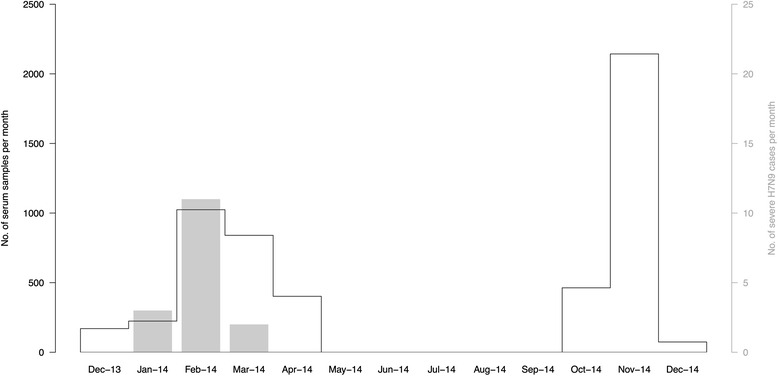
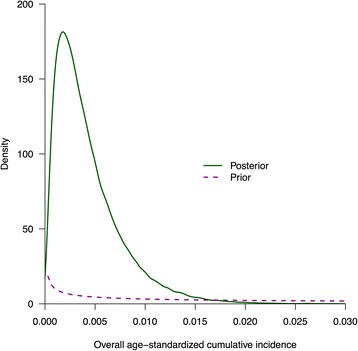
We collected a total of 5360 residual sera from December 2013 to April 2014 and from October 2014 to December 2014, and found two specimens that tested positive for H7N9 antibody at haemagglutination inhibition titer ≥40 and a neutralization titer ≥40. Based on this, we estimated that 64,000 (95 % credibility interval: 7300, 190,000) human infections with influenza A(H7N9) virus occurred in Guangzhou in early 2014, with an infection-fatality risk of 3.6 deaths (95 % credibility interval: 0.47, 15) per 10,000 infections.
Our study suggested that the number of influenza A(H7N9) virus infections in Guangzhou substantially exceeded the number of laboratory-confirmed cases there, albeit with considerable imprecision. Our study was limited by the small number of positive specimens identified, and larger serologic studies would be valuable. Our analytic framework would be useful if larger serologic studies are done.
自2013年初确认甲型H7N9流感病毒感染可导致严重疾病以来,很少有人尝试全面描述人类感染的严重程度特征。我们的目标是通过一项血清学研究来估计广州地区H7N9感染的数量和严重程度。
我们收集了2013年和2014年在中国南方广州市一家医院收治的各年龄段患者的剩余血清。我们使用血凝抑制试验,针对含有A/安徽/1/2013(H7N9)的H7和N9的假病毒对血清进行筛查,筛查效价≥10的样本进一步通过甲型H7N9流感的标准血凝抑制试验和病毒中和试验进行检测。我们使用统计模型来解读剩余血清中抗体效价的信息,假设剩余血清能够代表普通人群中甲型H7N9流感的感染情况,并考虑到潜在的交叉反应。
我们共收集了2013年12月至2014年4月以及2014年10月至12月的5360份剩余血清,发现两份血凝抑制效价≥40且中和效价≥40的标本H7N9抗体检测呈阳性。据此,我们估计2014年初广州地区有64000例(95%可信区间:7300,190000)人感染甲型H7N9流感病毒,每10000例感染的感染致死风险为3.6例死亡(95%可信区间:0.47,15)。
我们的研究表明,广州地区甲型H7N9流感病毒感染的数量大幅超过该地区实验室确诊病例数,尽管存在相当大的不精确性。我们的研究因鉴定出的阳性标本数量较少而受到限制,更大规模的血清学研究将很有价值。如果进行更大规模的血清学研究,我们的分析框架将很有用。