Kokko Sami, Selänne Harri, Alanko Lauri, Heinonen Olli J, Korpelainen Raija, Savonen Kai, Vasankari Tommi, Kannas Lasse, Kujala Urho M, Aira Tuula, Villberg Jari, Parkkari Jari
Department of Health Sciences , Research Center for Health Promotion, University of Jyvaskyla , Jyväskylä , Finland.
LIKES Foundation for Sport and Health Sciences and Mehiläinen Sports Clinic , Jyväskylä , Finland.
BMJ Open Sport Exerc Med. 2015 Sep 10;1(1):e000034. doi: 10.1136/bmjsem-2015-000034. eCollection 2015.
Sports clubs form a potential setting for health promotion, but the research is limited. The aim of the Health Promoting Sports Club (HPSC) study was to elucidate the current health promotion activities of youth sports clubs and coaches, and to investigate the health behaviours and health status of youth participating in sports clubs compared to non-participants.
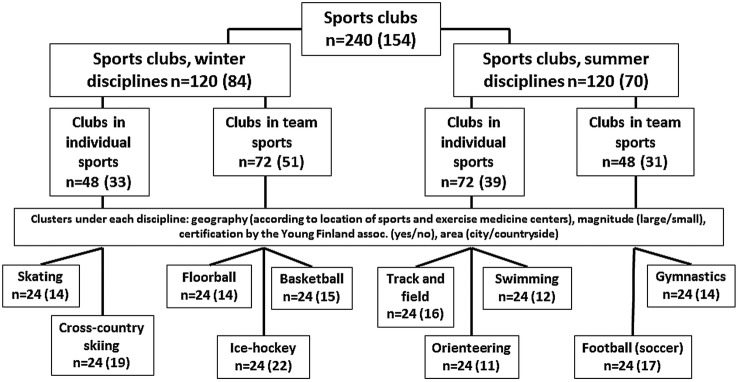
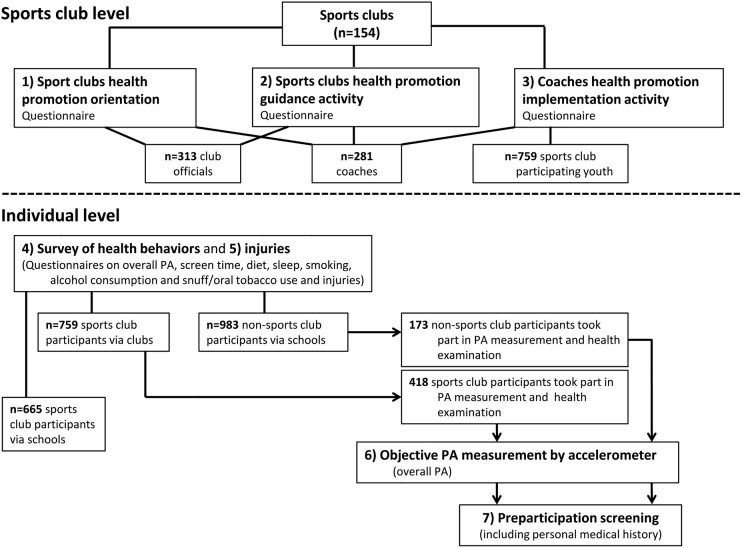
The study design employs cross-sectional multilevel and multimethod research with aspirations to a prospective cohort study in the next phase. The setting-based variables at sports clubs and coaching levels, and health behaviour variables at the individual level, are investigated using surveys; and total levels of physical activity are assessed using objective accelerometer measurements. Health status variables will be measured by preparticipation screening. The health promotion activity of sports clubs (n=154) is evaluated by club officials (n=313) and coaches (n=281). Coaches and young athletes aged 14-16 (n=759) years evaluate the coaches' health promotion activity. The survey of the adolescents' health behaviours consist of two data sets-the first is on their health behaviours and the second is on musculoskeletal complaints and injuries. Data are collected via sports clubs (759 participants) and schools 1650 (665 participants and 983 non-participants). 591 (418 athletes and 173 non-athletes) youth, have already participated in preparticipation screening. Screening consists of detailed personal medical history, electrocardiography, flow-volume spirometry, basic laboratory analyses and health status screening, including posture, muscle balance, and static and dynamic postural control tests, conducted by sports and exercise medicine specialists.
The HPSC study is carried out conforming with the declaration of Helsinki. Ethical approval was received from the Ethics Committee of Health Care District of Central Finland. The HPSC study is close-to-practice, which generates foundations for development work within youth sports clubs.
体育俱乐部是促进健康的一个潜在场所,但相关研究有限。健康促进体育俱乐部(HPSC)研究的目的是阐明青少年体育俱乐部和教练当前的健康促进活动,并调查参与体育俱乐部的青少年与未参与者相比的健康行为和健康状况。
本研究设计采用横断面多层次多方法研究,并期望在下一阶段开展前瞻性队列研究。通过调查来研究体育俱乐部和教练层面基于场所的变量以及个体层面的健康行为变量;使用客观的加速度计测量来评估身体活动总量。健康状况变量将通过参与前筛查进行测量。由俱乐部官员(n = 313)和教练(n = 281)对体育俱乐部(n = 154)的健康促进活动进行评估。14 - 16岁的教练和年轻运动员(n = 759)对教练的健康促进活动进行评估。青少年健康行为调查包括两个数据集——第一个是关于他们的健康行为,第二个是关于肌肉骨骼问题和损伤。数据通过体育俱乐部(759名参与者)和学校(1650名,其中665名参与者和983名未参与者)收集。591名青少年(418名运动员和173名非运动员)已经参与了参与前筛查。筛查包括详细的个人病史、心电图、流量 - 容积肺活量测定、基础实验室分析以及健康状况筛查,包括姿势、肌肉平衡以及由运动和运动医学专家进行的静态和动态姿势控制测试。
HPSC研究是按照赫尔辛基宣言进行的。已获得芬兰中部医疗保健区伦理委员会的伦理批准。HPSC研究贴近实践,为青少年体育俱乐部的发展工作奠定了基础。