Shatté Andrew, Perlman Adam, Smith Brad, Lynch Wendy D
Mindflex, LLC; College of Medicine, The University of Arizona, Arizona; The Brookings Institution (Dr Shatté); meQuilibrium (Drs Shatté, Perlman, Smith); Department of Medicine, Duke University School of Medicine, Durham, North Carolina (Dr Perlman); and Lynch Consulting, Ltd., Steamboat Springs, Colorado; IUPUI School of Nursing, Indianapolis, Indiana (Dr Lynch).
J Occup Environ Med. 2017 Feb;59(2):135-140. doi: 10.1097/JOM.0000000000000914.
To examine whether resilience has a protective effect in difficult work environments.
A survey of 2063 individuals measured individual resilience, stress, burnout, sleep problems, likelihood of depression, job satisfaction, intent to quit, absences, and productivity. It also measured work characteristics: job demands, job influence, and social support. Multivariate and logistic regression models examined the main effects and interactions of resilience and job characteristics.
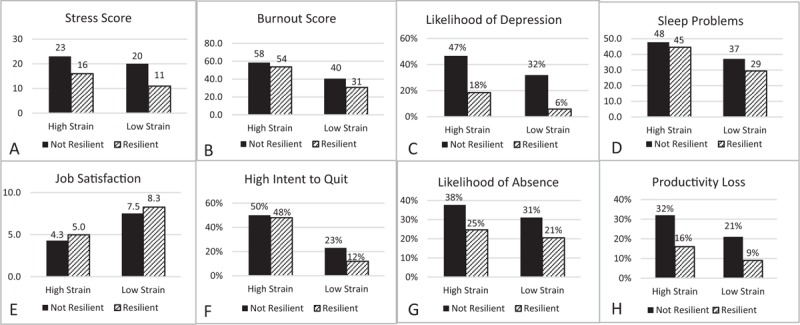
High strain work environments (high demand, low influence, and low support) have an unfavorable effect on all outcomes. Resilience has a protective effect on all outcomes. For stress, burnout, and sleep, higher resilience has a more protective effect under low-strain conditions. For depression, absence and productivity, resilience has a more protective effect when job strain is high.
Workers with high resilience have better outcomes in difficult work environments.
探讨心理韧性在困难工作环境中是否具有保护作用。
对2063名个体进行调查,测量个体的心理韧性、压力、倦怠、睡眠问题、抑郁可能性、工作满意度、离职意愿、缺勤率和工作效率。该调查还测量了工作特征:工作要求、工作影响力和社会支持。多变量和逻辑回归模型检验了心理韧性与工作特征的主要影响及相互作用。
高压力工作环境(高要求、低影响力和低支持)对所有结果均有不利影响。心理韧性对所有结果均有保护作用。对于压力、倦怠和睡眠,在低压力条件下,较高的心理韧性具有更强的保护作用。对于抑郁、缺勤和工作效率,当工作压力较高时,心理韧性具有更强的保护作用。
心理韧性高的员工在困难工作环境中表现更好。