Pareja-Blanco Fernando, Suarez-Arrones Luis, Rodríguez-Rosell David, López-Segovia Manuel, Jiménez-Reyes Pedro, Bachero-Mena Beatriz, González-Badillo Juan José
Research Center on Physical and Athletic Performance, Pablo de Olavide University, Seville, Spain; Faculty of Sport, Pablo de Olavide University, Seville, Spain.
Faculty of Sport, Pablo de Olavide University, Seville, Spain.
J Hum Kinet. 2016 Dec 15;54:115-126. doi: 10.1515/hukin-2016-0040. eCollection 2016 Dec 1.
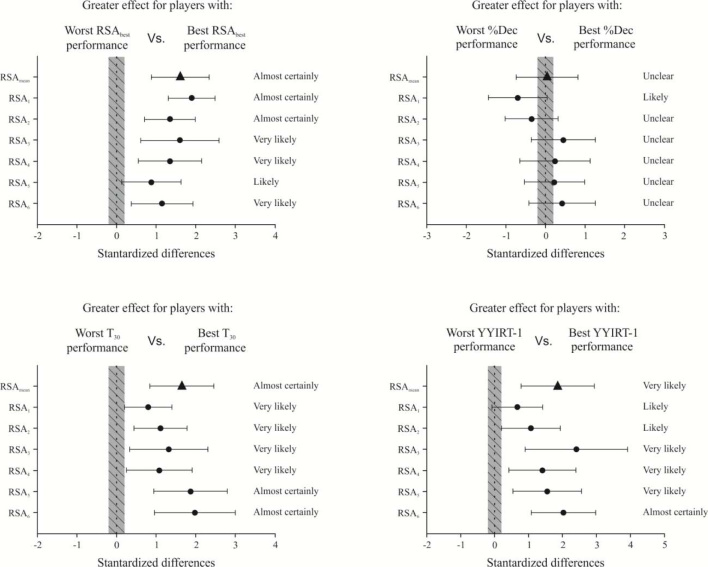
The aim of this study was to investigate the changes in the relationships between repeated sprint ability (RSA) and anthropometric measures as well as fitness qualities in soccer players. Twenty-one professional soccer players performed several anthropometric and physical tests including countermovement vertical jumps (CMJs), a straight-line 30 m sprint (T30), an RSA test (6 x 20 + 20 m with 20 s recovery), a progressive isoinertial loading test in a full squat, a Yo-Yo Intermittent Recovery Test Level-1 (YYIRT-1) and a 20 m shuttle run test (20mSRT). The mean (RSAmean), the fastest (RSAbest), each single sprint time, and the percentage in a sprint decrease (%Dec) in the RSA test were calculated. RSAbest correlated significantly with RSAmean (r = .82) and with all single sprints (p < 0.05), showing a downward trend as the number of sprints performed increased. No significant relationship was observed between the %Dec and RSA performance. CMJs and the T30 also showed a correlation with RSA performance, whereas lower limb strength did not show any relationship with RSA performance. RSAmean showed significant (p < 0.05) relationships with body mass (r = .44), adiposity (r = .59) and the YYIRT-1 (r = -.62), increasing as the number of repeated sprints increased. The 20mSRT showed minimal relationships with RSA performance. In conclusion, maximal sprint capacity seems to be relevant for the RSA performance, mainly in the first sprints. However, high intermittent endurance capacity and low adiposity might help enhance the RSA performance when increasing the number of repeated sprints.
本研究旨在调查足球运动员反复冲刺能力(RSA)与人体测量指标以及身体素质之间关系的变化。21名职业足球运动员进行了多项人体测量和体能测试,包括反向纵跳(CMJ)、30米直线冲刺(T30)、RSA测试(6次20 + 20米,每次冲刺后休息20秒)、全蹲渐进等惯性负荷测试、Yo-Yo间歇恢复测试一级(YYIRT-1)和20米穿梭跑测试(20mSRT)。计算了RSA测试中的平均速度(RSAmean)、最快速度(RSAbest)、每次单次冲刺时间以及冲刺速度下降百分比(%Dec)。RSAbest与RSAmean显著相关(r = 0.82),且与所有单次冲刺均显著相关(p < 0.05),随着冲刺次数的增加呈下降趋势。未观察到%Dec与RSA表现之间存在显著关系。CMJ和T30也与RSA表现相关,而下肢力量与RSA表现无显著关系。RSAmean与体重(r = 0.44)、肥胖程度(r = 0.59)和YYIRT-1(r = -0.62)显著相关(p < 0.05),随着反复冲刺次数的增加而增加。20mSRT与RSA表现的关系最小。总之,最大冲刺能力似乎与RSA表现相关,主要体现在最初的几次冲刺中。然而,高间歇耐力能力和低肥胖程度可能有助于在增加反复冲刺次数时提高RSA表现。