Joubouhi Christelle, Tamokou Jean-de-Dieu, Ngnokam David, Voutquenne-Nazabadioko Laurence, Kuiate Jules-Roger
Department of Chemistry, Laboratory of Environmental and Applied Chemistry, Faculty of Science, University of Dschang, P.O. Box 67, Dschang, Cameroon.
Department of Biochemistry, Laboratory of Microbiology and Antimicrobial Substances, Faculty of Science, University of Dschang, P.O. Box 67, Dschang, Cameroon.
BMC Complement Altern Med. 2017 Jan 5;17(1):17. doi: 10.1186/s12906-016-1536-8.
The continuous emergence of multi-drug-resistant bacteria drastically reduces the efficacy of antibiotic armory and, consequently, increases the frequency of therapeutic failure. The discovery of new antibacterial drugs is an urgent need. The present study reports the antibacterial and antioxidant activities of the methanol extract, fractions and iridoids from Canthium subcordatum, a plant traditionally used as antidiabetic, anti-inflammatory, and antimicrobial.
Broth microdilution assay was used to determine minimum inhibitory concentrations (MICs) and minimum bactericidal concentrations (MBCs) of extracts and iridoids against Staphylococcus aureus, Vibrio cholerae and Shigella flexneri. Antioxidant activity was evaluated using 1,1-diphenyl-2-picrylhydrazyl (DPPH) and gallic acid equivalent antioxidant capacity (GAEAC) assays. The samples were also tested for their cytotoxicity against human red blood cells (RBC).
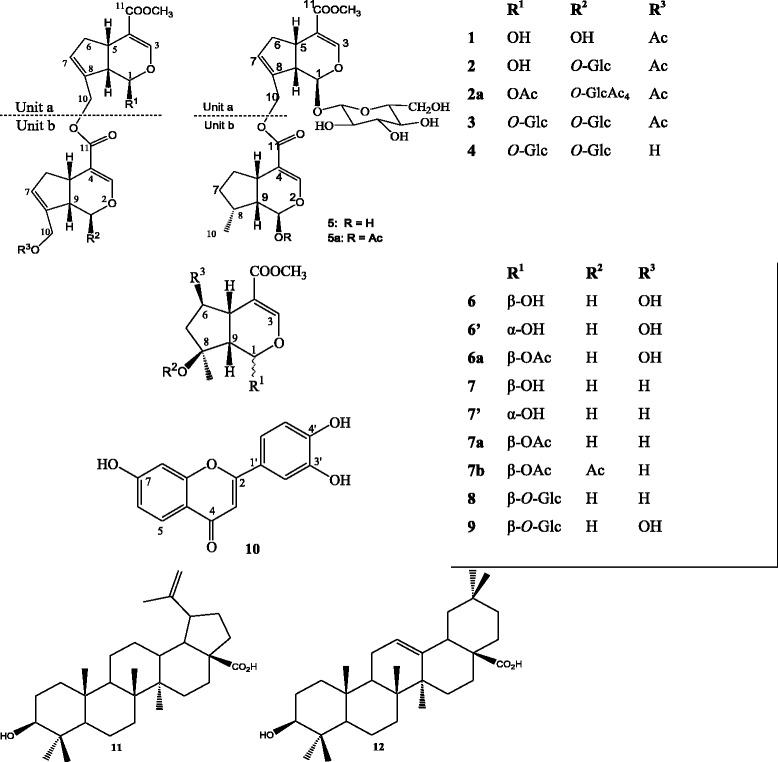
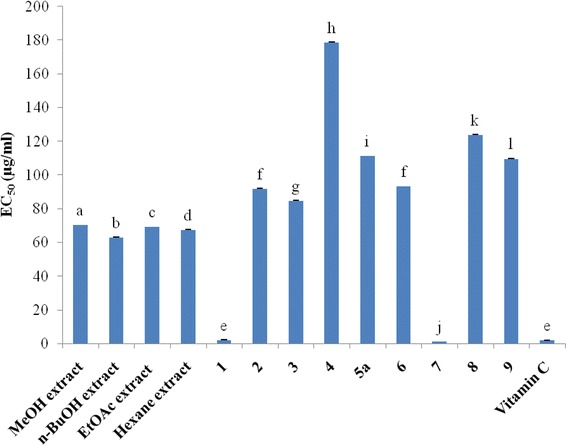
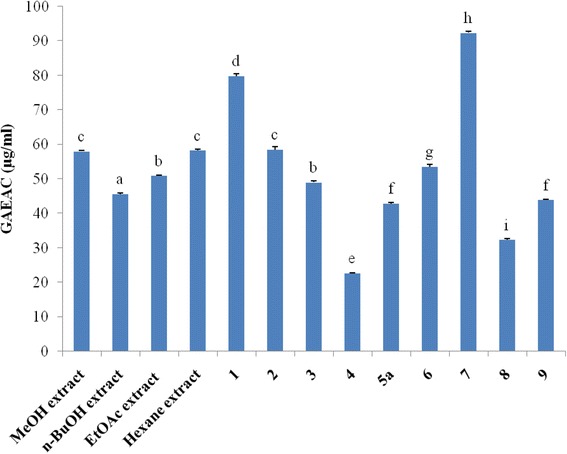
The methanol extract, hexane, ethyl acetate and iso-butanol fractions from C. subcordatum fruits displayed different degrees of antioxidant (EC = 62.83-70.17 μg/ml; GAEAC = 45.63-58.23 μg/ml) and antibacterial (MIC = 128-512 μg/ml) activities. Canthiumoside 1(1) and linearin (7) were the most active antioxidant (EC = 1.12-2.03 μg/ml; GAEAC = 79.82-92.35 μg/ml) and antibacterial (MIC = 8-64 μg/ml) compounds while the most sensitive bacterium was Staphylococcus aureus. The tested samples were non-toxic to normal cells.
Our results demonstrated that compounds 1 and 7 were potent antibacterial agents and DPPH/ABTS· radical scavengers, so they warrant further investigation.
多重耐药菌的不断出现极大地降低了抗生素储备的疗效,从而增加了治疗失败的频率。迫切需要发现新的抗菌药物。本研究报道了来自心叶刺篱木的甲醇提取物、馏分和环烯醚萜类化合物的抗菌和抗氧化活性,心叶刺篱木是一种传统上用于治疗糖尿病、抗炎和抗菌的植物。
采用肉汤微量稀释法测定提取物和环烯醚萜类化合物对金黄色葡萄球菌、霍乱弧菌和福氏志贺菌的最低抑菌浓度(MIC)和最低杀菌浓度(MBC)。使用1,1-二苯基-2-苦基肼(DPPH)和没食子酸当量抗氧化能力(GAEAC)测定法评估抗氧化活性。还测试了样品对人红细胞(RBC)的细胞毒性。
心叶刺篱木果实的甲醇提取物、己烷、乙酸乙酯和异丁醇馏分表现出不同程度的抗氧化(EC = 62.83 - 70.17μg/ml;GAEAC = 45.63 - 58.23μg/ml)和抗菌(MIC = 128 - 512μg/ml)活性。心叶刺篱木苷1(1)和线性苷(7)是活性最强的抗氧化(EC = 1.12 - 2.03μg/ml;GAEAC = 79.82 - 92.35μg/ml)和抗菌(MIC = 8 - 64μg/ml)化合物,而最敏感的细菌是金黄色葡萄球菌。测试的样品对正常细胞无毒。
我们的结果表明,化合物1和7是有效的抗菌剂和DPPH/ABTS·自由基清除剂,因此值得进一步研究。