Ai Luoyan, Tian Haiying, Chen Zhaofei, Chen Huimin, Xu Jie, Fang Jing-Yuan
Division of Gastroenterology and Hepatology, Shanghai Institute of Digestive Disease, Key Laboratory of Gastroenterology and Hepatology, Ministry of Health, State Key Laboratory for Oncogenes and Related Genes, Renji Hospital, School of Medicine, Shanghai Jiao-Tong University, Shanghai 200001, China.
Oncotarget. 2017 Feb 7;8(6):9546-9556. doi: 10.18632/oncotarget.14488.
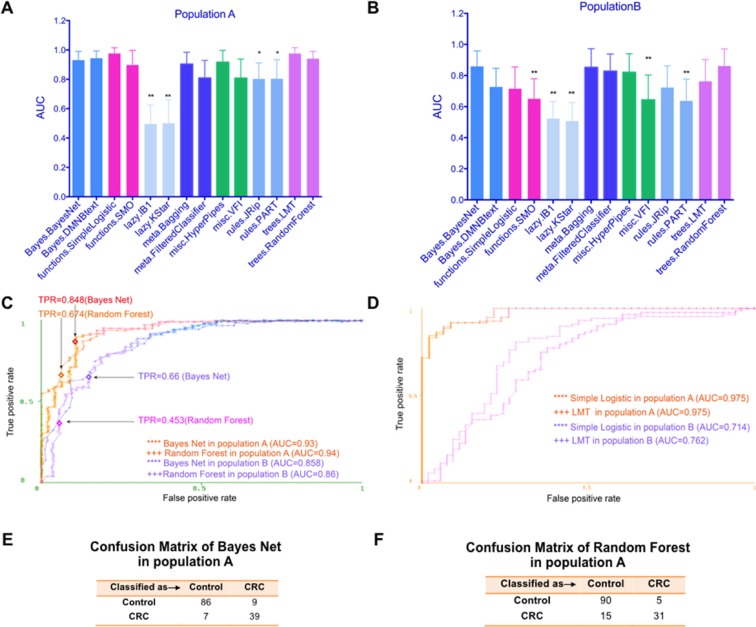
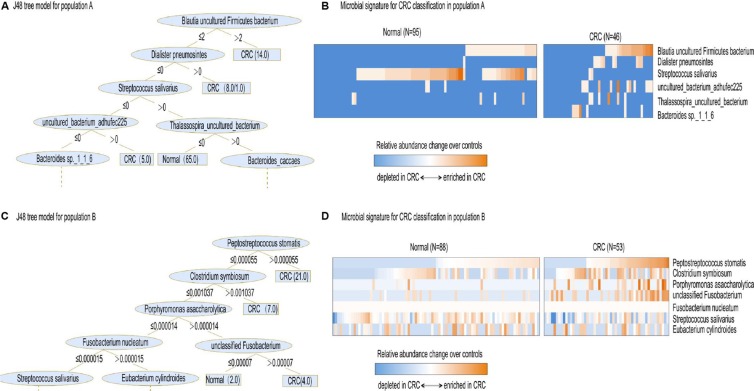
Predicting colorectal cancer (CRC) based on fecal microbiota presents a promising method for non-invasive screening of CRC, but the optimization of classification models remains an unaddressed question. The purpose of this study was to systematically evaluate the effectiveness of different supervised machine-learning models in predicting CRC in two independent eastern and western populations. The structures of intestinal microflora in feces in Chinese population (N = 141) were determined by 454 FLX pyrosequencing, and different supervised classifiers were employed to predict CRC based on fecal microbiota operational taxonomic unit (OTUs). As a result, Bayes Net and Random Forest displayed higher accuracies than other algorithms in both populations, although Bayes Net was found with a lower false negative rate than that of Random Forest. Gut microbiota-based prediction was more accurate than the standard fecal occult blood test (FOBT), and the combination of both approaches further improved the prediction accuracy. Moreover, when unclassified OTUs were used as input, the BayesDMNB text algorithm achieved higher accuracy in the Chinese population (AUC=0.994). Taken together, our results suggest that Bayes Net classification model combined with unclassified OTUs may present an accurate method for predicting CRC based on the compositions of gut microbiota.
基于粪便微生物群预测结直肠癌(CRC)为CRC的非侵入性筛查提供了一种很有前景的方法,但分类模型的优化仍然是一个未解决的问题。本研究的目的是系统评估不同监督机器学习模型在两个独立的东西方人群中预测CRC的有效性。通过454 FLX焦磷酸测序确定了中国人群(N = 141)粪便中肠道微生物群的结构,并采用不同的监督分类器基于粪便微生物群操作分类单元(OTUs)预测CRC。结果,在两个人群中,贝叶斯网络和随机森林的准确率均高于其他算法,尽管发现贝叶斯网络的假阴性率低于随机森林。基于肠道微生物群的预测比标准粪便潜血试验(FOBT)更准确,两种方法的结合进一步提高了预测准确率。此外,当将未分类的OTUs用作输入时,贝叶斯DMNB文本算法在中国人群中实现了更高的准确率(AUC = 0.994)。综上所述,我们的结果表明,结合未分类OTUs的贝叶斯网络分类模型可能是一种基于肠道微生物群组成预测CRC的准确方法。