Machine Learning Group, Technische Universität Berlin, Marchstr. 23, 10587 Berlin, Germany.
Department of Brain and Cognitive Engineering, Korea University, Anam-dong, Seongbuk-gu, Seoul 136-713, Republic of Korea.
Nat Commun. 2017 Jan 9;8:13890. doi: 10.1038/ncomms13890.
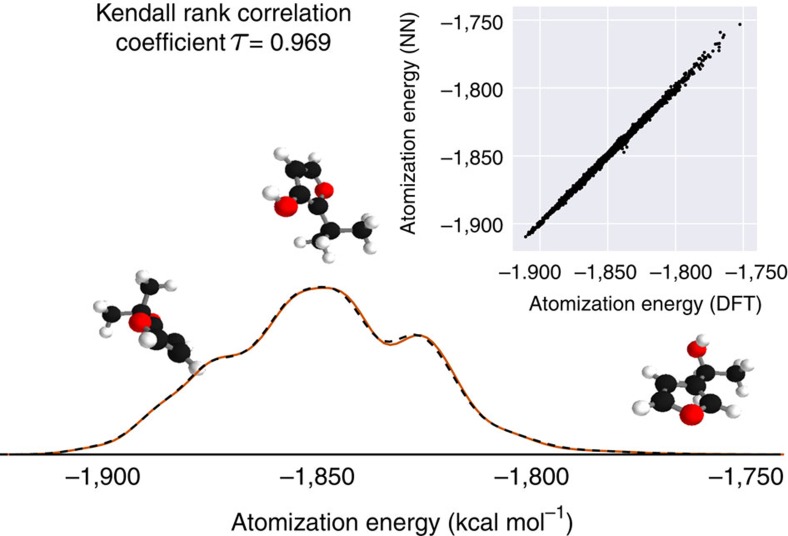
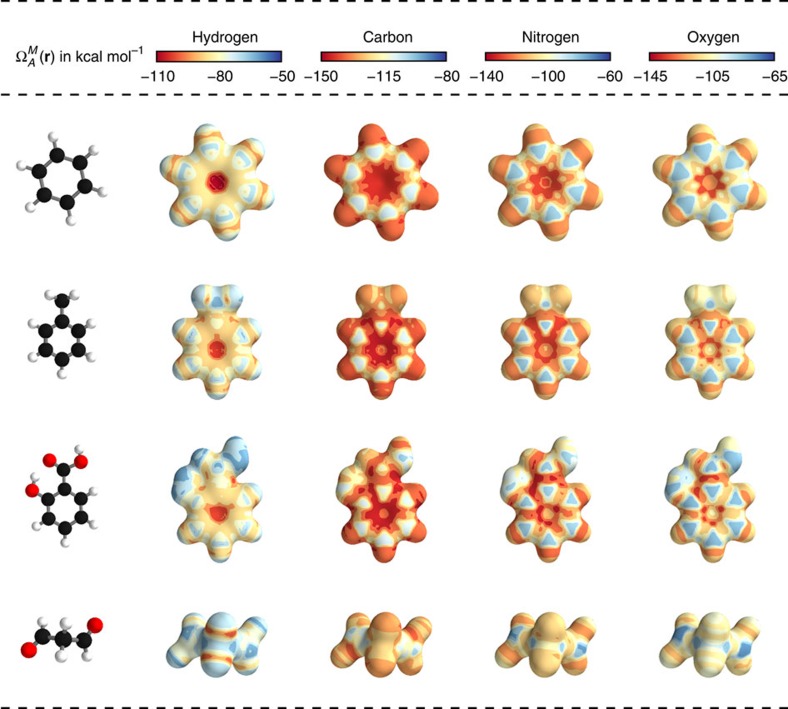
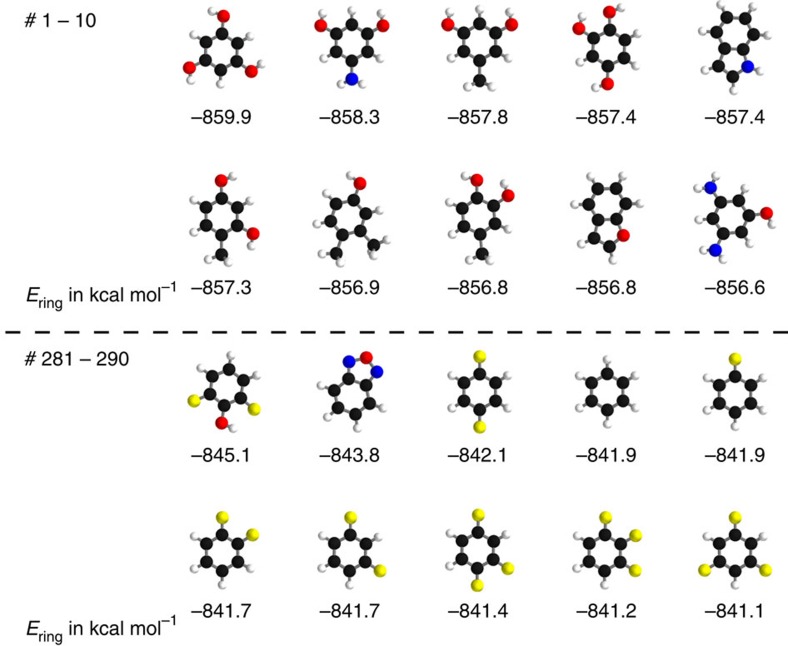
Learning from data has led to paradigm shifts in a multitude of disciplines, including web, text and image search, speech recognition, as well as bioinformatics. Can machine learning enable similar breakthroughs in understanding quantum many-body systems? Here we develop an efficient deep learning approach that enables spatially and chemically resolved insights into quantum-mechanical observables of molecular systems. We unify concepts from many-body Hamiltonians with purpose-designed deep tensor neural networks, which leads to size-extensive and uniformly accurate (1 kcal mol) predictions in compositional and configurational chemical space for molecules of intermediate size. As an example of chemical relevance, the model reveals a classification of aromatic rings with respect to their stability. Further applications of our model for predicting atomic energies and local chemical potentials in molecules, reliable isomer energies, and molecules with peculiar electronic structure demonstrate the potential of machine learning for revealing insights into complex quantum-chemical systems.
从数据中学习已经在多个领域(包括网络、文本和图像搜索、语音识别以及生物信息学)引发了范式转变。机器学习能否在理解量子多体系统方面带来类似的突破?在这里,我们开发了一种高效的深度学习方法,可以深入了解分子系统的量子力学可观察量的空间和化学分辨率。我们将多体哈密顿量的概念与专门设计的深度张量神经网络统一起来,这导致在组成和构型化学空间中对中等大小分子的量子力学可观测量进行了具有尺寸扩展性和一致准确性(1kcal/mol)的预测。作为化学相关性的一个例子,该模型揭示了芳香环在稳定性方面的分类。我们的模型在预测分子中的原子能量和局部化学势、可靠的异构体能量以及具有特殊电子结构的分子方面的进一步应用,证明了机器学习在揭示复杂量子化学系统的洞察力方面的潜力。