Clendinen Chaevien S, Stupp Gregory S, Wang Bing, Garrett Timothy J, Edison Arthur S
Department of Biochemistry & Molecular Biology,; Department of Chemistry & Biochemistry, Georgia Institute of Technology, Atlanta GA, 30332, USA; Molecular & Experimental Medicine, The Scripps Research Institute, 10550 North Torrey Pines Road, La Jolla, CA 92037.
Department of Biochemistry & Molecular Biology,; Department of Biochemistry & Molecular Biology.
Curr Metabolomics. 2016 Aug;4(2):116-120. doi: 10.2174/2213235X04666160407212156.
Isotopic Ratio Outlier Analysis (IROA) is an untargeted metabolomics method that uses stable isotopic labeling and LC-HRMS for identification and relative quantification of metabolites in a biological sample under varying experimental conditions.
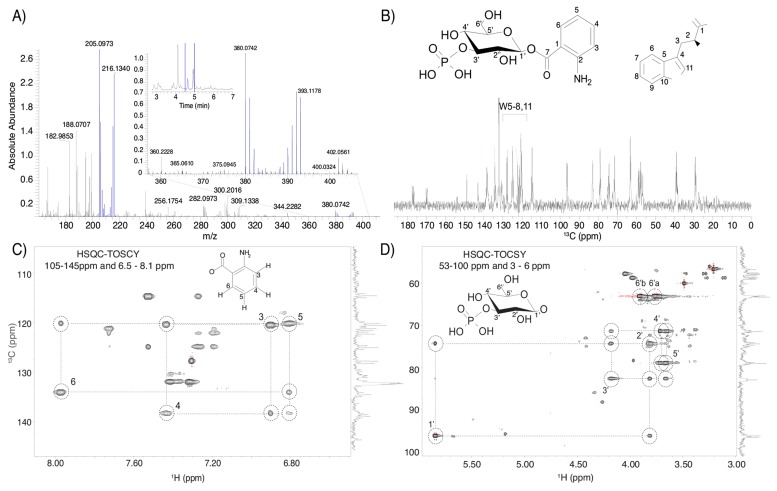
We demonstrate a method using high-sensitivity C NMR to identify an unknown metabolite isolated from fractionated material from an IROA LC-HRMS experiment.
IROA samples from the nematode Caenorhabditis elegans were fractionated using LC-HRMS using 5 repeated injections and collecting 30 sec fractions. These were concentrated and analyzed by C NMR.
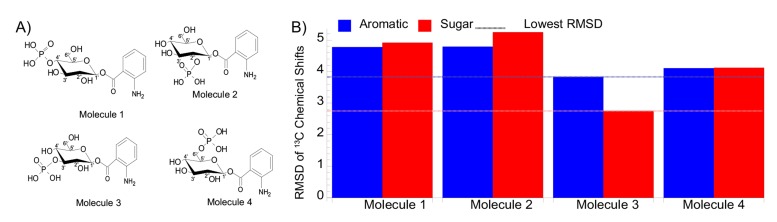
We isotopically labeled samples of C. elegans and collected 2 adjacent LC fractions. By HRMS, one contained at least 2 known metabolites, phenylalanine and inosine, and the other contained tryptophan and an unknown feature with a monoisotopic mass of m/z 380.0742 [M+H]. With NMR, we were able to easily verify the known compounds, and we then identified the spin system networks responsible for the unknown resonances. After searching the BMRB database and comparing the molecular formula from LC-HRMS, we determined that the fragments were a modified anthranilate and a glucose modified by a phosphate. We then performed quantum chemical NMR chemical shift calculations to determine the most likely isomer, which was 3'-O-phospho-β-D-glucopyranosyl-anthranilate. This compound had previously been found in the same organism, validating our approach.
We were able to dereplicate previously known metabolites and identify a metabolite that was not in databases by matching resonances to NMR databases and using chemical shift calculations to determine the correct isomer. This approach is efficient and can be used to identify unknown compounds of interest using the same material used for IROA.
摘要 背景:同位素比率离群值分析(IROA)是一种非靶向代谢组学方法,它使用稳定同位素标记和液相色谱-高分辨质谱(LC-HRMS)在不同实验条件下对生物样品中的代谢物进行鉴定和相对定量。
我们展示了一种使用高灵敏度碳核磁共振(C NMR)来鉴定从IROA LC-HRMS实验的分级材料中分离出的未知代谢物的方法。
使用LC-HRMS对秀丽隐杆线虫的IROA样品进行分级,重复进样5次,收集30秒的馏分。将这些馏分浓缩并通过C NMR进行分析。
我们对秀丽隐杆线虫样品进行同位素标记,并收集了2个相邻的液相色谱馏分。通过高分辨质谱,一个馏分至少含有2种已知代谢物,苯丙氨酸和肌苷,另一个馏分含有色氨酸和一个单同位素质量为m/z 380.0742 [M+H]的未知特征峰。通过核磁共振,我们能够轻松验证已知化合物,然后确定了负责未知共振的自旋系统网络。在搜索生物磁共振数据库(BMRB)并比较LC-HRMS得到的分子式后,我们确定这些片段是一个修饰的邻氨基苯甲酸和一个经磷酸修饰的葡萄糖。然后我们进行了量子化学核磁共振化学位移计算,以确定最可能的异构体,即3'-O-磷酸-β-D-吡喃葡萄糖基-邻氨基苯甲酸。该化合物此前已在同一生物体中被发现,验证了我们的方法。
我们能够通过将共振与核磁共振数据库匹配并使用化学位移计算来确定正确的异构体,从而去除先前已知的代谢物并鉴定出数据库中不存在的代谢物。这种方法效率高,可用于使用与IROA相同的材料鉴定感兴趣的未知化合物。