Chen Tony Hsiu-Hsi, Yen Amy Ming-Fang, Fann Jean Ching-Yuan, Gordon Paula, Chen Sam Li-Sheng, Chiu Sherry Yueh-Hsia, Hsu Chen-Yang, Chang King-Jen, Lee Won-Chul, Yeoh Khay Guan, Saito Hiroshi, Promthet Supannee, Hamashima Chisato, Maidin Alimin, Robinson Fredie, Zhao Li-Zhong
Graduate Institute of Epidemiology and Preventive Medicine, College of Public Health, National Taiwan University School of Oral Hygiene, College of Oral Medicine, Taipei Medical University, Taipei Department of Health Industry Management, School of Healthcare Management, Kainan University, Tao-Yuan, Taiwan BC Women's Hospital, Vancouver, British Columbia Department of Health Care Management, College of Management, Chang Gung University, Tao-Yuan Cheng Ching General Hospital, Taichung, Taiwan Department of Preventive Medicine, College of Medicine, Catholic University of Korea, Seoul, Korea Yong Loo Lin School of Medicine, National University of Singapore, Singapore, Singapore Screening Assessment & Management Division, Research Center for Cancer Prevention and Screening, National Cancer Center, Tokyo, Japan Department of Epidemiology, Faculty of Public Health, Khon Kaen University, Khon Kaen, Thailand Cancer Screening Assessment and Management Division, Research Center for Cancer Prevention and Screening, National Cancer Center, Tokyo, Japan School of Public Health, Makassar University, Makassar, Indonesia Community Treatment Centre, Universiti Malaysia Sabah, Sabah, Malaysia Department of Epidemiology, Tianjin Colorectal and Anal Disease Research Institute, Tianjin, China.
Medicine (Baltimore). 2017 Jan;96(3):e5684. doi: 10.1097/MD.0000000000005684.
The recent controversy about using mammography to screen for breast cancer based on randomized controlled trials over 3 decades in Western countries has not only eclipsed the paradigm of evidence-based medicine, but also puts health decision-makers in countries where breast cancer screening is still being considered in a dilemma to adopt or abandon such a well-established screening modality.
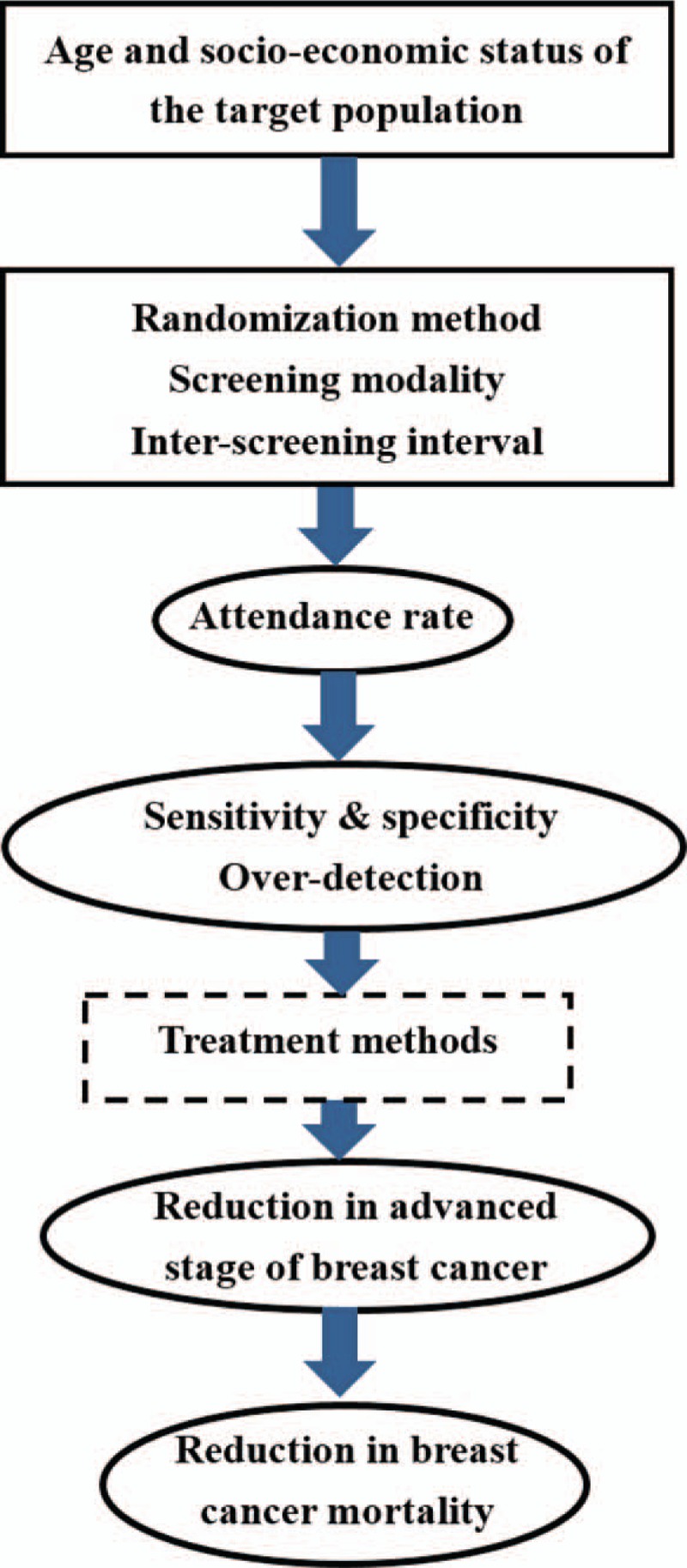
We reanalyzed the empirical data from the Health Insurance Plan trial in 1963 to the UK age trial in 1991 and their follow-up data published until 2015. We first performed Bayesian conjugated meta-analyses on the heterogeneity of attendance rate, sensitivity, and over-detection and their impacts on advanced stage breast cancer and death from breast cancer across trials using Bayesian Poisson fixed- and random-effect regression model. Bayesian meta-analysis of causal model was then developed to assess a cascade of causal relationships regarding the impact of both attendance and sensitivity on 2 main outcomes.
The causes of heterogeneity responsible for the disparities across the trials were clearly manifested in 3 components. The attendance rate ranged from 61.3% to 90.4%. The sensitivity estimates show substantial variation from 57.26% to 87.97% but improved with time from 64% in 1963 to 82% in 1980 when Bayesian conjugated meta-analysis was conducted in chronological order. The percentage of over-detection shows a wide range from 0% to 28%, adjusting for long lead-time. The impacts of the attendance rate and sensitivity on the 2 main outcomes were statistically significant. Causal inference made by linking these causal relationships with emphasis on the heterogeneity of the attendance rate and sensitivity accounted for the variation in the reduction of advanced breast cancer (none-30%) and of mortality (none-31%). We estimated a 33% (95% CI: 24-42%) and 13% (95% CI: 6-20%) breast cancer mortality reduction for the best scenario (90% attendance rate and 95% sensitivity) and the poor scenario (30% attendance rate and 55% sensitivity), respectively.
Elucidating the scenarios from high to low performance and learning from the experiences of these trials helps screening policy-makers contemplate on how to avoid errors made in ineffective studies and emulate the effective studies to save women lives.
西方国家30多年来基于随机对照试验对使用乳房X光检查筛查乳腺癌的争议,不仅使循证医学范式黯然失色,也让那些仍在考虑乳腺癌筛查的国家的卫生决策者在采用或放弃这种成熟的筛查方式时陷入两难境地。
我们重新分析了1963年健康保险计划试验至1991年英国年龄试验的实证数据及其截至2015年公布的随访数据。我们首先使用贝叶斯泊松固定效应和随机效应回归模型,对各试验中参与率、敏感度、过度诊断的异质性及其对晚期乳腺癌和乳腺癌死亡的影响进行贝叶斯共轭荟萃分析。然后开发了因果模型的贝叶斯荟萃分析,以评估参与率和敏感度对两个主要结果影响的一系列因果关系。
试验间差异的异质性原因在三个方面明显体现。参与率从61.3%到90.4%不等。敏感度估计值差异很大,从57.26%到87.97%,但随着时间推移有所改善,从1963年的64%提高到1980年的82%(按时间顺序进行贝叶斯共轭荟萃分析时)。调整较长的提前期后,过度诊断的百分比范围很广,从0%到28%。参与率和敏感度对两个主要结果的影响具有统计学意义。通过将这些因果关系联系起来进行因果推断,重点关注参与率和敏感度的异质性,解释了晚期乳腺癌减少(0%-30%)和死亡率降低(0%-31%)的差异。我们估计,在最佳情况(参与率90%,敏感度95%)和最差情况(参与率30%,敏感度55%)下,乳腺癌死亡率分别降低33%(95%可信区间:24%-42%)和13%(95%可信区间:6%-20%)。
阐明从高到低的表现情况并借鉴这些试验的经验,有助于筛查政策制定者思考如何避免在无效研究中出现的错误,并效仿有效研究以挽救女性生命。