Golozar Asieh, Khalili Davood, Etemadi Arash, Poustchi Hossein, Fazeltabar Akbar, Hosseini Firoozeh, Kamangar Farin, Khoshnia Masoud, Islami Farhad, Hadaegh Farzad, Brennan Paul, Boffetta Paolo, Abnet Christian C, Dawsey Sanford M, Azizi Fereidoun, Malekzadeh Reza, Danaei Goodarz
Digestive Disease Research Institute, Shariati Hospital, Tehran University of Medical Sciences, Tehran, 14117, Iran.
Department of Epidemiology, Johns Hopkins Bloomberg School of Public Health, Baltimore, MD, 21205, USA.
BMC Public Health. 2017 Jan 31;17(1):133. doi: 10.1186/s12889-016-3999-4.
Refined grains and white rice have been associated with elevated risk of type 2 diabetes mellitus (T2DM). In this study, we sought to quantify the effect of white rice intake on incident T2DM in two prospective population-based cohort studies from Iran, where white rice is one of the main staple.
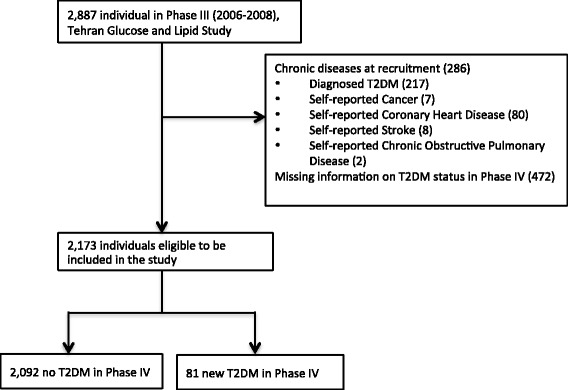
We used follow-up data from 9,182 participants from Golestan Cohort Study (GCS, 2004-2007, conducted mainly in rural areas) and 2,173 from Tehran Lipid and Glucose Study (TLGS, 2004-2006) who did not have T2DM and other chronic diseases at baseline. Diet was assessed using validated food frequency questionnaires. Multivariable logistic regression models were used to estimate adjusted odds ratios (ORs) for incident T2DM.
We documented 902 new cases of T2DM in GCS and 81 in TLGS. Age-standardized cumulative incidence of T2DM was 9.9% in Golestan and 8.0% in Tehran. Daily white rice intake was significantly higher among residents of Tehran compared to Golestan (median daily intake: 250 vs. 120 grams; P-value < 0.001). After adjustment for potential confounders, there was no significant association between daily white rice intake and incident T2DM in GCS. In TLGS, the adjusted OR (95% confidence interval (CI)) was 2.1 (1.1, 3.9) comparing participants with daily white rice intake of >250 grams/day to those with <250.
We observed an increased lieklihood of T2DM associated with high white rice intake among residents of Tehran and no association in Golestan. Our findings, if further supported by other studies, have important public health implications especially for countries where white rice is a major staple and diabetes is increasing rapidly incidence is high. Further research is needed to investigate lack of an association between lower levels of white rice intake and T2DM.
精制谷物和白米与2型糖尿病(T2DM)风险升高有关。在本研究中,我们试图在伊朗两项基于人群的前瞻性队列研究中量化白米摄入量对新发T2DM的影响,在伊朗白米是主要主食之一。
我们使用了来自戈勒斯坦队列研究(GCS,2004 - 2007年,主要在农村地区进行)的9182名参与者以及德黑兰血脂与血糖研究(TLGS,2004 - 2006年)的2173名参与者的随访数据,这些参与者在基线时没有T2DM和其他慢性病。使用经过验证的食物频率问卷评估饮食。多变量逻辑回归模型用于估计新发T2DM的调整优势比(OR)。
我们在GCS中记录了902例新的T2DM病例,在TLGS中记录了81例。戈勒斯坦T2DM的年龄标准化累积发病率为9.9%,德黑兰为8.0%。与戈勒斯坦相比,德黑兰居民的每日白米摄入量显著更高(每日摄入量中位数:250克对120克;P值<0.001)。在调整潜在混杂因素后,GCS中每日白米摄入量与新发T2DM之间无显著关联。在TLGS中,将每日白米摄入量>250克/天的参与者与<250克/天的参与者相比,调整后的OR(95%置信区间(CI))为2.1(1.1,3.9)。
我们观察到德黑兰居民中高白米摄入量与T2DM可能性增加有关,而在戈勒斯坦没有关联。我们的发现,如果得到其他研究的进一步支持,具有重要的公共卫生意义,特别是对于白米是主要主食且糖尿病发病率迅速上升的国家。需要进一步研究来调查较低水平的白米摄入量与T2DM之间缺乏关联的情况。