Saw Swee Hock School of Public Health, National University of Singapore (NUS), Singapore, Singapore.
NUS Graduate School for Integrative Sciences and Engineering, NUS, Singapore, Singapore.
Eur J Nutr. 2019 Dec;58(8):3349-3360. doi: 10.1007/s00394-018-1879-7. Epub 2018 Dec 10.
The prevalence of type 2 diabetes (T2D) is increasing in Asian populations. White rice is a common staple food in these populations and results from several studies suggest that high white rice consumption increases T2D risk. We assessed whether rice, noodles and bread intake was associated with T2D risk in an ethnic Chinese population.
We included data from 45,411 male and female Chinese participants of the Singapore Chinese Health Study cohort aged 45-74 years at baseline. Usual diet at baseline was evaluated by a validated 165-item semi-quantitative food frequency questionnaire. Physician-diagnosed T2D was self-reported during two follow-up interviews. Multivariable Cox regression models were used to estimate hazard ratios (HRs) and 95% confidence intervals (CIs).
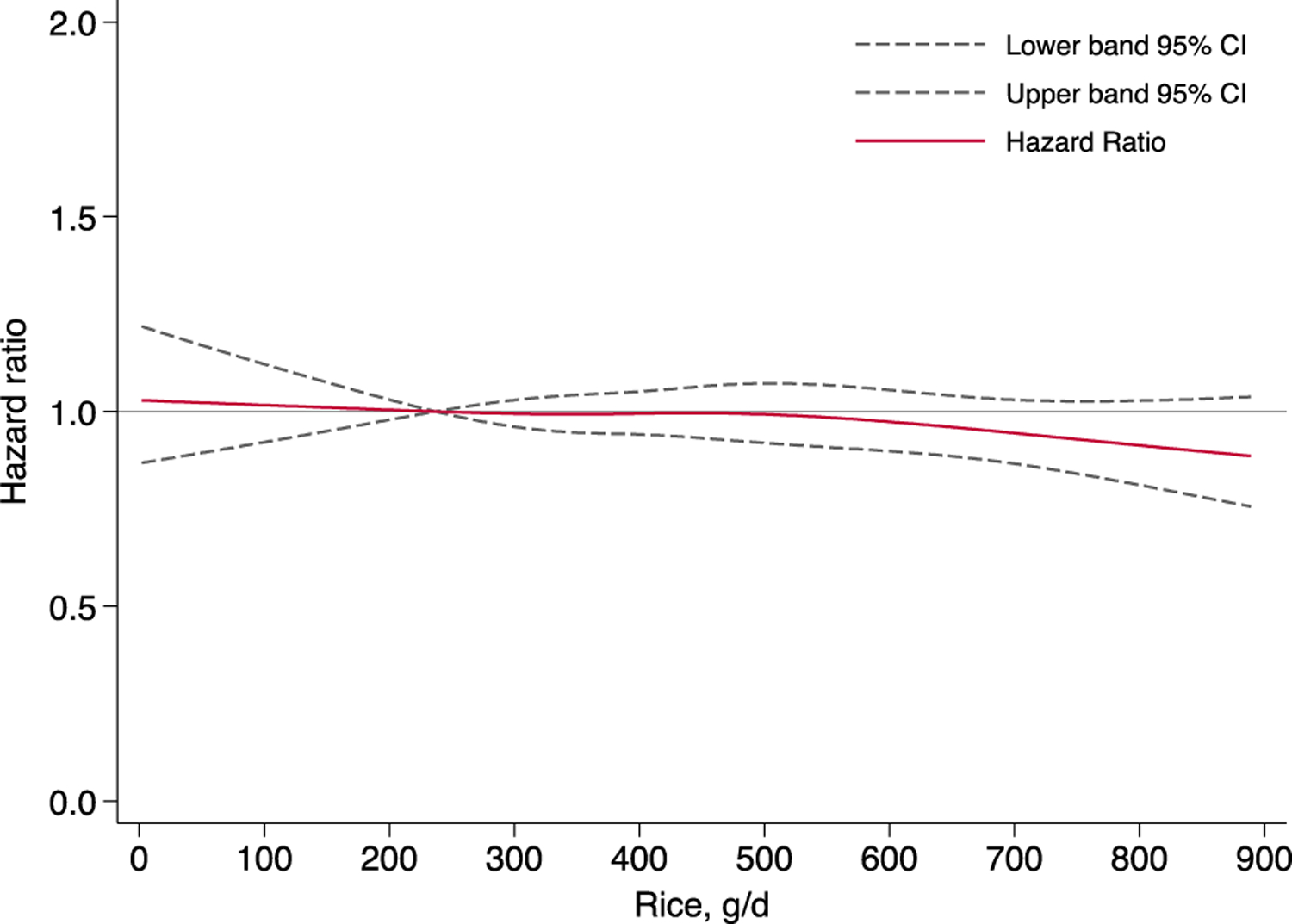
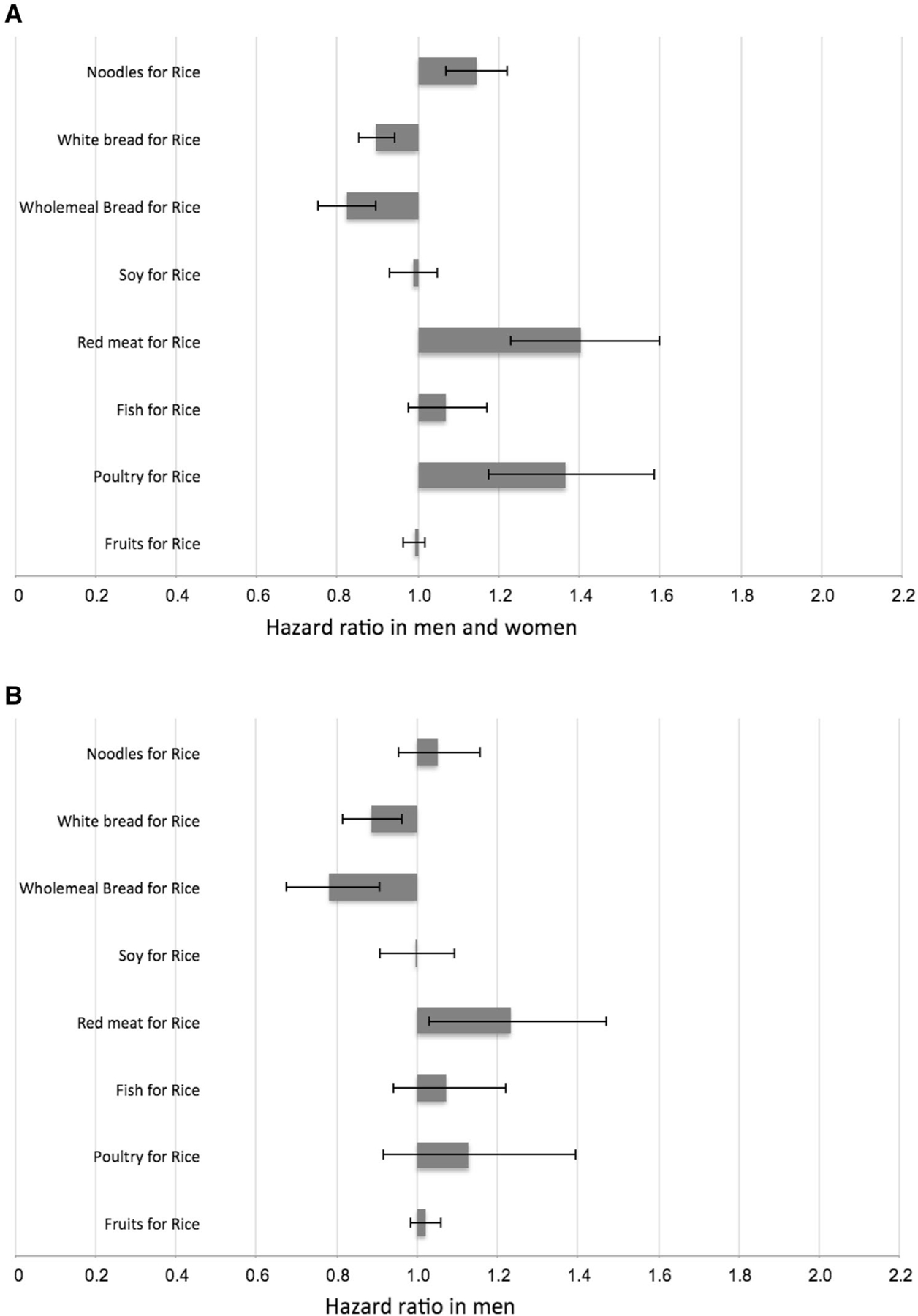
During a mean follow-up of 11 years, 5207 incident cases of T2D were documented. Rice intake was not associated with higher T2D risk [HR for extreme quintiles, 0.98 (95% CI 0.90, 1.08)] despite the large variation in intake levels (median intake for extreme quintiles: 236.5 g/day vs. 649.3 g/day), although the precise risk estimate depended greatly on the substitute food. Replacing one daily serving of rice with noodles [HR 1.14 (95% CI 1.07, 1.22)], red meat [HR 1.40 (95% CI 1.23, 1.60)] and poultry [HR 1.37 (95% CI 1.18, 1.59)] was associated with higher T2D risk, whereas the replacement of rice with white bread [HR 0.90 (95% CI 0.85, 0.94)] or wholemeal bread [HR 0.82 (95% CI 0.75, 0.90)] was associated with lower T2D risk.
Higher rice consumption was not substantially associated with a higher risk of T2D in this Chinese population. Recommendations to reduce high white rice consumption in Asian populations for the prevention of T2D may only be effective if substitute foods are considered carefully.
NCT03356340, http://www.clinicaltrials.gov.
2 型糖尿病(T2D)在亚洲人群中的患病率正在增加。大米是这些人群的常见主食,多项研究结果表明,大量食用白米饭会增加 T2D 的风险。我们评估了中国人的米饭、面条和面包摄入量与 T2D 风险之间的关系。
我们纳入了新加坡华人健康研究队列中 45411 名年龄在 45-74 岁的男性和女性中国参与者的数据。基线时通过经过验证的 165 项半定量食物频率问卷评估了常规饮食。通过两次随访访谈,自我报告了医生诊断的 T2D。使用多变量 Cox 回归模型估计了危险比(HR)和 95%置信区间(CI)。
在平均 11 年的随访期间,记录了 5207 例 T2D 事件。尽管摄入量水平差异很大(极端五分位数的中位数摄入量:236.5g/天与 649.3g/天),但大米摄入量与更高的 T2D 风险无关[极端五分位数的 HR,0.98(95%CI,0.90,1.08)],尽管确切的风险估计在很大程度上取决于替代食物。用面条[HR 1.14(95%CI,1.07,1.22)]、红肉[HR 1.40(95%CI,1.23,1.60)]和禽肉[HR 1.37(95%CI,1.18,1.59)]替代每天一份米饭,而用白面包[HR 0.90(95%CI,0.85,0.94)]或全麦面包[HR 0.82(95%CI,0.75,0.90)]替代大米与较低的 T2D 风险相关。
在本中国人群中,较高的大米摄入量与 T2D 风险增加没有显著相关性。如果仔细考虑替代食物,建议亚洲人群减少高白米饭的摄入,以预防 T2D,可能仅有效。
NCT03356340,http://www.clinicaltrials.gov。