Hall LaToya N, Ficker Lisa J, Chadiha Letha A, Green Carmen R, Jackson James S, Lichtenberg Peter A
Wayne State University, Detroit, MI, USA.
University of Michigan, Ann Arbor, USA.
Gerontol Geriatr Med. 2016 Nov 16;2:2333721416677469. doi: 10.1177/2333721416677469. eCollection 2016 Jan-Dec.
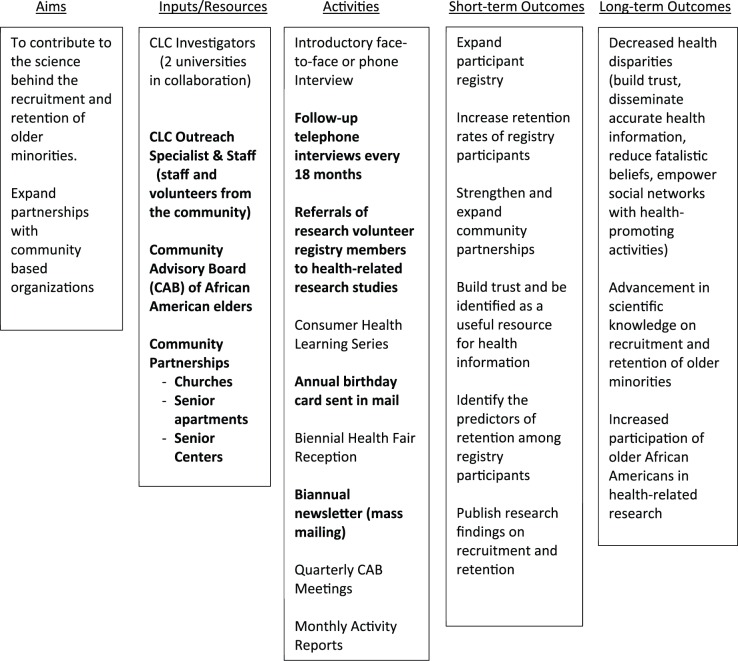
The objectives of this study were to evaluate the capability of a research volunteer registry to retain community-dwelling African American older adults, and to explore demographic and health factors associated with retention. A logistic regression model was used to determine the influence of demographics, health factors, and registry logic model activities on retention in a sample of 1,730 older African American adults. Almost 80% of participants active in the volunteer research registry between January 2012 and June 2015 were retained. Employment, being referred to research studies, a higher number of medical conditions, and more follow-up contacts were associated with an increased likelihood of retention. Older age, more months in the registry, and more mobility problems decreased the likelihood of retention. These results suggest the Michigan Center for Urban African American Aging Research logic model promotes retention through involving older African American adults in research through study referrals and intensive follow-up. The loss of participants due to age- and mobility-related issues indicate the registry may be losing its most vulnerable participants.
本研究的目的是评估一个研究志愿者登记系统留住居住在社区的非裔美国老年人的能力,并探索与留存相关的人口统计学和健康因素。使用逻辑回归模型来确定人口统计学、健康因素和登记系统逻辑模型活动对1730名非裔美国老年人样本留存率的影响。在2012年1月至2015年6月期间活跃于志愿者研究登记系统的参与者中,近80%被留存下来。就业、被推荐参加研究、更多的健康问题以及更多的随访联系与更高的留存可能性相关。年龄较大、在登记系统中的时间更长以及更多的行动不便问题会降低留存的可能性。这些结果表明,密歇根城市非裔美国老年人研究中心的逻辑模型通过研究推荐和密集随访让非裔美国老年人参与研究,从而促进了留存。因年龄和行动不便相关问题导致的参与者流失表明登记系统可能正在失去其最脆弱的参与者。