Reijnierse Esmee M, de Jong Nynke, Trappenburg Marijke C, Blauw Gerard Jan, Butler-Browne Gillian, Gapeyeva Helena, Hogrel Jean-Yves, McPhee Jamie S, Narici Marco V, Sipilä Sarianna, Stenroth Lauri, van Lummel Rob C, Pijnappels Mirjam, Meskers Carel G M, Maier Andrea B
Department of Internal Medicine, Section of Gerontology and Geriatrics, VU University Medical Center, 1007 MB, Amsterdam, The Netherlands.
Department of Internal Medicine, Amstelland Hospital, 1180 AH, Amstelveen, The Netherlands.
J Cachexia Sarcopenia Muscle. 2017 Jun;8(3):466-474. doi: 10.1002/jcsm.12181. Epub 2017 Feb 2.
Handgrip strength (HGS) is used to identify individuals with low muscle strength (dynapenia). The influence of the number of attempts on maximal HGS is not yet known and may differ depending on age and health status. This study aimed to assess how many attempts of HGS are required to obtain maximal HGS.
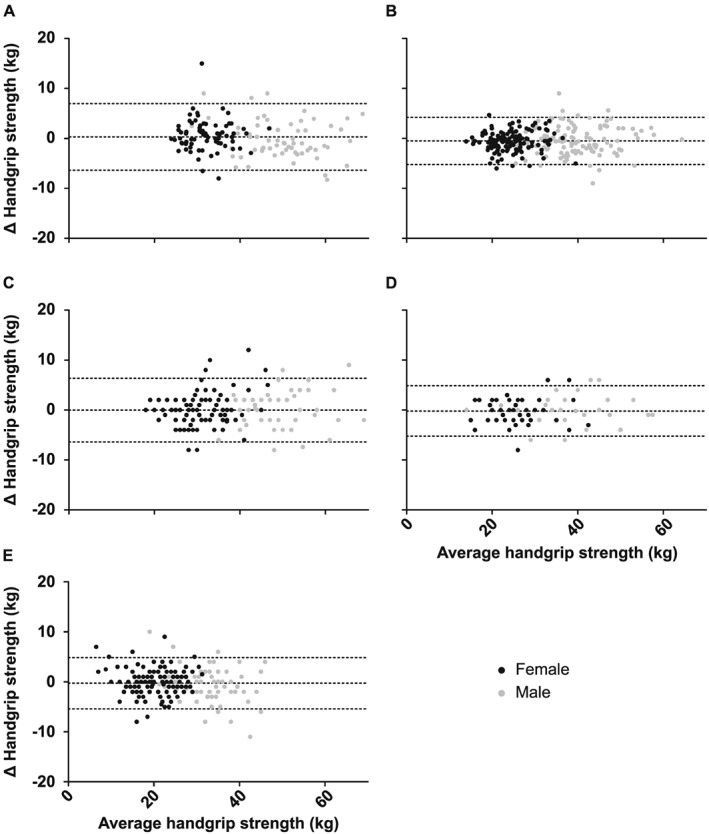
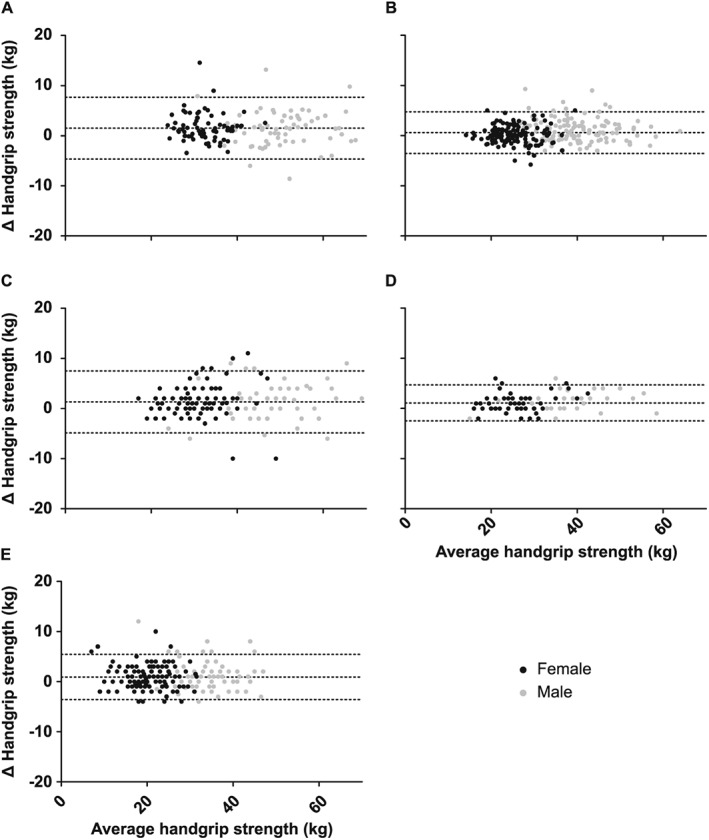
Three cohorts (939 individuals) differing in age and health status were included. HGS was assessed three times and explored as continuous and dichotomous variable. Paired t-test, intraclass correlation coefficients (ICC) and Bland-Altman analysis were used to test reproducibility of HGS. The number of individuals with misclassified dynapenia at attempts 1 and 2 with respect to attempt 3 were assessed.
Results showed the same pattern in all three cohorts. Maximal HGS at attempts 1 and 2 was higher than at attempt 3 on population level (P < 0.001 for all three cohorts). ICC values between all attempts were above 0.8, indicating moderate to high reproducibility. Bland-Altman analysis showed that 41.0 to 58.9% of individuals had the highest HGS at attempt 2 and 12.4 to 37.2% at attempt 3. The percentage of individuals with a maximal HGS above the gender-specific cut-off value at attempt 3 compared with attempts 1 and 2 ranged from 0 to 50.0%, with a higher percentage of misclassification in middle-aged and older populations.
Maximal HGS is dependent on the number of attempts, independent of age and health status. To assess maximal HGS, at least three attempts are needed if HGS is considered to be a continuous variable. If HGS is considered as a discrete variable to assess dynapenia, two attempts are sufficient to assess dynapenia in younger populations. Misclassification should be taken into account in middle-aged and older populations.
握力(HGS)用于识别肌肉力量低下(肌肉减少症)的个体。尝试次数对最大握力的影响尚不清楚,可能因年龄和健康状况而异。本研究旨在评估需要进行多少次握力测试才能获得最大握力。
纳入了年龄和健康状况不同的三个队列(共939人)。对握力进行了三次评估,并将其作为连续变量和二分变量进行探讨。采用配对t检验、组内相关系数(ICC)和Bland-Altman分析来检验握力的可重复性。评估了在第1次和第2次尝试时与第3次尝试相比被错误分类为肌肉减少症的个体数量。
所有三个队列的结果呈现相同模式。在总体水平上,第1次和第2次尝试时的最大握力高于第3次尝试时(所有三个队列P<0.001)。所有尝试之间的ICC值均高于0.8,表明具有中度至高度的可重复性。Bland-Altman分析显示,41.0%至58.9%的个体在第2次尝试时握力最高,12.4%至37.2%的个体在第3次尝试时握力最高。与第1次和第2次尝试相比,第3次尝试时最大握力高于性别特异性临界值的个体百分比在0%至50.0%之间,中年和老年人群中的错误分类百分比更高。
最大握力取决于尝试次数,与年龄和健康状况无关。如果将握力视为连续变量来评估最大握力,则至少需要进行三次尝试。如果将握力视为评估肌肉减少症的离散变量,那么两次尝试就足以评估年轻人群中的肌肉减少症。在中年和老年人群中应考虑错误分类的情况。