Cerin Ester, Nathan Andrea, van Cauwenberg Jelle, Barnett David W, Barnett Anthony
Institute for Health and Ageing, Australian Catholic University, Level 6, 215 Spring Street, Melbourne, VIC, 3000, Australia.
School of Public Health, The University of Hong Kong, Hong Kong, China.
Int J Behav Nutr Phys Act. 2017 Feb 6;14(1):15. doi: 10.1186/s12966-017-0471-5.
Perceived and objectively-assessed aspects of the neighbourhood physical environment have been postulated to be key contributors to regular engagement in active travel (AT) in older adults. We systematically reviewed the literature on neighbourhood physical environmental correlates of AT in older adults and applied a novel meta-analytic approach to statistically quantify the strength of evidence for environment-AT associations.
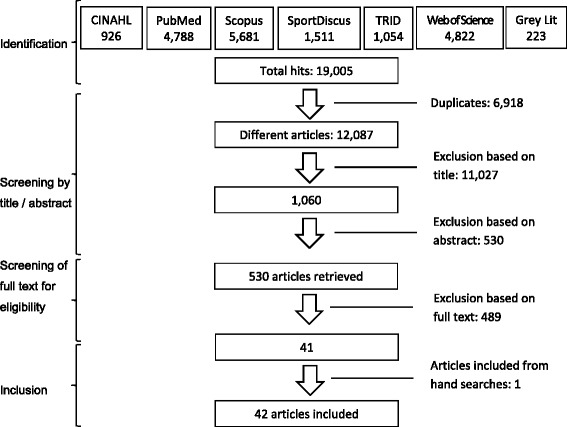
Forty two quantitative studies that estimated associations of aspects of the neighbourhood built environment with AT in older adults (aged ≥ 65 years) and met selection criteria were reviewed and meta-analysed. Findings were analysed according to five AT outcomes (total walking for transport, within-neighbourhood walking for transport, combined walking and cycling for transport, cycling for transport, and all AT outcomes combined) and seven categories of the neighbourhood physical environment (residential density/urbanisation, walkability, street connectivity, access to/availability of services/destinations, pedestrian and cycling infrastructure, aesthetics and cleanliness/order, and safety and traffic).
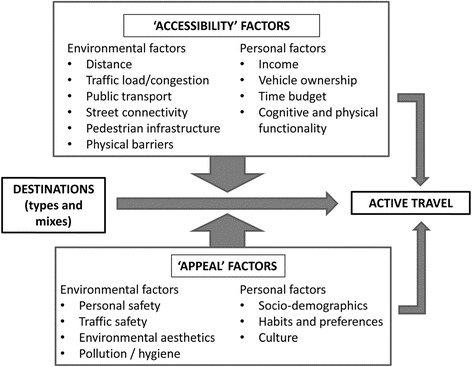
Most studies examined correlates of total walking for transport. A sufficient amount of evidence of positive associations with total walking for transport was found for residential density/urbanisation, walkability, street connectivity, overall access to destinations/services, land use mix, pedestrian-friendly features and access to several types of destinations. Littering/vandalism/decay was negatively related to total walking for transport. Limited evidence was available on correlates of cycling and combined walking and cycling for transport, while sufficient evidence emerged for a positive association of within-neighbourhood walking with pedestrian-friendly features and availability of benches/sitting facilities. Correlates of all AT combined mirrored those of walking for transport. Positive associations were also observed with food outlets, business/institutional/industrial destinations, availability of street lights, easy access to building entrance and human and motorised traffic volume. Several but inconsistent individual- and environmental-level moderators of associations were identified.
Results support strong links between the neighbourhood physical environment and older adults' AT. Future research should focus on the identification of types and mixes of destinations that support AT in older adults and how these interact with individual characteristics and other environmental factors. Future research should also aim to clarify dose-response relationships through multi-country investigations and data-pooling from diverse geographical regions.
据推测,老年人对邻里物理环境的感知以及客观评估的方面是其定期参与主动出行(AT)的关键因素。我们系统回顾了关于老年人AT与邻里物理环境相关性的文献,并应用一种新颖的荟萃分析方法,从统计学角度量化环境与AT关联的证据强度。
对42项估计老年人(年龄≥65岁)邻里建成环境各方面与AT之间关联且符合选择标准的定量研究进行了回顾和荟萃分析。根据五种AT结果(出行总步行量、邻里内出行步行量、步行与骑行出行总量、骑行出行量以及所有AT结果总和)和七类邻里物理环境(居住密度/城市化程度、步行适宜性、街道连通性、服务/目的地的可达性/可用性、行人与自行车基础设施、美观与清洁/秩序以及安全与交通)对研究结果进行了分析。
大多数研究考察了出行总步行量的相关因素。对于居住密度/城市化程度、步行适宜性、街道连通性、目的地/服务的总体可达性、土地利用混合情况、行人友好型特征以及多种类型目的地的可达性,发现了与出行总步行量呈正相关的充分证据。乱扔垃圾/破坏公物/破败与出行总步行量呈负相关。关于骑行以及步行与骑行出行总量的相关因素,证据有限,而对于邻里内步行与行人友好型特征以及长椅/坐具设施的可用性呈正相关,出现了充分证据。所有AT总和的相关因素反映了出行步行量的相关因素。与食品店、商业/机构/工业目的地、路灯的可用性、建筑物入口的便捷可达性以及人和机动车交通流量也观察到了正相关。确定了几个但不一致的个体和环境层面的关联调节因素。
结果支持邻里物理环境与老年人AT之间的紧密联系。未来的研究应侧重于确定支持老年人AT的目的地类型和组合,以及它们如何与个体特征和其他环境因素相互作用。未来的研究还应旨在通过多国调查和来自不同地理区域的数据汇总来阐明剂量反应关系。