Sana Barindra, Chia Kuan Hui Burton, Raghavan Sarada S, Ramalingam Balamurugan, Nagarajan Niranjan, Seayad Jayasree, Ghadessy Farid J
p53 Laboratory, Agency for Science Technology And Research (ASTAR), 8A Biomedical Grove, #06-04/05 Neuros/Immunos, Singapore, 138648 Singapore.
Genome Institute of Singapore, 60 Biopolis Street, Genome, #02-01, Singapore, 138672 Singapore.
Biotechnol Biofuels. 2017 Feb 3;10:32. doi: 10.1186/s13068-017-0720-5. eCollection 2017.
Lignin is a potential biorefinery feedstock for the production of value-added chemicals including vanillin. A huge amount of lignin is produced as a by-product of the paper industry, while cellulosic components of plant biomass are utilized for the production of paper pulp. In spite of vast potential, lignin remains the least exploited component of plant biomass due to its extremely complex and heterogenous structure. Several enzymes have been reported to have lignin-degrading properties and could be potentially used in lignin biorefining if their catalytic properties could be improved by enzyme engineering. The much needed improvement of lignin-degrading enzymes by high-throughput selection techniques such as directed evolution is currently limited, as robust methods for detecting the conversion of lignin to desired small molecules are not available.
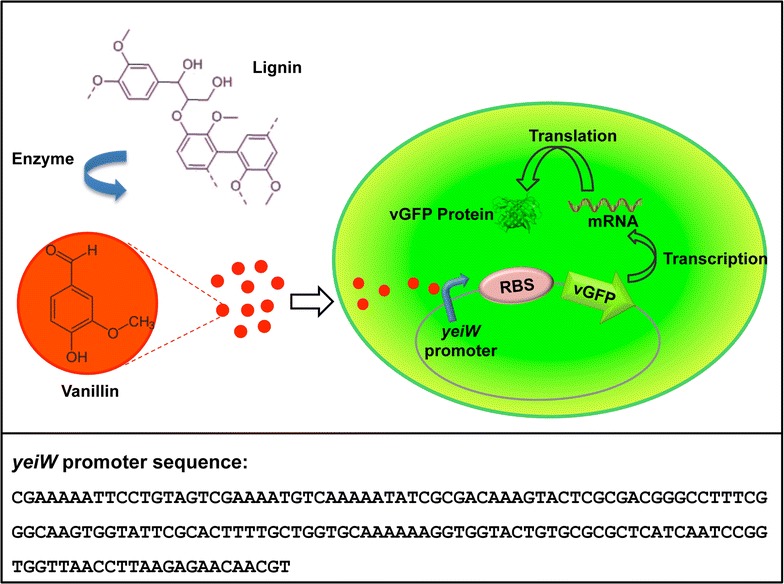
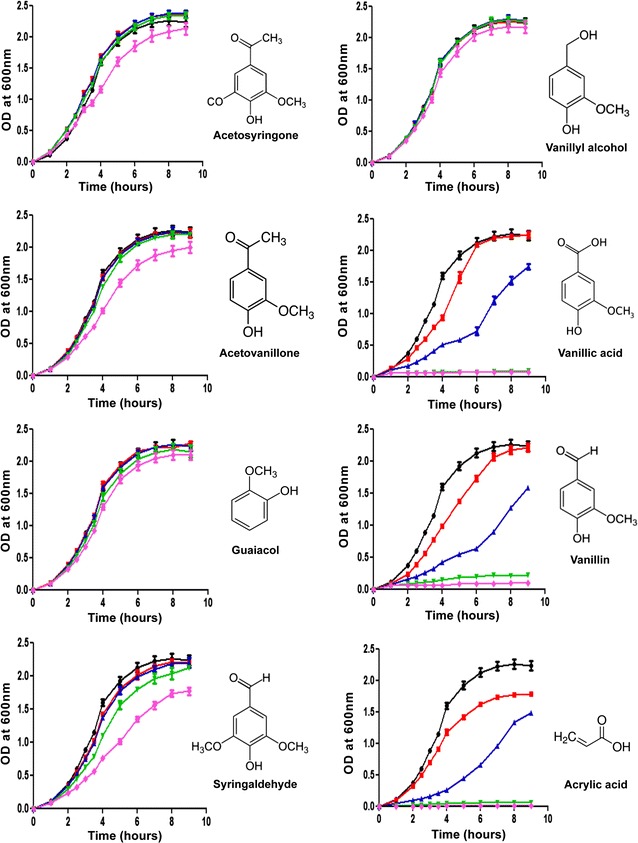
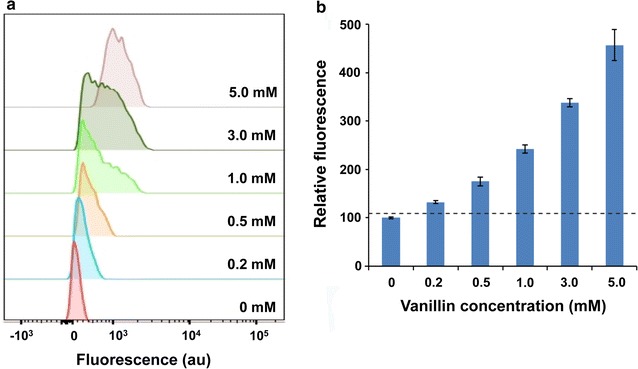
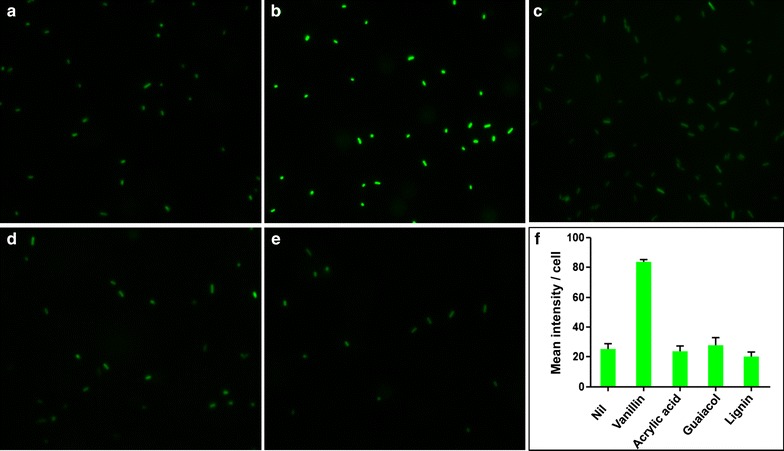
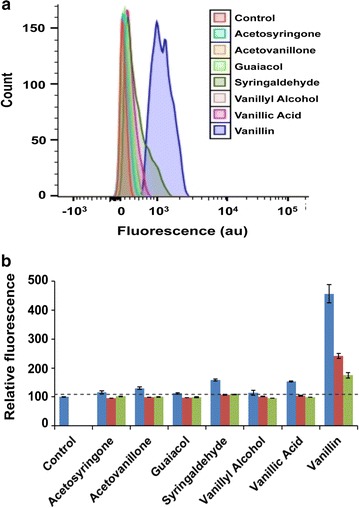
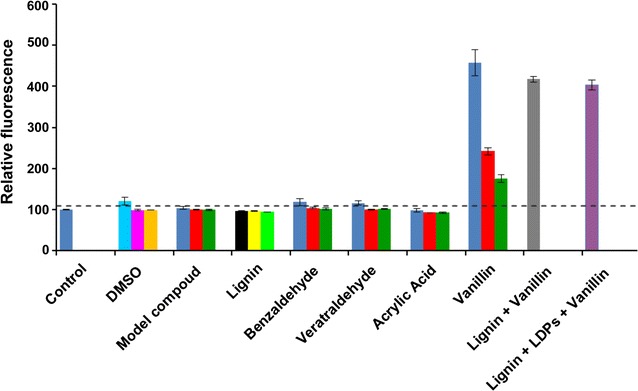
We identified a vanillin-inducible promoter by RNAseq analysis of cells treated with a sublethal dose of vanillin and developed a genetically programmed vanillin-sensing cell by placing the 'very green fluorescent protein' gene under the control of this promoter. Fluorescence of the biosensing cell is enhanced significantly when grown in the presence of vanillin and is readily visualized by fluorescence microscopy. The use of fluorescence-activated cell sorting analysis further enhances the sensitivity, enabling dose-dependent detection of as low as 200 µM vanillin. The biosensor is highly specific to vanillin and no major response is elicited by the presence of lignin, lignin model compound, DMSO, vanillin analogues or non-specific toxic chemicals.
We developed an engineered cell that can detect vanillin at a concentration as low as 200 µM. The vanillin-sensing cell did not show cross-reactivity towards lignin or major lignin degradation products including vanillin analogues. This engineered cell could potentially be used as a host cell for screening lignin-degrading enzymes that can convert lignin to vanillin.
木质素是一种潜在的生物精炼原料,可用于生产包括香草醛在内的增值化学品。造纸工业产生大量木质素作为副产品,而植物生物质的纤维素成分则用于生产纸浆。尽管木质素具有巨大潜力,但由于其极其复杂和异质的结构,它仍然是植物生物质中开发最少的成分。据报道,几种酶具有木质素降解特性,如果通过酶工程改善其催化特性,则有可能用于木质素生物精炼。目前,通过定向进化等高通量筛选技术对木质素降解酶进行急需的改进受到限制,因为缺乏检测木质素转化为所需小分子的可靠方法。
我们通过对用亚致死剂量香草醛处理的细胞进行RNA测序分析,鉴定出一个香草醛诱导型启动子,并通过将“非常绿色荧光蛋白”基因置于该启动子的控制下,开发出一种基因编程的香草醛传感细胞。当在香草醛存在下生长时,生物传感细胞的荧光会显著增强,并且通过荧光显微镜很容易观察到。使用荧光激活细胞分选分析进一步提高了灵敏度,能够剂量依赖性地检测低至200μM的香草醛。该生物传感器对香草醛具有高度特异性,木质素、木质素模型化合物、二甲基亚砜、香草醛类似物或非特异性有毒化学物质的存在不会引起主要反应。
我们开发了一种工程细胞,能够检测低至200μM浓度的香草醛。香草醛传感细胞对木质素或包括香草醛类似物在内的主要木质素降解产物没有交叉反应。这种工程细胞有可能用作宿主细胞,用于筛选能够将木质素转化为香草醛的木质素降解酶。