Martin Glen P, Sperrin Matthew, Ludman Peter F, de Belder Mark A, Gale Chris P, Toff William D, Moat Neil E, Trivedi Uday, Buchan Iain, Mamas Mamas A
Health e-Research Centre, University of Manchester, Manchester, United Kingdom.
Queen Elizabeth Hospital, Birmingham, United Kingdom.
Am Heart J. 2017 Feb;184:97-105. doi: 10.1016/j.ahj.2016.10.020. Epub 2016 Nov 3.
The performance of emerging transcatheter aortic valve implantation (TAVI) clinical prediction models (CPMs) in national TAVI cohorts distinct from those where they have been derived is unknown. This study aimed to investigate the performance of the German Aortic Valve, FRANCE-2, OBSERVANT and American College of Cardiology (ACC) TAVI CPMs compared with the performance of historic cardiac CPMs such as the EuroSCORE and STS-PROM, in a large national TAVI registry.
The calibration and discrimination of each CPM were analyzed in 6676 patients from the UK TAVI registry, as a whole cohort and across several subgroups. Strata included gender, diabetes status, access route, and valve type. Furthermore, the amount of agreement in risk classification between each of the considered CPMs was analyzed at an individual patient level.
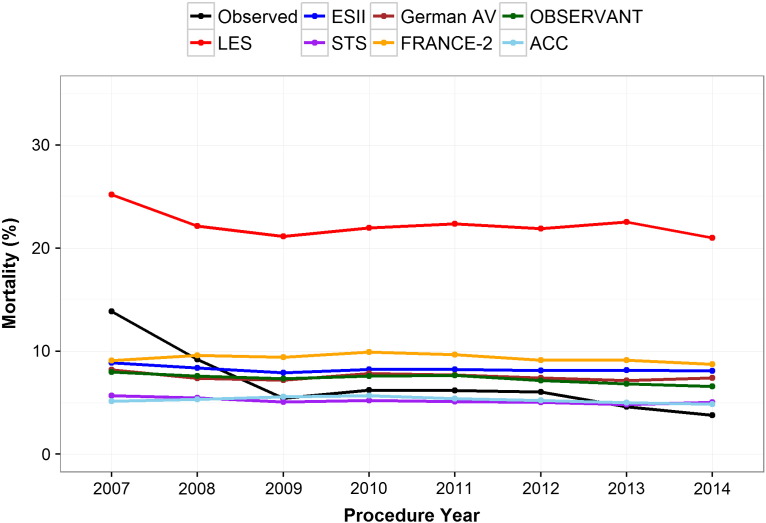
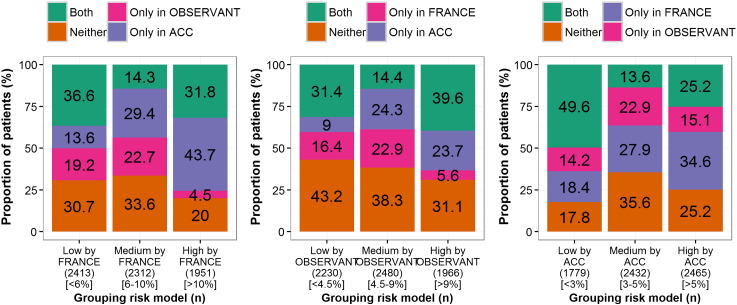
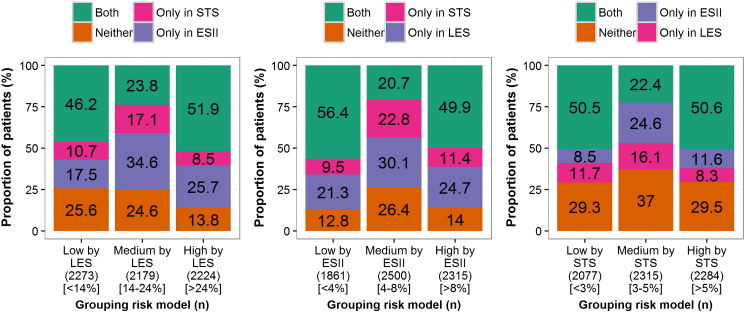
The observed 30-day mortality rate was 5.4%. In the whole cohort, the majority of CPMs over-estimated the risk of 30-day mortality, although the mean ACC score (5.2%) approximately matched the observed mortality rate. The areas under ROC curve were between 0.57 for OBSERVANT and 0.64 for ACC. Risk classification agreement was low across all models, with Fleiss's kappa values between 0.17 and 0.50.
Although the FRANCE-2 and ACC models outperformed all other CPMs, the performance of current TAVI-CPMs was low when applied to an independent cohort of TAVI patients. Hence, TAVI specific CPMs need to be derived outside populations previously used for model derivation, either by adapting existing CPMs or developing new risk scores in large national registries.
新型经导管主动脉瓣植入术(TAVI)临床预测模型(CPMs)在与模型推导人群不同的国家TAVI队列中的表现尚不清楚。本研究旨在调查德国主动脉瓣、法国-2、观察性研究和美国心脏病学会(ACC)TAVI CPMs与历史心脏CPMs(如欧洲心脏手术风险评估系统(EuroSCORE)和胸外科医师协会预测模型(STS-PROM))在一个大型国家TAVI注册研究中的表现。
在英国TAVI注册研究的6676例患者中,作为一个整体队列并在几个亚组中分析每个CPM的校准和区分能力。分层包括性别、糖尿病状态、入路途径和瓣膜类型。此外,在个体患者水平上分析每个考虑的CPM之间风险分类的一致程度。
观察到的30天死亡率为5.4%。在整个队列中,大多数CPMs高估了30天死亡率的风险,尽管ACC平均评分(5.2%)与观察到的死亡率大致匹配。ROC曲线下面积在观察性研究的0.57至ACC的0.64之间。所有模型的风险分类一致性较低,Fleiss卡方值在0.17至0.50之间。
尽管法国-2和ACC模型的表现优于所有其他CPMs,但当前TAVI-CPMs应用于独立的TAVI患者队列时表现不佳。因此,TAVI特异性CPMs需要在以前用于模型推导的人群之外得出,要么通过调整现有CPMs,要么在大型国家注册研究中开发新的风险评分。