Geiller Tristan, Royer Sebastien, Choi June-Seek
Department of Psychology, Korea University, Seoul 02841, Korea.; Center for Functional Connectomics, Korea Institute of Science and Technology, Seoul 02792, Korea.
Center for Functional Connectomics, Korea Institute of Science and Technology, Seoul 02792, Korea.
Exp Neurobiol. 2017 Feb;26(1):1-10. doi: 10.5607/en.2017.26.1.1. Epub 2017 Feb 13.
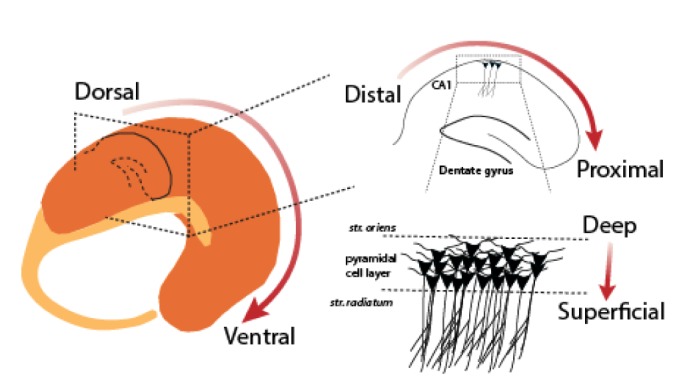
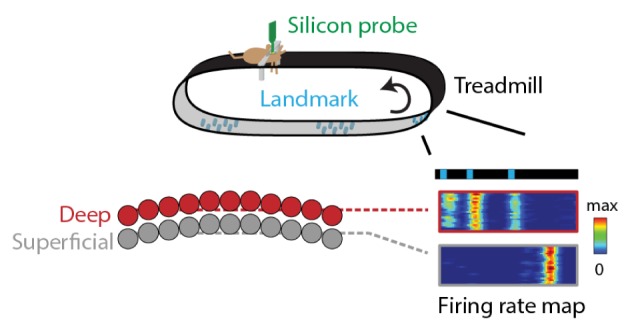
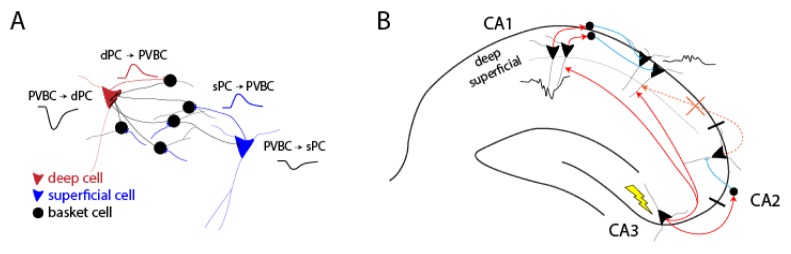
Numerous studies have implicated the hippocampus in the encoding and storage of declarative and spatial memories. Several models have considered the hippocampus and its distinct subfields to contain homogeneous pyramidal cell populations. Yet, recent studies have led to a consensus that the dorso-ventral and proximo-distal axes have different connectivities and physiologies. The remaining deep-superficial axis of the pyramidal layer, however, remains relatively unexplored due to a lack of techniques that can record from neurons simultaneously at different depths. Recent advances in transgenic mice, two-photon imaging and dense multisite recording have revealed extensive disparities between the pyramidal cells located in the deep and the superficial layers. Here, we summarize differences between the two populations in terms of gene expression and connectivity with other intra-hippocampal subregions and local interneurons that underlie distinct learning processes and spatial representations. A unified picture will emerge to describe how such local segregations can increase the capacity of the hippocampus to compute and process numerous tasks in parallel.
众多研究表明海马体与陈述性记忆和空间记忆的编码及存储有关。有几种模型认为海马体及其不同的子区域包含同质的锥体细胞群体。然而,最近的研究已达成共识,即背腹轴和远近轴具有不同的连接性和生理学特性。然而,由于缺乏能够在不同深度同时记录神经元活动的技术,锥体细胞层剩余的深浅轴仍相对未被探索。转基因小鼠、双光子成像和密集多部位记录等方面的最新进展揭示了位于深层和浅层的锥体细胞之间存在广泛差异。在这里,我们总结了这两种细胞群体在基因表达、与海马体内其他子区域及局部中间神经元的连接性方面的差异,这些差异构成了不同学习过程和空间表征的基础。一幅统一的图景将浮现出来,以描述这种局部隔离如何能够提高海马体并行计算和处理众多任务的能力。