Chiolerio Alessandro, Chiappalone Michela, Ariano Paolo, Bocchini Sergio
Center for Sustainable Future Technologies, Istituto Italiano di Tecnologia Torino, Italy.
Neuroscience and Brain Technologies Department, Istituto Italiano di Tecnologia Genova, Italy.
Front Neurosci. 2017 Feb 15;11:70. doi: 10.3389/fnins.2017.00070. eCollection 2017.
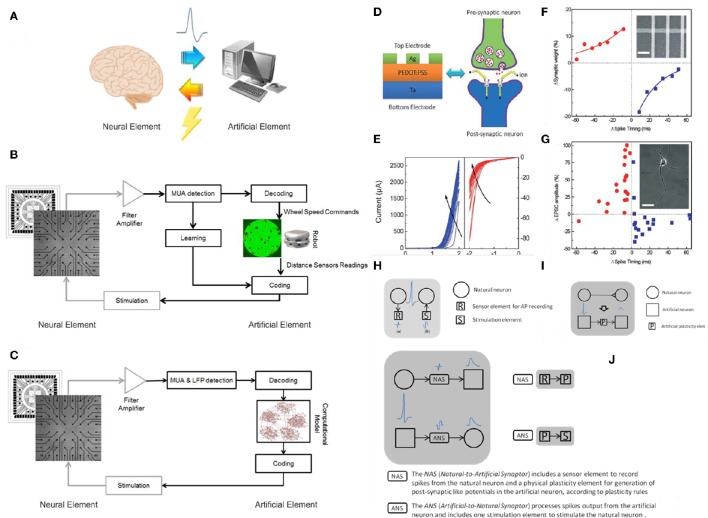
Here we provide the state-of-the-art of bioelectronic interfacing between biological neuronal systems and artificial components, focusing the attention on the potentiality offered by neuromorphic synthetic devices based on Resistive Switching (RS). Neuromorphic engineering is outside the scopes of this Perspective. Instead, our focus is on those materials and devices featuring genuine physical effects that could be sought as non-linearity, plasticity, excitation, and extinction which could be directly and more naturally coupled with living biological systems. In view of important applications, such as prosthetics and future life augmentation, a cybernetic parallelism is traced, between biological and artificial systems. We will discuss how such intrinsic features could reduce the complexity of conditioning networks for a more natural direct connection between biological and synthetic worlds. Putting together living systems with RS devices could represent a feasible though innovative perspective for the future of bionics.
在此,我们介绍生物神经元系统与人工组件之间生物电子接口的最新技术,重点关注基于电阻开关(RS)的神经形态合成器件所具有的潜力。神经形态工程不在本综述范围内。相反,我们关注的是那些具有真正物理效应的材料和器件,这些效应可表现为非线性、可塑性、激发和消退,能够直接且更自然地与活的生物系统耦合。鉴于诸如假肢和未来生活增强等重要应用,我们在生物和人工系统之间描绘了一种控制论上的并行关系。我们将讨论这些内在特性如何能够降低调节网络的复杂性,以实现生物世界与合成世界之间更自然的直接连接。将活体系统与电阻开关器件结合起来,可能代表了仿生学未来一个可行且创新的前景。