Junqueira Tassia L, Chagas Mateus F, Gouveia Vera L R, Rezende Mylene C A F, Watanabe Marcos D B, Jesus Charles D F, Cavalett Otavio, Milanez Artur Y, Bonomi Antonio
Laboratório Nacional de Ciência e Tecnologia do Bioetanol (CTBE), Centro Nacional de Pesquisa em Energia e Materiais (CNPEM), Caixa Postal 6192, Campinas, SP CEP 13083-970 Brazil.
Faculdade de Engenharia Química, Universidade Estadual de Campinas (UNICAMP), Campinas, SP Brazil.
Biotechnol Biofuels. 2017 Mar 14;10:50. doi: 10.1186/s13068-017-0722-3. eCollection 2017.
Ethanol production from lignocellulosic feedstocks (also known as 2nd generation or 2G ethanol process) presents a great potential for reducing both ethanol production costs and climate change impacts since agricultural residues and dedicated energy crops are used as feedstock. This study aimed at the quantification of the economic and environmental impacts considering the current and future scenarios of sugarcane biorefineries taking into account not only the improvements of the industrial process but also of biomass production systems. Technology assumptions and scenarios setup were supported by main companies and stakeholders, involved in the lignocellulosic ethanol production chain from Brazil and abroad. For instance, scenarios considered higher efficiencies and lower residence times for pretreatment, enzymatic hydrolysis, and fermentation (including pentoses fermentation); higher sugarcane yields; and introduction of energy cane (a high fiber variety of cane).
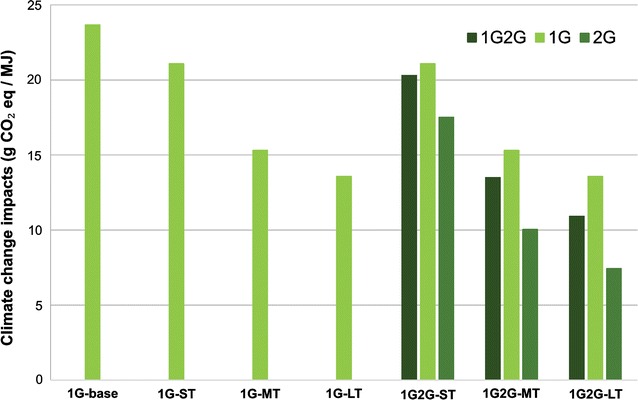
Ethanol production costs were estimated for different time horizons. In the short term, 2G ethanol presents higher costs compared to 1st generation (1G) ethanol. However, in the long term, 2G ethanol is more competitive, presenting remarkable lower production cost than 1G ethanol, even considering some uncertainties regarding technology and market aspects. In addition, environmental assessment showed that both 1G (in the medium and long term) and 2G ethanol can reduce climate change impacts by more than 80% when compared to gasoline.
This work showed the great potential of 2G ethanol production in terms of economic and environmental aspects. These results can support new research programs and public policies designed to stimulate both production and consumption of 2G ethanol in Brazil, accelerating the path along the learning curve. Some examples of mechanisms include: incentives to the establishment of local equipment and enzyme suppliers; and specific funding programs for the development and use of energy cane.
利用木质纤维素原料生产乙醇(也称为第二代或2G乙醇工艺)具有降低乙醇生产成本和气候变化影响的巨大潜力,因为农业残留物和专用能源作物被用作原料。本研究旨在量化甘蔗生物精炼厂当前和未来情景下的经济和环境影响,不仅考虑工业过程的改进,还考虑生物质生产系统的改进。技术假设和情景设定得到了参与巴西和国外木质纤维素乙醇生产链的主要公司和利益相关者的支持。例如,情景考虑了预处理、酶水解和发酵(包括戊糖发酵)的更高效率和更短停留时间;更高的甘蔗产量;以及引入能源甘蔗(一种高纤维甘蔗品种)。
估算了不同时间范围内的乙醇生产成本。短期内,2G乙醇的成本高于第一代(1G)乙醇。然而,从长期来看,2G乙醇更具竞争力,即使考虑到技术和市场方面的一些不确定性,其生产成本也显著低于1G乙醇。此外,环境评估表明,与汽油相比,1G(中长期)和2G乙醇都可以将气候变化影响降低80%以上。
这项工作显示了2G乙醇生产在经济和环境方面的巨大潜力。这些结果可以支持新的研究计划和公共政策,旨在刺激巴西2G乙醇的生产和消费,加速沿着学习曲线的进程。一些机制示例包括:激励建立本地设备和酶供应商;以及为能源甘蔗的开发和使用设立特定的资助计划。