Rocha Thaís Gomes, Silva Fernanda Dornelas Florentino, Gregori Fábio, Alfieri Amauri Alcindo, Buzinaro Maria da Glória, Fagliari José Jurandir
Research Laboratory of the Department of Veterinary Medicine and Surgery, School of Agricultural and Veterinarian Sciences, São Paulo State University (Unesp), Via de Acesso Prof. Paulo Donato Castellane, s/n, Jaboticabal, SP, CEP14884-900, Brazil.
, Jaboticabal, SP, CEP 14870-720, Brazil.
Trop Anim Health Prod. 2017 Apr;49(4):783-790. doi: 10.1007/s11250-017-1263-2. Epub 2017 Mar 20.
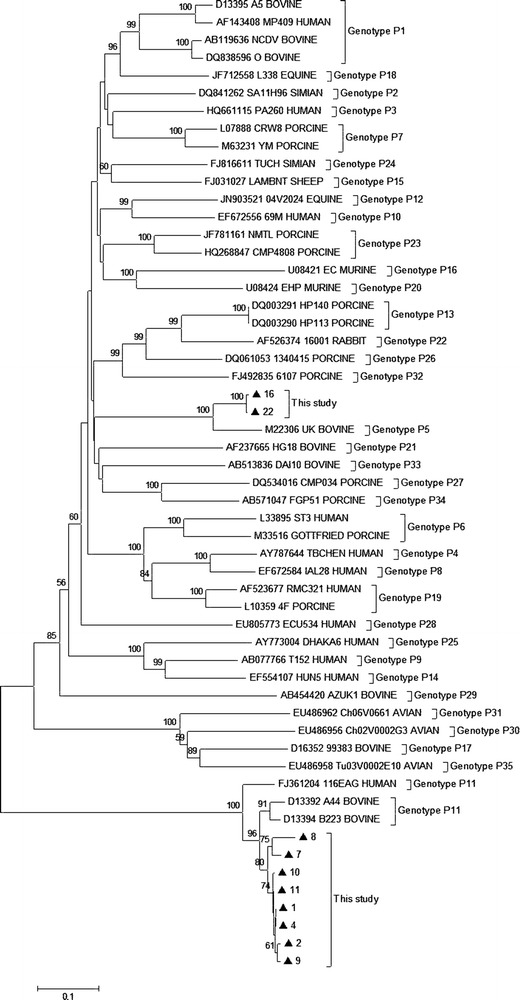
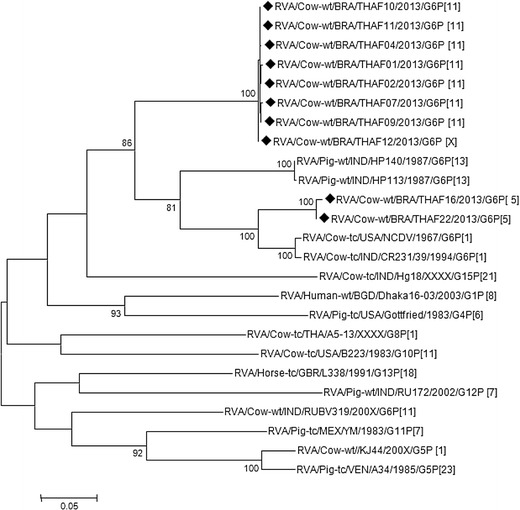
Reports of rotavirus excretion in calves usually result from cross-sectional studies, and in face of the conflicting results regarding protection of calves born to vaccinated dams against diarrhea, the aim of the present study was to evaluate rotavirus excretion in dairy calves born to vaccinated or unvaccinated dams, to identify the genotypes of bovine rotavirus group A (RVA) strains isolated from these animals as well as to investigate characteristics of the disease in naturally occurring circumstances throughout the first month of life. Five hundred fifty-two fecal samples were taken from 56 calves, 28 from each farm and, in the vaccinated herd, 11/281 samples (3.91%) taken from six different calves tested positive for RVA while in the unvaccinated herd, 3/271 samples (1.11%) taken from 3 different calves tested positive. The genotyping of the VP7 genes showed 91.2% nucleotide sequence identity to G6 genotype (NCDV strain), and for the VP4 gene, strains from the vaccinated herd were 96.6% related to B223 strain, while strains from the unvaccinated herd were 88% related to P[5] genotype (UK strain). Genotypes found in this study were G6P[11] in the vaccinated herd and G6P[5] in the unvaccinated herd. All calves infected with rotavirus presented an episode of diarrhea in the first month of life, and the discrepancy between the genotypes found in the commercial vaccine (G6P[1] and G10P[11]) and the rotavirus strains circulating in both vaccinated and unvaccinated herds show the importance of keeping constant surveillance in order to avoid potential causes of vaccination failure.
关于犊牛轮状病毒排泄情况的报告通常来自横断面研究,鉴于接种疫苗的母畜所生犊牛预防腹泻的结果相互矛盾,本研究的目的是评估接种或未接种疫苗的母畜所生奶牛犊的轮状病毒排泄情况,鉴定从这些动物中分离出的A组牛轮状病毒(RVA)毒株的基因型,并调查这些动物在出生后第一个月自然发病情况下的疾病特征。从56头犊牛采集了552份粪便样本,每个农场28份,在接种疫苗的牛群中,从6头不同的犊牛采集的11/281份样本(3.91%)RVA检测呈阳性,而在未接种疫苗的牛群中,从3头不同的犊牛采集的3/271份样本(1.11%)检测呈阳性。VP7基因的基因分型显示与G6基因型(NCDV毒株)的核苷酸序列同一性为91.2%,对于VP4基因,接种疫苗牛群的毒株与B223毒株的相关性为96.6%,而未接种疫苗牛群的毒株与P[5]基因型(英国毒株)的相关性为88%。本研究中发现的基因型在接种疫苗的牛群中为G6P[11],在未接种疫苗的牛群中为G6P[5]。所有感染轮状病毒的犊牛在出生后第一个月都出现了腹泻症状,商业疫苗中发现的基因型(G6P[1]和G10P[11])与接种和未接种疫苗牛群中传播的轮状病毒毒株之间的差异表明持续监测的重要性,以避免潜在的疫苗接种失败原因。