College of Life Science, Yan'an University, Yan'an, Shaanxi, 716000, China.
Institute of Soil and Water Conservation, Chinese Academy of Sciences and Ministry of Water Resources, Yangling, Shaanxi, 712100, China.
Sci Rep. 2017 Mar 23;7(1):350. doi: 10.1038/s41598-017-00373-8.
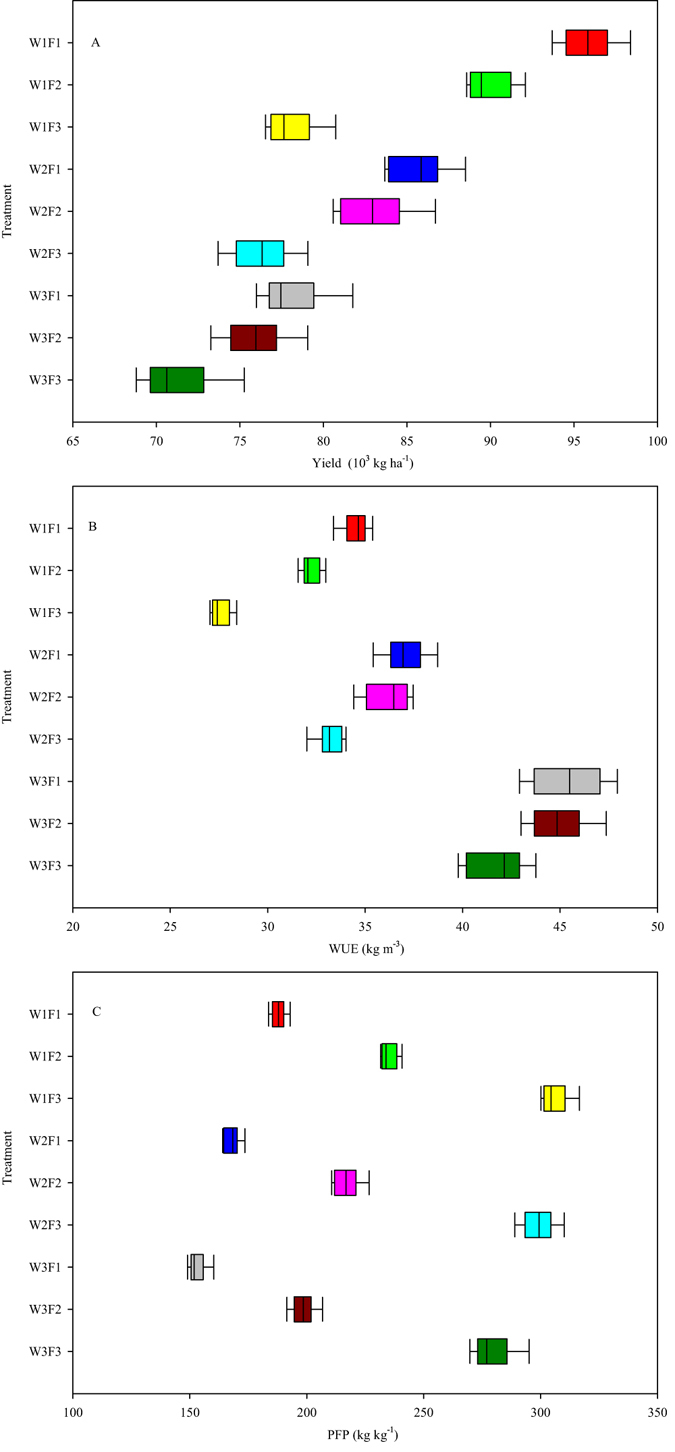
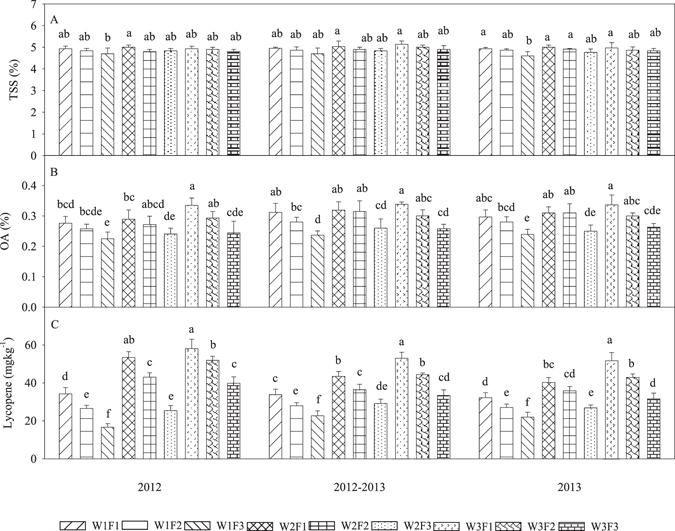
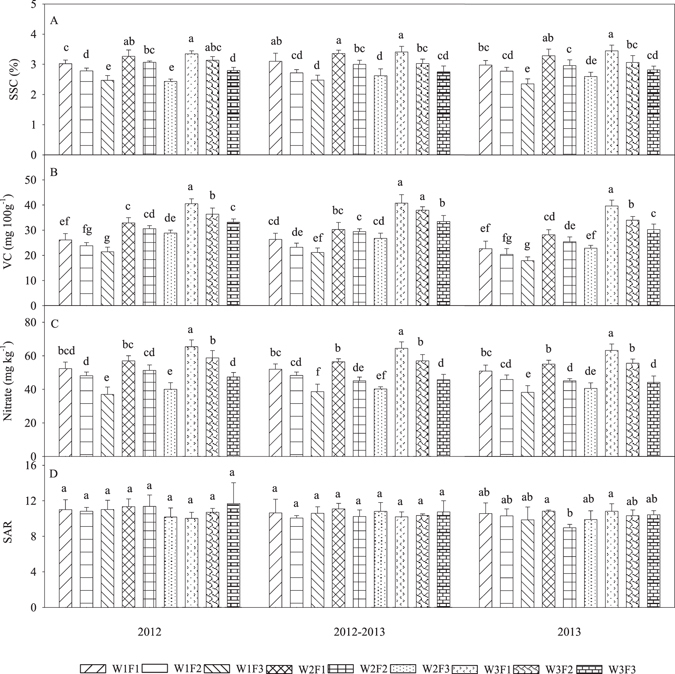
Irrigation and fertilization are key practices for improving the fruit quality and yield of vegetables grown in greenhouses. We carried out an experiment in a solar greenhouse spanning three consecutive growing seasons to evaluate the effects of irrigation and fertilization on the fruit yield and quality, water use efficiency (WUE) and fertilizer partial factor productivity (PFP) of tomatoes. Interactions between irrigation and fertilization treatments and individual factors of irrigation and fertilization significantly (p < 0.01) affected fruit yield, WUE and PFP. WUE and fruit yield and quality were more sensitive to changes in irrigation than to changes in fertilizer, but PFP showed the opposite trend. Interestingly, the treatment with moderate irrigation (W2: 75% ET ) and high fertilizer level (F1: 240N-120PO-150KO kg ha) was twice ranked first after a combinational evaluation. In conclusion, the proper application of drip fertigation (W2F1) may be a good compromise for solar greenhouse-grown tomatoes with regard to fruit yield and quality, WUE, and PFP. The present study sheds light on the contributions of these practices, clarifies their impacts, and provides a basis for evaluating and selecting better management practices for growing greenhouse vegetables.
灌溉和施肥是提高温室蔬菜果实品质和产量的关键措施。我们在一个太阳能温室中进行了为期三个连续生长季节的实验,以评估灌溉和施肥对番茄果实产量和品质、水分利用效率(WUE)和肥料偏生产力(PFP)的影响。灌溉和施肥处理以及灌溉和施肥的个别因素之间的相互作用显著(p < 0.01)影响了果实产量、WUE 和 PFP。WUE 和果实产量与品质对灌溉的变化比肥料更敏感,但 PFP 则呈现相反的趋势。有趣的是,中度灌溉(W2:75%ET)和高肥料水平(F1:240N-120PO-150KO kg ha)的处理在综合评价后两次排名第一。总之,滴灌施肥(W2F1)的适当应用可能是太阳能温室种植番茄在果实产量和品质、WUE 和 PFP 方面的一个很好的折衷方案。本研究阐明了这些措施的贡献,明确了它们的影响,并为评估和选择更好的温室蔬菜管理措施提供了依据。