Takayasu Lena, Suda Wataru, Takanashi Kageyasu, Iioka Erica, Kurokawa Rina, Shindo Chie, Hattori Yasue, Yamashita Naoko, Nishijima Suguru, Oshima Kenshiro, Hattori Masahira
Laboratory of Metagenomics, Department of Computational Biology and Medical Science, Graduate School of Frontier Sciences, The University of Tokyo, 5-1-5, Kashiwanoha, Kashiwa, Chiba 277-8561, Japan.
Department of Microbiology and Immunology, School of Medicine, Keio University, 35 Shinanomachi, Shinjuku-ku, Tokyo 160-8582, Japan.
DNA Res. 2017 Jun 1;24(3):261-270. doi: 10.1093/dnares/dsx001.
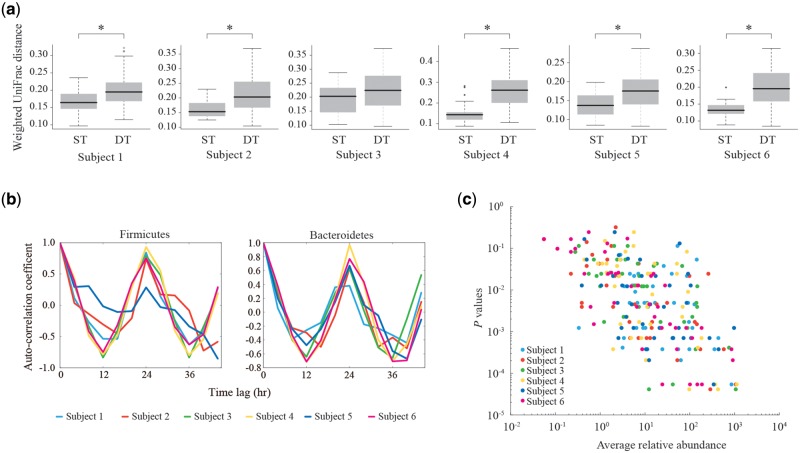
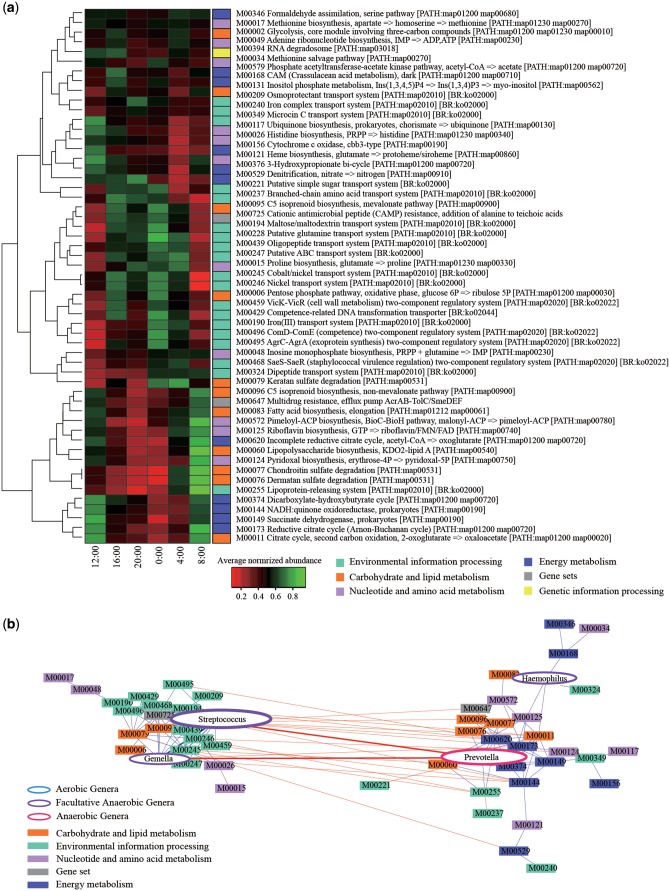
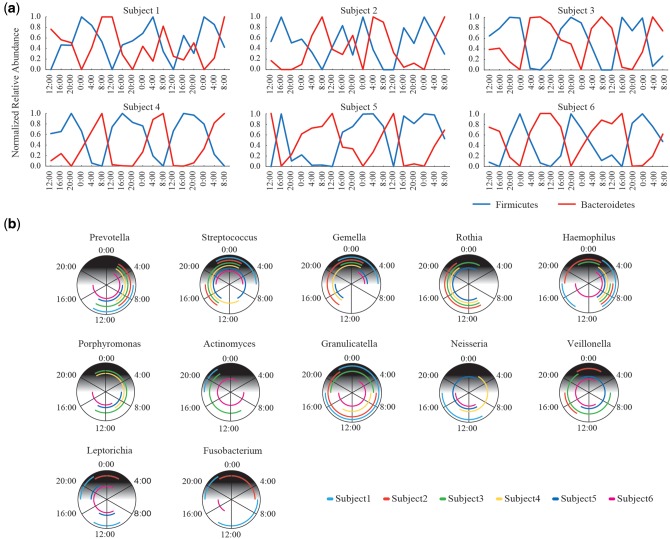
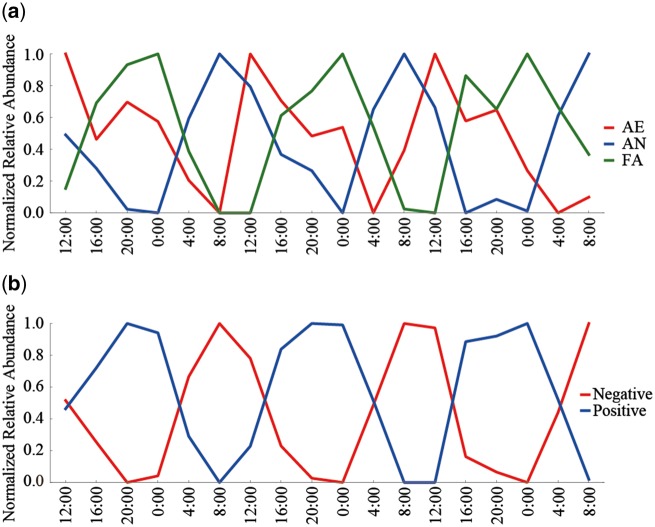
The human microbiomes across the body evidently interact with various signals in response to biogeographical physiological conditions. To understand such interactions in detail, we investigated how the salivary microbiome in the oral cavity would be regulated by host-related signals. Here, we show that the microbial abundance and gene participating in keeping the human salivary microbiome exhibit global circadian rhythm. Analysis of the 16S rRNA sequences of salivary microbial samples of six healthy adults collected at 4-h intervals for three days revealed that the microbial genera accounting for 68.4-89.6% of the total abundance were observed to significantly oscillate with the periodicity of ∼24 h. These oscillation patterns showed high variations amongst individuals, and the extent of circadian variations in individuals was generally lower than that of interindividual variations. Of the microbial categories oscillated, those classified by aerobic/anaerobic growth and Gram staining, Firmicutes including Streptococcus and Gemella, and Bacteroidetes including Prevotella showed high association with the circadian oscillation. The circadian oscillation was completely abolished by incubating the saliva in vitro, suggesting that host's physiological changes mostly contributed to the microbial oscillation. Further metagenomic analysis showed that circadian oscillation enriched the functions of environmental responses such as various transporters and two-component regulatory systems in the evening, and those of metabolisms such as the biosynthesis of vitamins and fatty acids in the morning.
人体各部位的微生物群显然会根据生物地理生理条件与各种信号相互作用。为了详细了解这种相互作用,我们研究了口腔中的唾液微生物群如何受到宿主相关信号的调节。在这里,我们表明参与维持人类唾液微生物群的微生物丰度和基因呈现出整体昼夜节律。对六名健康成年人的唾液微生物样本进行为期三天、每隔4小时采集一次的16S rRNA序列分析发现,占总丰度68.4 - 89.6%的微生物属呈现出约24小时周期的显著振荡。这些振荡模式在个体间存在很大差异,个体内昼夜变化的程度通常低于个体间变化的程度。在发生振荡的微生物类别中,按需氧/厌氧生长和革兰氏染色分类的微生物、包括链球菌和孪生球菌的厚壁菌门,以及包括普雷沃菌属的拟杆菌门与昼夜振荡高度相关。通过体外培养唾液,昼夜振荡完全消失,这表明宿主的生理变化主要导致了微生物的振荡。进一步的宏基因组分析表明,昼夜振荡在夜间丰富了各种转运蛋白和双组分调节系统等环境响应功能,在早晨则丰富了维生素和脂肪酸生物合成等代谢功能。