Hilary Serene, Habib Hosam, Souka Usama, Ibrahim Wissam, Platat Carine
Nutrition and Health Department, College of Food and Agriculture, United Arab Emirates University, P. O. Box 15551, Al Ain, United Arab Emirates.
Alexandria University, 22 El-Guish Road, El-Shatby, Alexandria, 21526, Egypt.
BMC Complement Altern Med. 2017 Mar 29;17(1):177. doi: 10.1186/s12906-017-1664-9.
Antioxidant and anti-inflammatory properties of honey have been largely recognized by various studies. Almost all of the potential benefits are associated with polyphenol content. Honey varieties from the arid region are reported to be rich in polyphenols, but data related to its bioactivity in vitro is greatly lacking. This study aimed at establishing the antioxidant and anti-inflammatory properties of arid region honey. Four honey varieties from arid region (H1, H2, H3, and H4) and two popular non-arid region honey (H5 and H6) were tested in vitro in this study.
The erythrocyte membrane protection effect of honey varieties were measured by hemolysis assay after exposing erythrocytes to a peroxide generator. The subsequent production of MDA (malondialdehyde) content in erythrocytes was measured. Immunomodulatory effect of the honey varieties was tested in prostate cancer cells PC-3 and PBMC (peripheral blood mononuclear cells) by measuring the IL-6 (interleukin 6) and NO (nitric oxide) levels in cell culture supernatant after incubation with the honey varieties. PC-3 cell viability was assessed after incubation with honey varieties for 24 h.
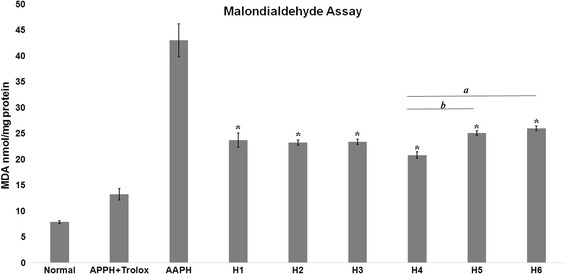
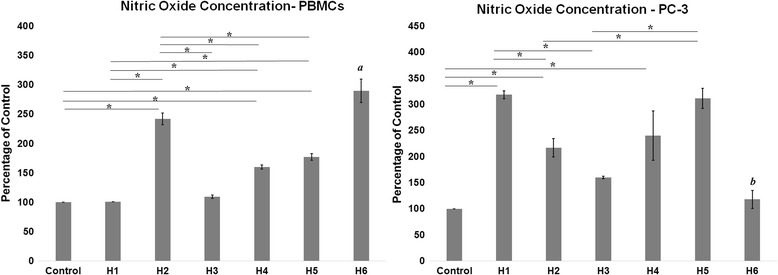
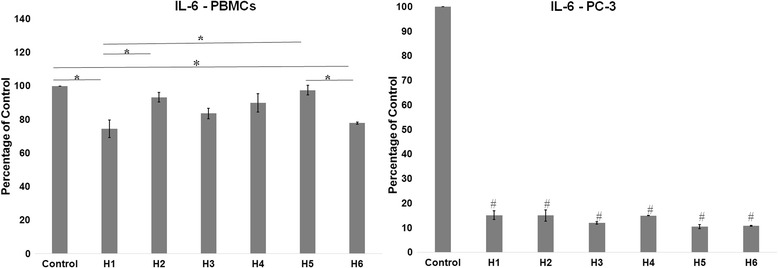
Arid region honey exhibited superior erythrocyte membrane protection effect with H4 measuring 1.3 ± 0.042mMTE/g and H2 measuring 1.122 ± 0.018mMTE/g. MDA levels were significantly reduced by honey samples, especially H4 (20.819 ± 0.63 nmol/mg protein). We observed a significant decrease in cell population in PC-3 after 24 h in culture on treatment with honey. A moderate increase in NO levels was observed in both cultures after 24 h at the same time levels of IL-6 were remarkably reduced by honey varieties.
The results demonstrate the antioxidant effect of arid region honey due to its erythrocyte membrane protection effect and subsequent lowering of oxidative damage as evident from lower levels of lipid peroxidation byproduct MDA. Arid region honey varieties were as good as non-arid region types at decreasing cell viability of prostate cancer cells. The moderate increase in NO levels in PC-3 and PBMCs were not significant enough to elicit any pro-inflammatory response. However, IL-6 secretion was remarkably reduced by all honey varieties in a comparable level indicating the potential anti-inflammatory property of arid region honey.
蜂蜜的抗氧化和抗炎特性已在多项研究中得到广泛认可。几乎所有潜在益处都与多酚含量有关。据报道,干旱地区的蜂蜜品种富含多酚,但关于其体外生物活性的数据却极为匮乏。本研究旨在确定干旱地区蜂蜜的抗氧化和抗炎特性。本研究对来自干旱地区的四个蜂蜜品种(H1、H2、H3和H4)以及两个常见的非干旱地区蜂蜜(H5和H6)进行了体外测试。
将红细胞暴露于过氧化物生成剂后,通过溶血试验测定蜂蜜品种对红细胞膜的保护作用。随后测量红细胞中丙二醛(MDA)含量的产生。通过测量与蜂蜜品种孵育后细胞培养上清液中的白细胞介素6(IL-6)和一氧化氮(NO)水平,在前列腺癌细胞PC-3和外周血单核细胞(PBMC)中测试蜂蜜品种的免疫调节作用。与蜂蜜品种孵育24小时后评估PC-3细胞活力。
干旱地区蜂蜜表现出优异的红细胞膜保护作用,H4为1.3±0.042mMTE/g,H2为1.122±0.018mMTE/g。蜂蜜样品显著降低了MDA水平,尤其是H4(20.819±0.63nmol/mg蛋白质)。我们观察到,用蜂蜜处理后,培养24小时的PC-3细胞数量显著减少。24小时后,两种培养物中的NO水平均适度升高,同时蜂蜜品种显著降低了IL-6水平。
结果表明,干旱地区蜂蜜具有抗氧化作用,这是由于其对红细胞膜的保护作用以及随后氧化损伤的降低,这从脂质过氧化副产物MDA水平较低可以明显看出。干旱地区蜂蜜品种在降低前列腺癌细胞活力方面与非干旱地区品种一样有效。PC-3和PBMC中NO水平的适度升高不足以引发任何促炎反应。然而,所有蜂蜜品种均显著降低了IL-6分泌,且降低程度相当,这表明干旱地区蜂蜜具有潜在的抗炎特性。