Kaur Charanpreet, Sharma Shweta, Hasan Mohammad Rokebul, Pareek Ashwani, Singla-Pareek Sneh L, Sopory Sudhir K
Stress Physiology and Molecular Biology Laboratory, School of Life Sciences, Jawaharlal Nehru University, New Delhi 110067, India.
Plant Stress Biology Group, International Centre for Genetic Engineering and Biotechnology, New Delhi 110067, India.
Int J Mol Sci. 2017 Mar 30;18(4):250. doi: 10.3390/ijms18040250.
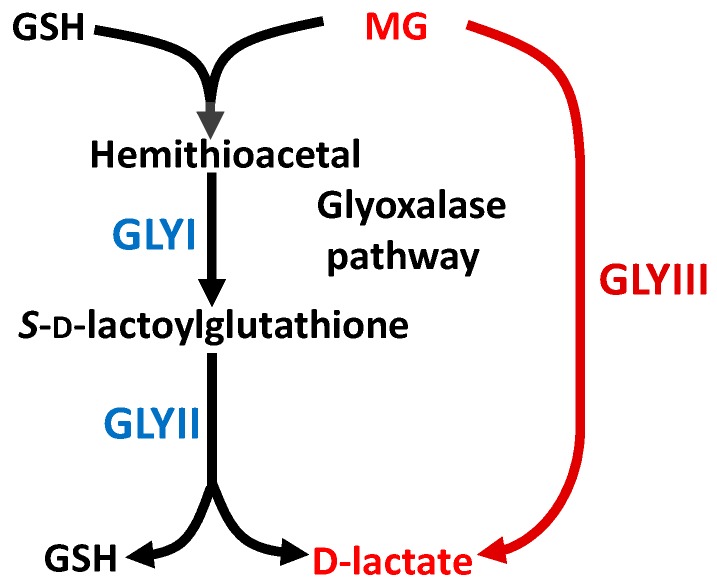
The glyoxalase system is the ubiquitous pathway for the detoxification of methylglyoxal (MG) in the biological systems. It comprises two enzymes, glyoxalase I (GLYI) and glyoxalase II (GLYII), which act sequentially to convert MG into d-lactate, thereby helping living systems get rid of this otherwise cytotoxic byproduct of metabolism. In addition, a glutathione-independent GLYIII enzyme activity also exists in the biological systems that can directly convert MG to d-lactate. Humans and possess a single copy of (encoding either the Ni- or Zn-dependent form) and genes, which through MG detoxification provide protection against various pathological and disease conditions. By contrast, the plant genome possesses multiple and genes with a role in abiotic stress tolerance. Plants possess both Ni- and Zn-dependent forms of GLYI, and studies on plant glyoxalases reveal the various unique features of these enzymes distinguishing them from prokaryotic and other eukaryotic glyoxalases. Through this review, we provide an overview of the plant glyoxalase family along with a comparative analysis of glyoxalases across various species, highlighting similarities as well as differences in the biochemical, molecular, and physiological properties of these enzymes. We believe that the evolution of multiple glyoxalases isoforms in plants is an important component of their robust defense strategies.
乙二醛酶系统是生物系统中普遍存在的甲基乙二醛(MG)解毒途径。它由两种酶组成,即乙二醛酶I(GLYI)和乙二醛酶II(GLYII),它们依次作用将MG转化为d-乳酸,从而帮助生物系统清除这种原本具有细胞毒性的代谢副产物。此外,生物系统中还存在一种不依赖谷胱甘肽的GLYIII酶活性,它可以直接将MG转化为d-乳酸。人类拥有单个拷贝的(编码镍或锌依赖性形式)和基因,通过MG解毒为抵御各种病理和疾病状况提供保护。相比之下,植物基因组拥有多个与非生物胁迫耐受性相关的和基因。植物拥有镍依赖性和锌依赖性两种形式的GLYI,对植物乙二醛酶的研究揭示了这些酶与原核生物和其他真核生物乙二醛酶不同的各种独特特征。通过本综述,我们概述了植物乙二醛酶家族,并对不同物种的乙二醛酶进行了比较分析,突出了这些酶在生化、分子和生理特性方面的异同。我们认为植物中多种乙二醛酶同工型的进化是其强大防御策略的重要组成部分。