
使用时域特征对同一上肢的三种虚拟状态进行分类。
Classifying three imaginary states of the same upper extremity using time-domain features.
作者信息
Tavakolan Mojgan, Frehlick Zack, Yong Xinyi, Menon Carlo
机构信息
Menrva Research Group, Schools of Mechatronic Systems Engineering and Engineering Science, Simon Fraser University, Burnaby, British Columbia, Canada.
出版信息
PLoS One. 2017 Mar 30;12(3):e0174161. doi: 10.1371/journal.pone.0174161. eCollection 2017.
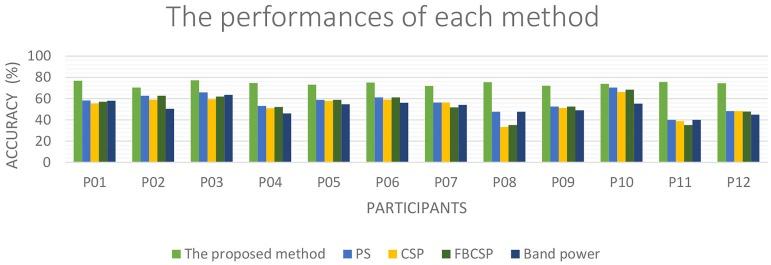
Brain-computer interface (BCI) allows collaboration between humans and machines. It translates the electrical activity of the brain to understandable commands to operate a machine or a device. In this study, we propose a method to improve the accuracy of a 3-class BCI using electroencephalographic (EEG) signals. This BCI discriminates rest against imaginary grasps and elbow movements of the same limb. This classification task is challenging because imaginary movements within the same limb have close spatial representations on the motor cortex area. The proposed method extracts time-domain features and classifies them using a support vector machine (SVM) with a radial basis kernel function (RBF). An average accuracy of 74.2% was obtained when using the proposed method on a dataset collected, prior to this study, from 12 healthy individuals. This accuracy was higher than that obtained when other widely used methods, such as common spatial patterns (CSP), filter bank CSP (FBCSP), and band power methods, were used on the same dataset. These results are encouraging and the proposed method could potentially be used in future applications including BCI-driven robotic devices, such as a portable exoskeleton for the arm, to assist individuals with impaired upper extremity functions in performing daily tasks.
脑机接口(BCI)实现了人与机器之间的协作。它将大脑的电活动转化为可理解的命令,以操作机器或设备。在本研究中,我们提出了一种利用脑电图(EEG)信号提高三类BCI准确性的方法。该BCI区分静息状态与同一肢体的想象抓握和肘部运动。这项分类任务具有挑战性,因为同一肢体的想象运动在运动皮层区域具有相近的空间表征。所提出的方法提取时域特征,并使用具有径向基核函数(RBF)的支持向量机(SVM)对其进行分类。在本研究之前从12名健康个体收集的数据集上使用所提出的方法时,获得了74.2%的平均准确率。该准确率高于在同一数据集上使用其他广泛使用的方法(如共同空间模式(CSP)、滤波器组CSP(FBCSP)和带功率方法)时所获得的准确率。这些结果令人鼓舞,所提出的方法可能会在未来的应用中得到应用,包括由BCI驱动的机器人设备,如手臂便携式外骨骼,以帮助上肢功能受损的个体执行日常任务。



 Zotero 插件