Panfili Elisa, Esposito Susanna, Di Cara Giuseppe
Pediatric Clinic, Università degli Studi di Perugia, 06129 Perugia, Italy.
Int J Environ Res Public Health. 2017 Apr 14;14(4):421. doi: 10.3390/ijerph14040421.
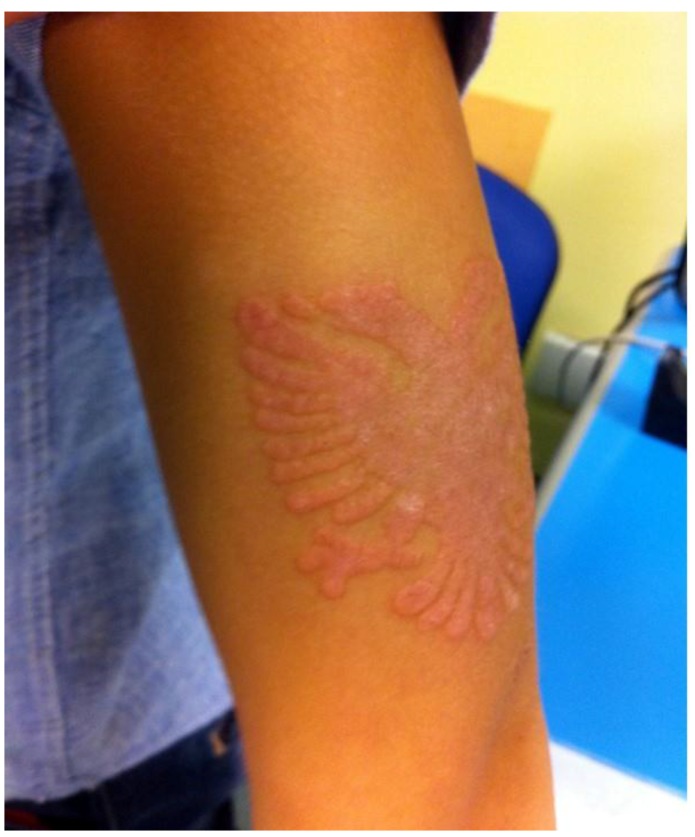
: The use of temporary henna tattoos has increased dramatically in recent years, especially in children and adolescents. To obtain a darker colour and prolong the life of the tattoo, red henna, a plant-derived substance, is typically added to -phenylenediamine (PPD). The mixture is called temporary black henna tattoo (TBHT). Because of its molecular characteristics, PPD can induce skin sensitization that may cause various clinical manifestations with successive exposures, among which the most common is allergic contact dermatitis (ACD). This report describes two paediatric cases of PPD sensitization and ACD after the exposure to TBHT and summarizes the literature on this emerging clinical problem. : We describe two cases of childhood-onset ACD that occurred 2 and 10 days, respectively, after the application of a TBHT during the summer holidays. Patch tests showed an evident positive response to 1% PPD in both cases. Sensitization to PPD occurred in the first case because a previous henna tattoo did not result in overt symptoms; in the second case, the reaction occurred after the same tattoo was retouched. In both cases, hypopigmentation persisted and both the patients and their families were advised to avoid further contact with PPD-containing materials and substances that could lead to cross-reactions. : Sensitization to PPD is a growing phenomenon in children. The most common cause appears to be exposure to TBHT in which PPD might be present at unknown or high concentrations. Once sensitization occurs, patients may experience severe clinical symptoms which can present with a persistent hypopigmentation when they are re-exposed to substances that contain or cross-react with PPD. Given the widespread use of PPD, TBHT could adversely affect the daily life of paediatric patients; thus, for this reason, this practice as a fashion accessory must be discouraged. In addition, it is extremely important to provide scientific information on the risks of TBHT to consumers, especially to adolescents and to the parents of younger children to prevent PPD sensitization.
近年来,临时海娜纹身的使用急剧增加,尤其是在儿童和青少年中。为了获得更深的颜色并延长纹身的持续时间,通常会将一种植物来源的物质——红色海娜添加到对苯二胺(PPD)中。这种混合物被称为临时黑色海娜纹身(TBHT)。由于其分子特性,PPD可引起皮肤致敏,连续接触后可能导致各种临床表现,其中最常见的是过敏性接触性皮炎(ACD)。本报告描述了两例儿童在接触TBHT后发生PPD致敏和ACD的病例,并总结了关于这一新兴临床问题的文献。
我们描述了两例儿童期发生的ACD病例,分别在暑假期间涂抹TBHT后2天和10天出现。斑贴试验显示,两例患者对1%PPD均有明显阳性反应。第一例患者对PPD致敏是因为之前的海娜纹身未出现明显症状;第二例患者在同一次纹身修补后出现了反应。两例患者均持续存在色素减退,建议患者及其家属避免进一步接触含PPD的材料以及可能导致交叉反应的物质。
PPD致敏在儿童中是一个日益普遍的现象。最常见的原因似乎是接触TBHT,其中PPD可能以未知或高浓度存在。一旦发生致敏,患者再次接触含PPD或与PPD发生交叉反应的物质时,可能会出现严重的临床症状,并伴有持续性色素减退。鉴于PPD的广泛使用,TBHT可能会对儿科患者的日常生活产生不利影响;因此,必须不鼓励将这种做法作为一种时尚配饰。此外,向消费者,尤其是青少年和年幼儿童的家长提供关于TBHT风险的科学信息,以预防PPD致敏,这极其重要。