Roe Catherine M, Babulal Ganesh M, Head Denise M, Stout Sarah H, Vernon Elizabeth K, Ghoshal Nupur, Garland Brad, Barco Peggy P, Williams Monique M, Johnson Ann, Fierberg Rebecca, Fague M Scot, Xiong Chengjie, Mormino Elizabeth, Grant Elizabeth A, Holtzman David M, Benzinger Tammie L S, Fagan Anne M, Ott Brian R, Carr David B, Morris John C
Charles F. and Joanne Knight Alzheimer's Disease Research Center, Washington University School of Medicine.
Department of Neurology, Washington University School of Medicine.
Alzheimers Dement (N Y). 2017 Jan;3(1):74-82. doi: 10.1016/j.trci.2016.11.006.
Links between preclinical AD and driving difficulty onset would support the use of driving performance as an outcome in primary and secondary prevention trials among older adults (OAs). We examined whether AD biomarkers predicted the onset of driving difficulties among OAs.
104 OAs (65+ years) with normal cognition took part in biomarker measurements, a road test, clinical and psychometric batteries and self-reported their driving habits.
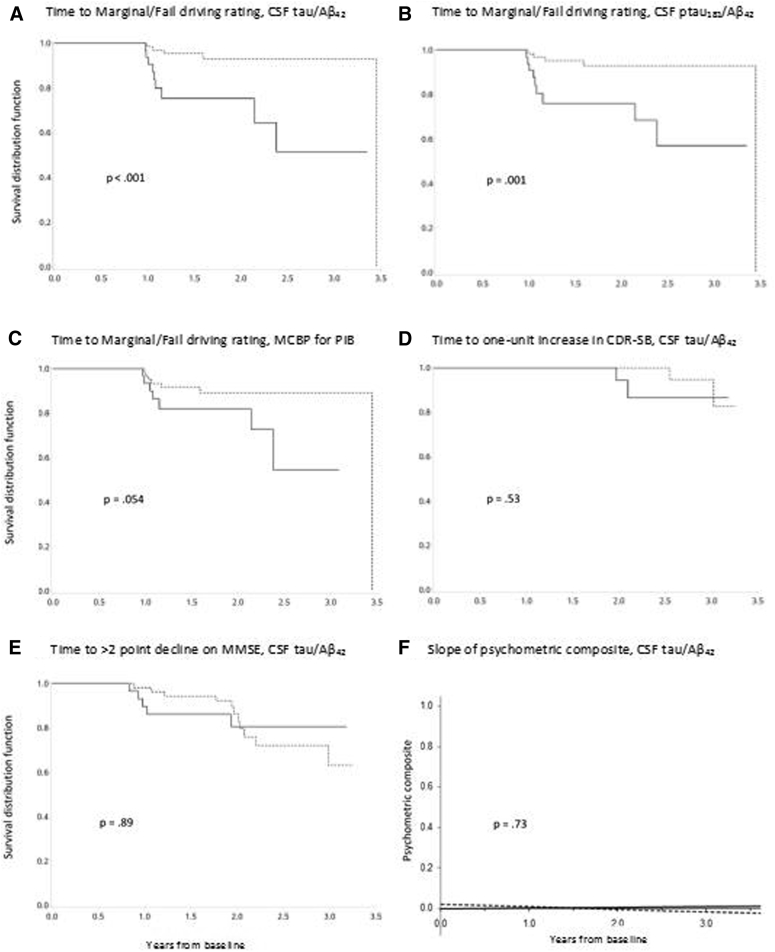
Higher values of CSF tau/Aβ and ptau/Aβ ratios, but not uptake on PIB amyloid imaging (p=.12), predicted time to a rating of Marginal or Fail on the driving test using Cox proportional hazards models. Hazards ratios (95% confidence interval) were 5.75 (1.70-19.53), p=.005 for CSF tau/Aβ; 6.19 (1.75-21.88) and p=.005 for CSF ptau/Aβ.
Preclinical AD predicted time to receiving a Marginal or Fail rating on an on-road driving test. Driving performance shows promise as a functional outcome in AD prevention trials.
临床前阿尔茨海默病(AD)与驾驶困难发作之间的联系将支持在老年人(OA)的一级和二级预防试验中使用驾驶性能作为一项结果指标。我们研究了AD生物标志物是否能预测OA中驾驶困难的发作。
104名认知正常的老年人(65岁及以上)参与了生物标志物测量、道路测试、临床和心理测量评估,并自我报告了他们的驾驶习惯。
使用Cox比例风险模型,脑脊液tau/Aβ和磷酸化tau/Aβ(ptau/Aβ)比值较高,但匹兹堡复合物B(PIB)淀粉样蛋白成像摄取情况并非如此(p = 0.12),可预测驾驶测试中获得“边缘”或“不合格”评级的时间。风险比(95%置信区间)对于脑脊液tau/Aβ为5.75(1.70 - 19.53),p = 0.005;对于脑脊液ptau/Aβ为6.19(1.75 - 21.88),p = 0.005。
临床前AD可预测在道路驾驶测试中获得“边缘”或“不合格”评级的时间。驾驶性能有望作为AD预防试验中的一项功能结果指标。