Sethi Sumit, Pedrini Mariana, Rizzo Lucas B, Zeni-Graiff Maiara, Mas Caroline Dal, Cassinelli Ana Cláudia, Noto Mariane N, Asevedo Elson, Cordeiro Quirino, Pontes João G M, Brasil Antonio J M, Lacerda Acioly, Hayashi Mirian A F, Poppi Ronei, Tasic Ljubica, Brietzke Elisa
Department of Psychiatry, Universidade Federal de São Paulo-UNIFESP, Rua Borges Lagoa, 570. Vila Clementino, São Paulo, CEP 04038-020, Brazil.
Department of Pharmacology, Universidade Federal de São Paulo-UNIFESP, Rua Três de Maio, 100. Vila Clementino, São Paulo, CEP 04044-020, Brazil.
Int J Bipolar Disord. 2017 Dec;5(1):23. doi: 10.1186/s40345-017-0088-2. Epub 2017 Jun 4.
The objective of this study was to identify molecular alterations in the human blood serum related to bipolar disorder, using nuclear magnetic resonance (NMR) spectroscopy and chemometrics.
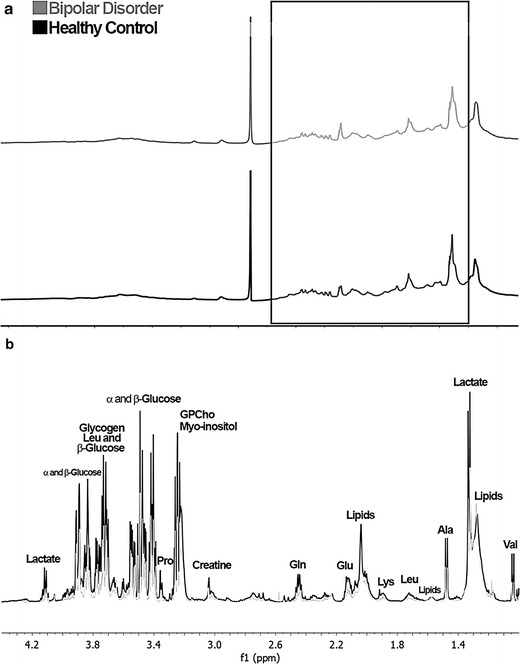
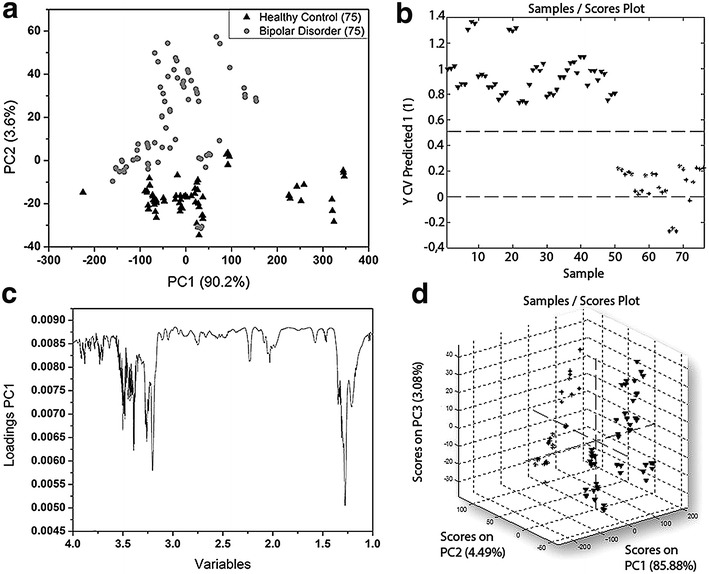
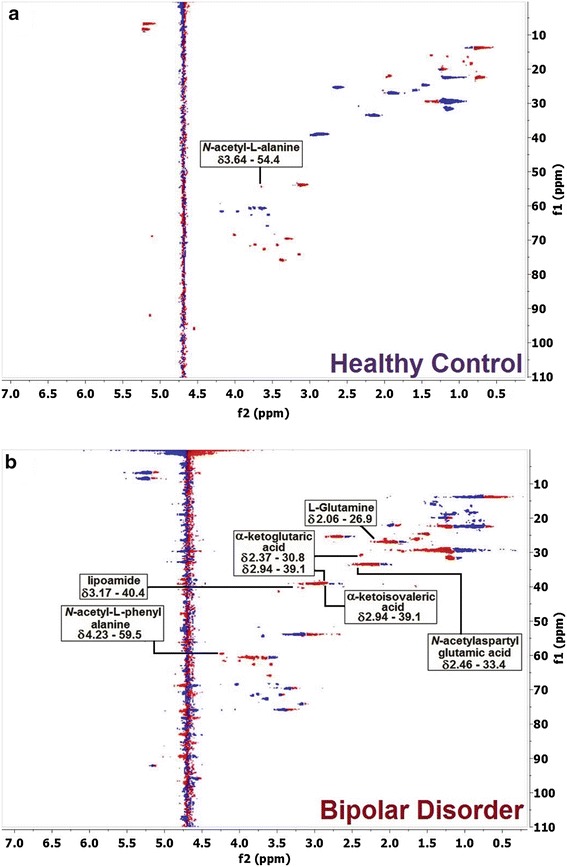
Metabolomic profiling, employing H-NMR, H-NMR T-edited, and 2D-NMR spectroscopy and chemometrics of human blood serum samples from patients with bipolar disorder (n = 26) compared with healthy volunteers (n = 50) was performed.
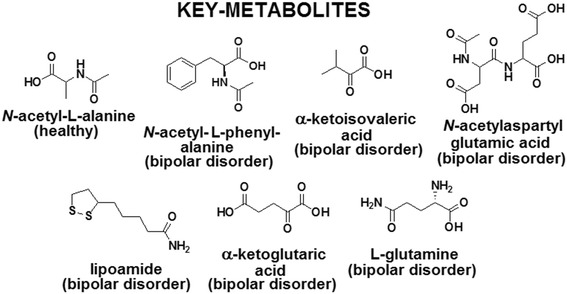
The investigated groups presented distinct metabolic profiles, in which the main differential metabolites found in the serum sample of bipolar disorder patients compared with those from controls were lipids, lipid metabolism-related molecules (choline, myo-inositol), and some amino acids (N-acetyl-L-phenyl alanine, N-acetyl-L-aspartyl-L-glutamic acid, L-glutamine). In addition, amygdalin, α-ketoglutaric acid, and lipoamide, among other compounds, were also present or were significantly altered in the serum of bipolar disorder patients. The data presented herein suggest that some of these metabolites differentially distributed between the groups studied may be directly related to the bipolar disorder pathophysiology.
The strategy employed here showed significant potential for exploring pathophysiological features and molecular pathways involved in bipolar disorder. Thus, our findings may contribute to pave the way for future studies aiming at identifying important potential biomarkers for bipolar disorder diagnosis or progression follow-up.
本研究的目的是利用核磁共振(NMR)光谱法和化学计量学来识别与双相情感障碍相关的人血清中的分子改变。
对双相情感障碍患者(n = 26)和健康志愿者(n = 50)的人血清样本进行代谢组学分析,采用氢核磁共振(H-NMR)、氢核磁共振T编辑和二维核磁共振光谱法以及化学计量学。
研究组呈现出不同的代谢谱,与对照组相比,双相情感障碍患者血清样本中发现的主要差异代谢物为脂质、脂质代谢相关分子(胆碱、肌醇)和一些氨基酸(N-乙酰-L-苯丙氨酸、N-乙酰-L-天冬氨酰-L-谷氨酸、L-谷氨酰胺)。此外,苦杏仁苷、α-酮戊二酸和硫辛酸等其他化合物在双相情感障碍患者血清中也存在或有显著改变。本文所呈现的数据表明,这些在研究组之间差异分布的代谢物中的一些可能与双相情感障碍的病理生理学直接相关。
这里采用的策略在探索双相情感障碍涉及的病理生理特征和分子途径方面显示出巨大潜力。因此,我们的发现可能有助于为未来旨在识别双相情感障碍诊断或病情进展随访的重要潜在生物标志物的研究铺平道路。