Correa-Burrows Paulina, Rodríguez Yanina, Blanco Estela, Gahagan Sheila, Burrows Raquel
Institute of Nutrition and Food Technology, University of Chile, Santiago 7830490, Chile.
Division of Child Development and Community Health, University of California, San Diego, CA 92093, USA.
Nutrients. 2017 Apr 27;9(5):433. doi: 10.3390/nu9050433.
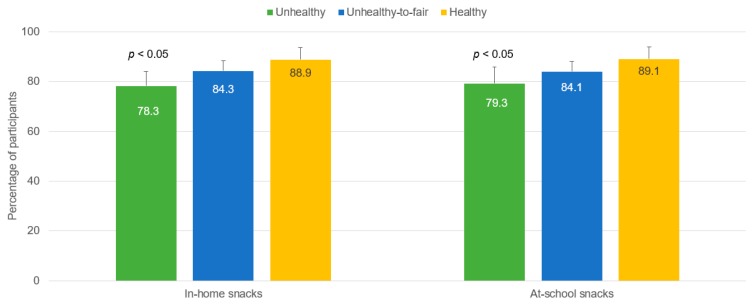
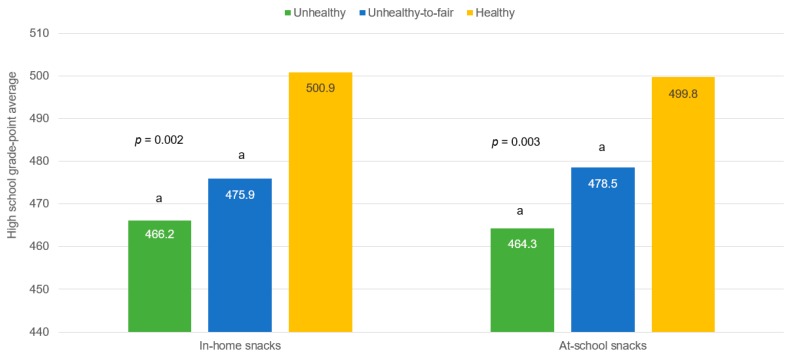
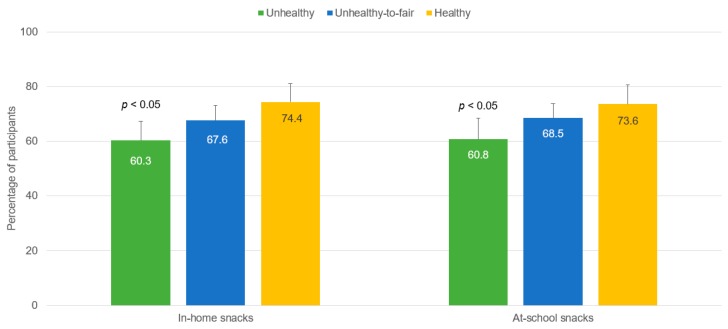
Although numerous studies have approached the effects of exposure to a Western diet (WD) on academic outcomes, very few have focused on foods consumed during snack times. We explored whether there is a link between nutritious snacking habits and academic achievement in high school (HS) students from Santiago, Chile. We conducted a cross-sectional study with 678 adolescents. The nutritional quality of snacks consumed by 16-year-old was assessed using a validated food frequency questionnaire. The academic outcomes measured were HS grade point average (GPA), the likelihood of HS completion, and the likelihood of taking college entrance exams. A multivariate analysis was performed to determine the independent associations of nutritious snacking with having completed HS and having taken college entrance exams. An analysis of covariance (ANCOVA) estimated the differences in GPA by the quality of snacks. Compared to students with healthy in-home snacking behaviors, adolescents having unhealthy in-home snacks had significantly lower GPAs ( difference: -40.1 points, 95% confidence interval (CI): -59.2, -16.9, = 0.41), significantly lower odds of HS completion (adjusted odds ratio (aOR): 0.47; 95% CI: 0.25-0.88), and significantly lower odds of taking college entrance exams (aOR: 0.53; 95% CI: 0.31-0.88). Unhealthy at-school snacking showed similar associations with the outcome variables. Poor nutritional quality snacking at school and at home was associated with poor secondary school academic achievement and the intention to enroll in higher education.
尽管众多研究探讨了西方饮食(WD)对学业成绩的影响,但很少有研究关注零食时间所吃的食物。我们探究了智利圣地亚哥高中生的营养零食习惯与学业成绩之间是否存在关联。我们对678名青少年进行了一项横断面研究。使用经过验证的食物频率问卷评估了16岁青少年所吃零食的营养质量。所测量的学业成绩指标包括高中平均绩点(GPA)、高中毕业的可能性以及参加大学入学考试的可能性。进行了多变量分析以确定营养零食与完成高中学业和参加大学入学考试之间的独立关联。协方差分析(ANCOVA)根据零食质量估计了GPA的差异。与有健康家庭零食行为的学生相比,有不健康家庭零食的青少年GPA显著更低(差异:-40.1分,95%置信区间(CI):-59.2,-16.9,P = 0.41),高中毕业的可能性显著更低(调整后的优势比(aOR):0.47;95% CI:0.25 - 0.88),参加大学入学考试的可能性也显著更低(aOR:0.53;95% CI:0.31 - 0.88)。在校不健康吃零食与结果变量显示出类似的关联。在学校和家里吃营养质量差的零食与中学学业成绩差以及接受高等教育的意愿有关。