Arens M, Dilworth V
Department of Pediatrics/Adolescent Medicine, St. Louis University Medical School, Missouri 63104.
J Clin Microbiol. 1988 Aug;26(8):1604-8. doi: 10.1128/jcm.26.8.1604-1608.1988.
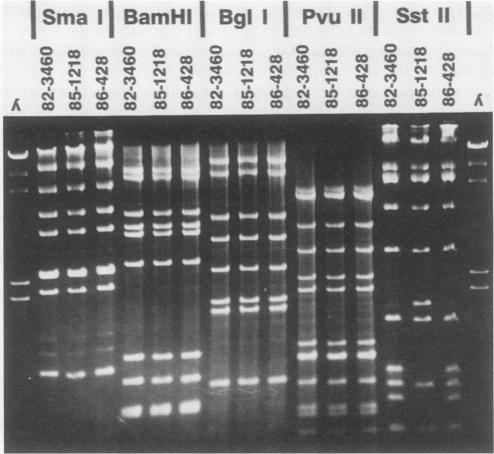
A total of 270 frozen adenovirus isolates, obtained from January 1981 to December 1986, were grown in KB cells. DNA was successfully prepared from 248 of these isolates, and the prepared DNA was digested initially with SmaI restriction endonuclease and then analyzed by agarose gel electrophoresis. Restriction fragment patterns showed that 68 of these DNAs were either adenovirus type 3 (Ad3) or Ad7. Further analysis by digestion with BamHI showed that 24 isolates were Ad3a and 44 isolates were Ad7b. When Ad3 isolates were digested with SmaI or PstI, the restriction fragment patterns of the 24 isolates were identical. Of these 24 isolates, 20 (83%) also gave identical patterns when digested with HindIII, and the patterns of the remaining 4 isolates were different from that of the 20 but identical to each other. All Ad3 isolates were obtained in 1982, 1983, and 1986. All the 44 Ad7b isolates gave identical fragment patterns when digested with BglI or PvuII, and 43 of 44 (98%) isolates gave identical patterns when digested with SstII. We obtained at least two Ad7 isolates during each of the 6 years studied. Although considerable genome heterogeneity within adenovirus serotypes and subtypes has been reported, our population of isolates is remarkably homogeneous. This homogeneous set of genome types was obtained from diverse anatomical sites and was associated with a broad spectrum of clinical syndromes.
1981年1月至1986年12月期间获得的总共270株冷冻腺病毒分离株在KB细胞中培养。成功从其中248株分离株中制备了DNA,制备的DNA首先用SmaI限制性内切酶消化,然后通过琼脂糖凝胶电泳进行分析。限制性片段模式显示,这些DNA中有68株是3型腺病毒(Ad3)或7型腺病毒(Ad7)。用BamHI消化进一步分析表明,24株分离株是Ad3a,44株分离株是Ad7b。当用SmaI或PstI消化Ad3分离株时,24株分离株的限制性片段模式相同。在这24株分离株中,20株(83%)用HindIII消化时也给出相同的模式,其余4株的模式与20株不同,但彼此相同。所有Ad3分离株均在1982年、1983年和1986年获得。所有44株Ad7b分离株用BglI或PvuII消化时给出相同的片段模式,44株中的43株(98%)用SstII消化时给出相同的模式。在研究的6年中的每一年我们都至少获得了两株Ad7分离株。尽管已经报道了腺病毒血清型和亚型内存在相当大的基因组异质性,但我们的分离株群体非常均匀。这组均匀的基因组类型是从不同的解剖部位获得的,并且与广泛的临床综合征相关。