Cerri Carlos Eduardo Pellegrino, You Xin, Cherubin Maurício Roberto, Moreira Cindy Silva, Raucci Guilherme Silva, Castigioni Bruno de Almeida, Alves Priscila Aparecida, Cerri Domingos Guilherme Pellegrino, Mello Francisco Fujita de Castro, Cerri Carlos Clemente
University of São Paulo, "Luiz de Queiroz" College of Agriculture, Department of Soil Science, 11 Pádua Dias Avenue, Piracicaba, SP, Brazil.
University of Hohenheim, Faculty of Agricultural Sciences, Institute of Soil Science and Land Evaluation (310), Stuttgart, Germany.
PLoS One. 2017 May 11;12(5):e0176948. doi: 10.1371/journal.pone.0176948. eCollection 2017.
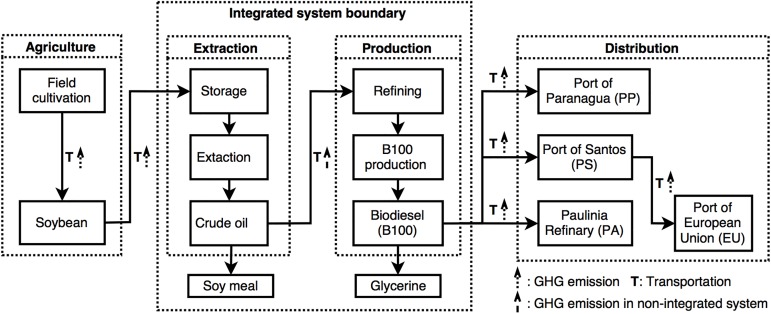
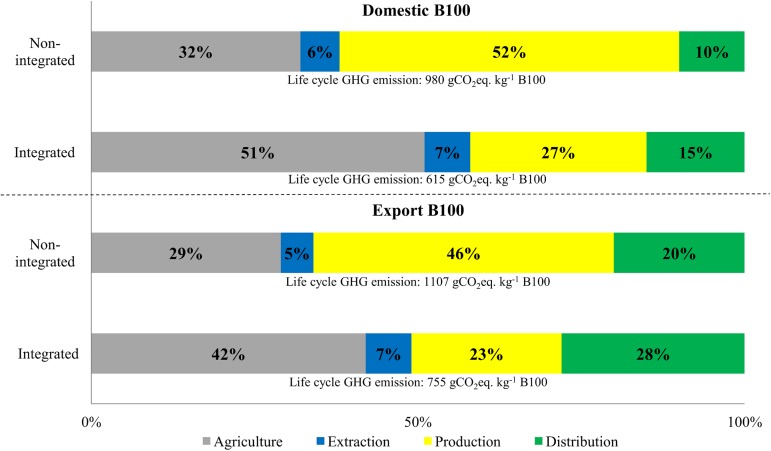
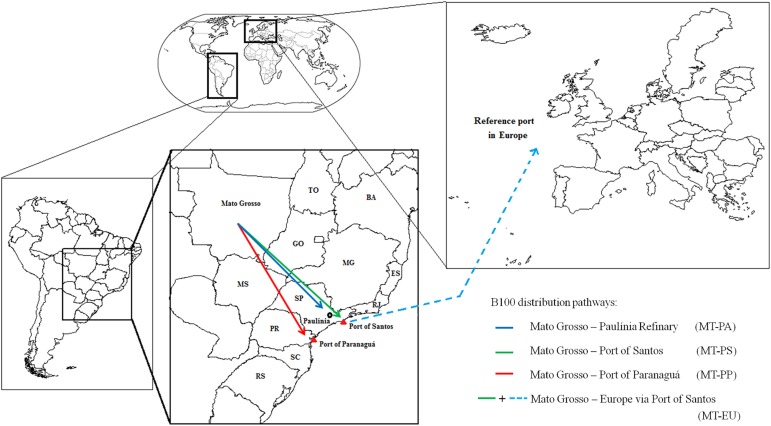
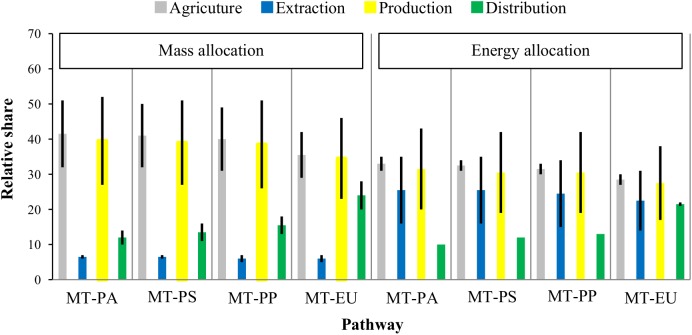
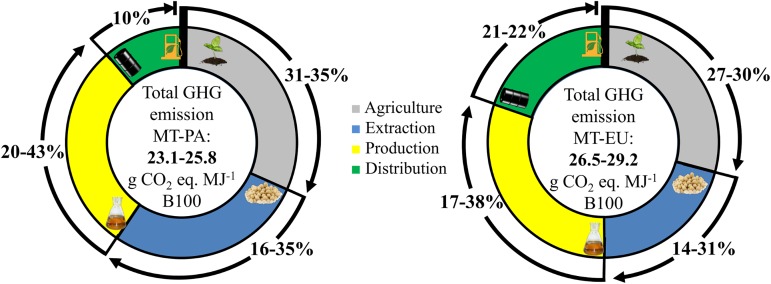
Soybean biodiesel (B100) has been playing an important role in Brazilian energy matrix towards the national bio-based economy. Greenhouse gas (GHG) emissions is the most widely used indicator for assessing the environmental sustainability of biodiesels and received particular attention among decision makers in business and politics, as well as consumers. Former studies have been mainly focused on the GHG emissions from the soybean cultivation, excluding other stages of the biodiesel production. Here, we present a holistic view of the total GHG emissions in four life cycle stages for soybean biodiesel. The aim of this study was to assess the GHG emissions of Brazilian soybean biodiesel production system with an integrated life cycle approach of four stages: agriculture, extraction, production and distribution. Allocation of mass and energy was applied and special attention was paid to the integrated and non-integrated industrial production chain. The results indicated that the largest source of GHG emissions, among four life cycle stages, is the agricultural stage (42-51%) for B100 produced in integrated systems and the production stage (46-52%) for B100 produced in non-integrated systems. Integration of industrial units resulted in significant reduction in life cycle GHG emissions. Without the consideration of LUC and assuming biogenic CO2 emissions is carbon neutral in our study, the calculated life cycle GHG emissions for domestic soybean biodiesel varied from 23.1 to 25.8 gCO2eq. MJ-1 B100 and those for soybean biodiesel exported to EU ranged from 26.5 to 29.2 gCO2eq. MJ-1 B100, which represent reductions by 65% up to 72% (depending on the delivery route) of GHG emissions compared with the EU benchmark for diesel fuel. Our findings from a life cycle perspective contributed to identify the major GHG sources in Brazilian soybean biodiesel production system and they can be used to guide mitigation priority for policy and decision-making. Projected scenarios in this study would be taken as references for accounting the environmental sustainability of soybean biodiesel within a domestic and global level.
大豆生物柴油(B100)在巴西能源体系迈向国家生物基经济的进程中发挥着重要作用。温室气体(GHG)排放是评估生物柴油环境可持续性时使用最为广泛的指标,受到了商业和政治领域的决策者以及消费者的特别关注。以往的研究主要集中在大豆种植过程中的温室气体排放,而未考虑生物柴油生产的其他阶段。在此,我们展示了大豆生物柴油四个生命周期阶段的温室气体总排放量的整体情况。本研究的目的是采用涵盖农业、提取、生产和分销四个阶段的综合生命周期方法,评估巴西大豆生物柴油生产系统的温室气体排放。应用了质量和能量分配方法,并特别关注了一体化和非一体化工业生产链。结果表明,在四个生命周期阶段中,一体化系统生产的B100的温室气体排放最大来源是农业阶段(42 - 51%),非一体化系统生产的B100的温室气体排放最大来源是生产阶段(46 - 52%)。工业单位的整合显著降低了生命周期的温室气体排放。在本研究中,不考虑土地利用变化(LUC)并假设生物源二氧化碳排放是碳中性的情况下,计算得出的国内大豆生物柴油的生命周期温室气体排放量为23.1至25.8 gCO₂eq.MJ⁻¹ B100,出口到欧盟的大豆生物柴油的生命周期温室气体排放量为26.5至29.2 gCO₂eq.MJ⁻¹ B100,与欧盟柴油燃料基准相比,温室气体排放量减少了65%至72%(取决于运输路线)。我们从生命周期角度得出的研究结果有助于确定巴西大豆生物柴油生产系统中的主要温室气体来源,并可用于指导政策和决策制定中的减排重点。本研究中的预测情景将作为在国内和全球层面核算大豆生物柴油环境可持续性的参考。