Life Sciences Institute, ‡Department of Medicinal Chemistry, §Department of Chemistry, and ∥Department of Microbiology & Immunology, University of Michigan , Ann Arbor, Michigan 48109, United States.
J Am Chem Soc. 2017 Jun 14;139(23):7913-7920. doi: 10.1021/jacs.7b02875. Epub 2017 Jun 5.
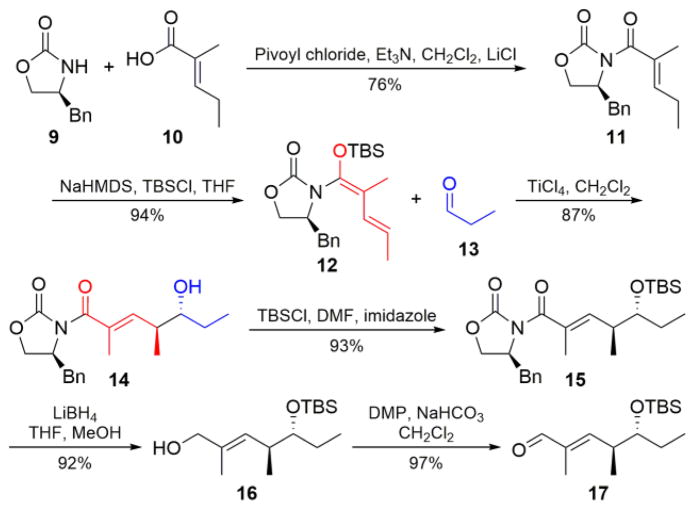
Polyketide synthases (PKSs) represent a powerful catalytic platform capable of effecting multiple carbon-carbon bond forming reactions and oxidation state adjustments. We explored the functionality of two terminal PKS modules that produce the 16-membered tylosin macrocycle, using them as biocatalysts in the chemoenzymatic synthesis of tylactone and its subsequent elaboration to complete the first total synthesis of the juvenimicin, M-4365, and rosamicin classes of macrolide antibiotics via late-stage diversification. Synthetic chemistry was employed to generate the tylactone hexaketide chain elongation intermediate that was accepted by the juvenimicin (Juv) ketosynthase of the penultimate JuvEIV PKS module. The hexaketide is processed through two complete modules (JuvEIV and JuvEV) in vitro, which catalyze elongation and functionalization of two ketide units followed by cyclization of the resulting octaketide into tylactone. After macrolactonization, a combination of in vivo glycosylation, selective in vitro cytochrome P450-mediated oxidation, and chemical oxidation was used to complete the scalable construction of a series of macrolide natural products in as few as 15 linear steps (21 total) with an overall yield of 4.6%.
聚酮合酶(PKSs)代表了一种强大的催化平台,能够进行多种碳-碳键形成反应和氧化态调整。我们探索了产生 16 元泰乐菌素大环的两个末端 PKS 模块的功能,将它们用作泰乐内酯及其随后的化学酶促合成的生物催化剂,以通过晚期多样化完成 juvenimicin、M-4365 和 rosamicin 类大环内酯抗生素的首次全合成。合成化学被用于生成泰乐内酯六酮肽链延伸中间体,该中间体被最后一个 JuvEIV PKS 模块的 juvenimicin(Juv)酮合酶接受。该六酮肽在体外通过两个完整的模块(JuvEIV 和 JuvEV)进行处理,该两个模块催化两个酮基单元的延伸和官能化,然后将所得的八酮肽环化成泰乐内酯。大环内酯化后,通过体内糖基化、选择性体外细胞色素 P450 介导的氧化和化学氧化的组合,在 15 个线性步骤(总共 21 步)内以 4.6%的总收率完成了一系列大环内酯天然产物的可扩展构建。