Liu Zunpeng, Yuan Xue, Fernandes Gabriela, Dziak Rosemary, Ionita Ciprian N, Li Chunyi, Wang Changdong, Yang Shuying
Department of Oral Biology, School of Dental Medicine, University of Buffalo, The State University of New York, Buffalo, NY, USA.
Department of Orthopedics, Fourth Affiliated Hospital, China Medical University, Shenyang, China.
Stem Cell Res Ther. 2017 May 25;8(1):122. doi: 10.1186/s13287-017-0574-6.
Mesenchymal stem cells (MSCs) can be differentiated into an osteoblastic lineage in the presence of growth factors (GFs). Platelet-rich plasma (PRP), which can be easily isolated from whole blood, contains a large amount of GFs, and, therefore, promotes bone growth and regeneration. The main goal of this work was to develop and investigate the effect of a new sandwich-like bone scaffold which combines a nano-calcium sulfate (nCS) disc along with PRP fibrin gel (nCS/PRP) with BMP2-modified MSCs on bone repair and regeneration in rat critical-sized calvarial defects.
We evaluated the cytotoxicity, osteogenic differentiation and mineralization effect of PRP extract on BMP2-modified MSCs and constructed a sandwich-like nCS/PRP scaffold (mimicking the nano-calcium matrix of bone and carrying multi GFs in the PRP) containing BMP2-modified MSCs. The capacity of this multifunctional bone regeneration system in promoting bone repair was assessed in vivo in a rat critical-sized (8 mm) calvarial bone defect model.
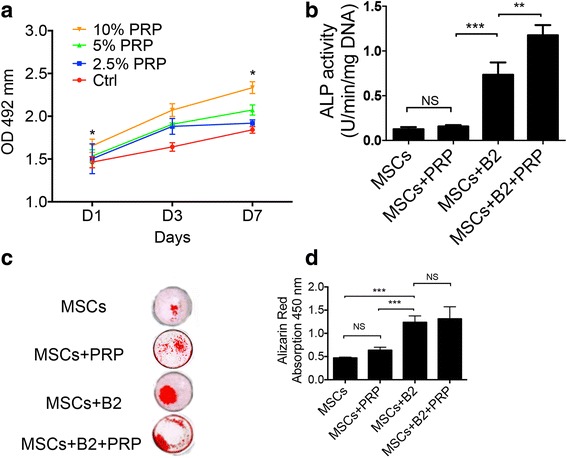
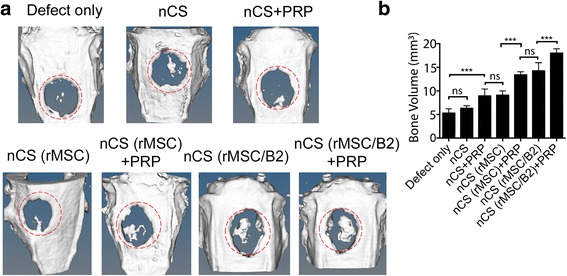
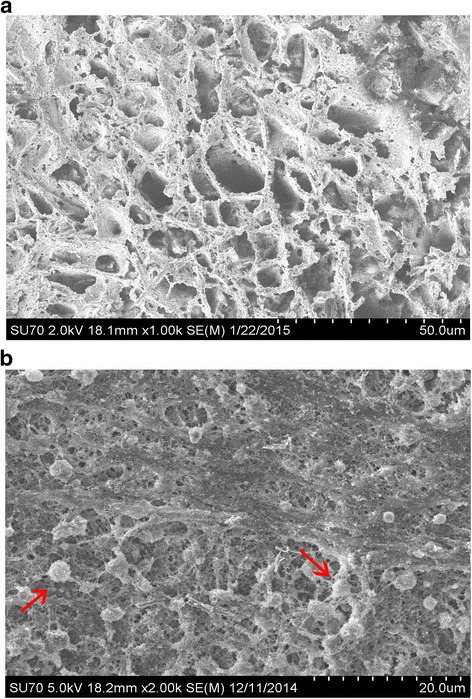
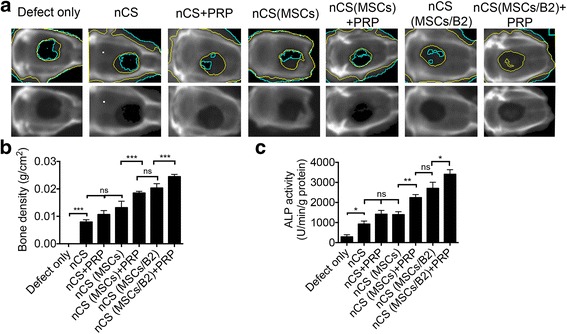
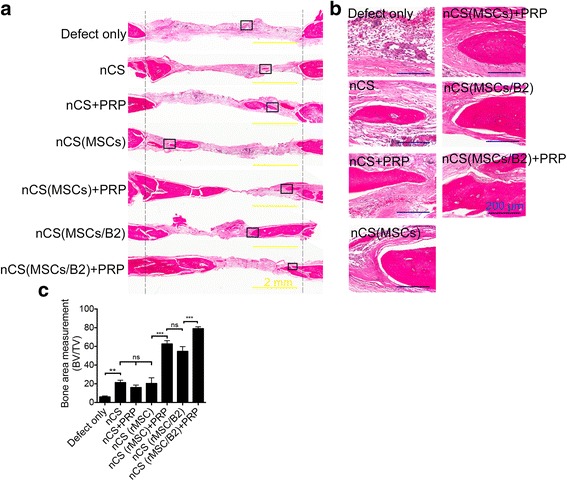
We developed an optimized nCS/PRP sandwich-like scaffold. Scanning electron microscopy (SEM) results showed that nCS/PRP are polyporous with an average pore diameter of 70-80 μm and the cells can survive in the nCS/PRP scaffold. PRP extract dramatically stimulated proliferation and differentiation of BMP2-modified MSCs in vitro. Our in vivo results showed that the combination of BMP2-modified MSCs and nCS/PRP scaffold dramatically increased new bone regeneration compared with the groups without PRP and/or BMP2.
nCS/PRP scaffolds containing BMP2-modified MSCs successfully promotes bone regeneration in critical-sized bone defects. This system could ultimately enable clinicians to better reconstruct the craniofacial bone and avoid donor site morbidity for critical-sized bone defects.
间充质干细胞(MSCs)在生长因子(GFs)存在的情况下可分化为成骨谱系。富含血小板的血浆(PRP)可从全血中轻松分离,含有大量生长因子,因此可促进骨生长和再生。本研究的主要目的是开发并研究一种新型三明治样骨支架(其将纳米硫酸钙(nCS)盘与PRP纤维蛋白凝胶(nCS/PRP)相结合,并联合BMP2修饰的MSCs)对大鼠临界尺寸颅骨缺损骨修复和再生的影响。
我们评估了PRP提取物对BMP2修饰的MSCs的细胞毒性、成骨分化和矿化作用,并构建了一种包含BMP2修饰的MSCs的三明治样nCS/PRP支架(模拟骨的纳米钙基质并在PRP中携带多种生长因子)。在大鼠临界尺寸(8毫米)颅骨缺损模型中对该多功能骨再生系统促进骨修复的能力进行了体内评估。
我们开发了一种优化的nCS/PRP三明治样支架。扫描电子显微镜(SEM)结果显示,nCS/PRP具有多孔结构,平均孔径为70 - 80μm,细胞可在nCS/PRP支架中存活。PRP提取物在体外显著刺激了BMP2修饰的MSCs的增殖和分化。我们的体内结果表明,与不含PRP和/或BMP2的组相比,BMP2修饰的MSCs与nCS/PRP支架的组合显著增加了新骨再生。
含有BMP2修饰的MSCs的nCS/PRP支架成功促进了临界尺寸骨缺损的骨再生。该系统最终可能使临床医生能够更好地重建颅面骨,并避免临界尺寸骨缺损的供区并发症。