Belfer Center for Science and International Affairs, Kennedy School of Government, Harvard University, Cambridge, MA 02138, USA.
Media Lab, Massachusetts Institute of Technology, Cambridge, MA 02139, USA.
Sci Adv. 2017 May 26;3(5):e1601555. doi: 10.1126/sciadv.1601555. eCollection 2017 May.
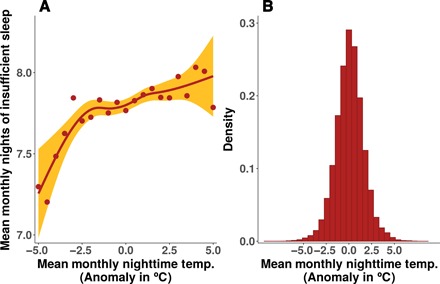
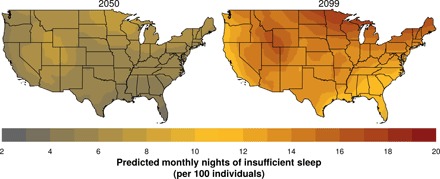
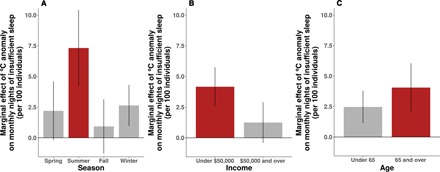
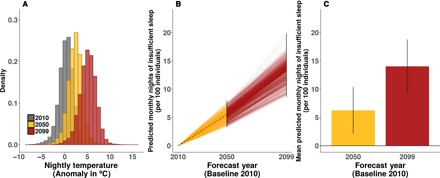
Human sleep is highly regulated by temperature. Might climate change-through increases in nighttime heat-disrupt sleep in the future? We conduct the inaugural investigation of the relationship between climatic anomalies, reports of insufficient sleep, and projected climate change. Using data from 765,000 U.S. survey respondents from 2002 to 2011, coupled with nighttime temperature data, we show that increases in nighttime temperatures amplify self-reported nights of insufficient sleep. We observe the largest effects during the summer and among both lower-income and elderly respondents. We combine our historical estimates with climate model projections and detail the potential sleep impacts of future climatic changes. Our study represents the largest ever investigation of the relationship between sleep and ambient temperature and provides the first evidence that climate change may disrupt human sleep.
人类的睡眠受到温度的高度调节。未来气候变化是否会通过夜间热量增加而破坏睡眠?我们首次调查了气候异常、睡眠不足报告和预计气候变化之间的关系。利用 2002 年至 2011 年来自美国的 76.5 万名调查受访者的数据以及夜间温度数据,我们表明夜间温度升高会增加自我报告的睡眠不足的夜晚。我们在夏季以及低收入和老年受访者中观察到最大的影响。我们将我们的历史估计与气候模型预测相结合,并详细说明了未来气候变化对睡眠的潜在影响。我们的研究代表了有史以来对睡眠与环境温度之间关系的最大调查,首次证明气候变化可能会扰乱人类睡眠。