Goold Susan, Rowe Zachary, Calhoun Karen, Campbell Terrance, Danis Marion, Hammad Adnan, Salman Cengiz, Szymecko Lisa, Coombe Chris
Prog Community Health Partnersh. 2016;10(4):515-522. doi: 10.1353/cpr.2016.0059.
Community-based participatory research (CBPR) typically defines communities by geography, ethnicity, shared health needs, or some combination.
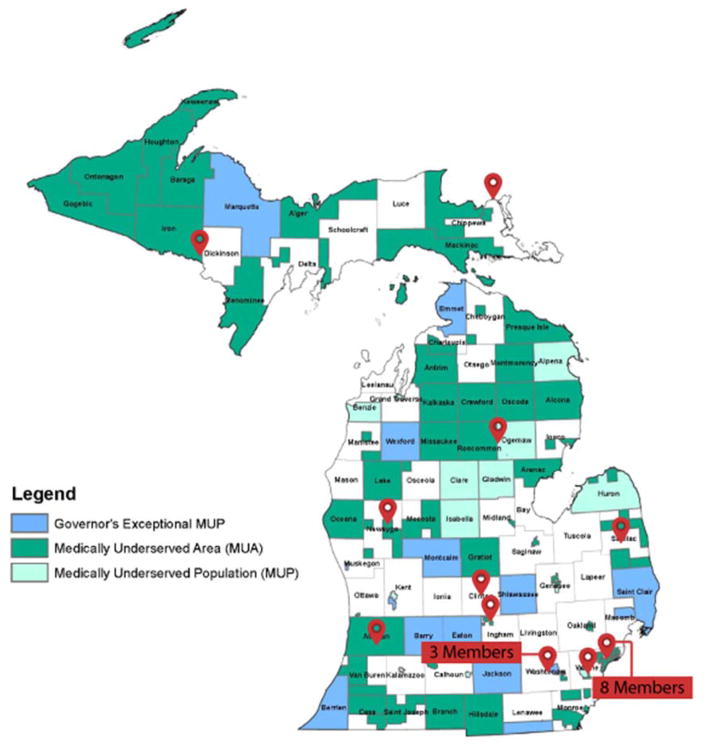
We describe a CBPR project aiming to engage diverse minority and underserved communities throughout Michigan in deliberations about health research priorities.
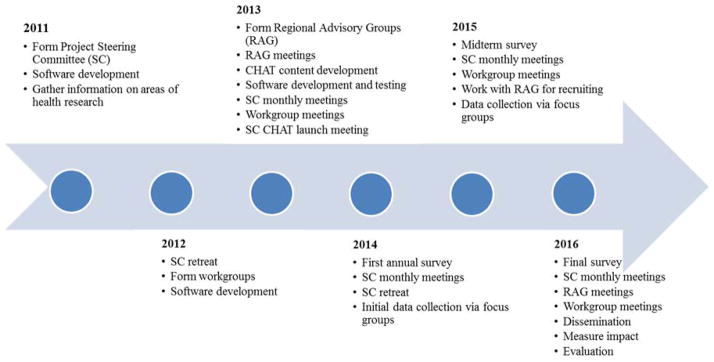
A steering committee (SC) with 15 members from minority and underserved communities and 4 members from research organizations led the project, with the help of regional advisory groups (RAGs) formed at the SC's request. Evaluation of the SC used questionnaires, focused group discussion, and review of SC meetings to describe engagement, partnership, and communication.
An academic-community partnership with a diverse, dispersed, and broadly defined community found value in RAGs, dedicated academic staff, face-to-face meetings, varied communication modalities, capacity building tailored to varying levels of CBPR experience, and ongoing evaluation.
A geographically and culturally diverse partnership presents challenges and opportunities in representativeness, relationship building, capacity building, and communication.
基于社区的参与性研究(CBPR)通常根据地理位置、种族、共同的健康需求或某种组合来界定社区。
我们描述了一个CBPR项目,旨在让密歇根州各地不同的少数族裔和服务不足社区参与关于健康研究优先事项的讨论。
一个由来自少数族裔和服务不足社区的15名成员以及来自研究机构的4名成员组成的指导委员会(SC)在应SC要求成立的区域咨询小组(RAGs)的帮助下领导该项目。对SC的评估使用了问卷调查、焦点小组讨论以及对SC会议的审查,以描述参与度、伙伴关系和沟通情况。
与一个多样化、分散且定义宽泛的社区建立的学术 - 社区伙伴关系在区域咨询小组、专职学术人员、面对面会议、多样的沟通方式、针对不同CBPR经验水平的能力建设以及持续评估中发现了价值。
一个地理和文化上多样化的伙伴关系在代表性、关系建立、能力建设和沟通方面既带来挑战也带来机遇。