Department of Psychiatry and Center for Circadian Biology, University of California, San Diego, La Jolla, CA, United States.
Department of Psychiatry and Center for Circadian Biology, University of California, San Diego, La Jolla, CA, United States; Veterans Affairs San Diego Healthcare System, San Diego, CA, United States.
Neuroscience. 2017 Aug 15;357:1-11. doi: 10.1016/j.neuroscience.2017.05.037. Epub 2017 May 31.
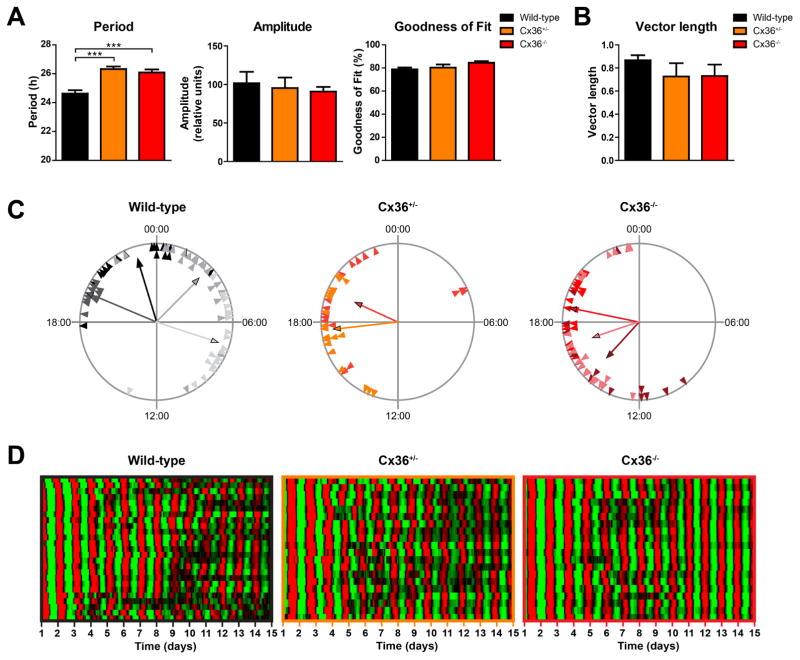
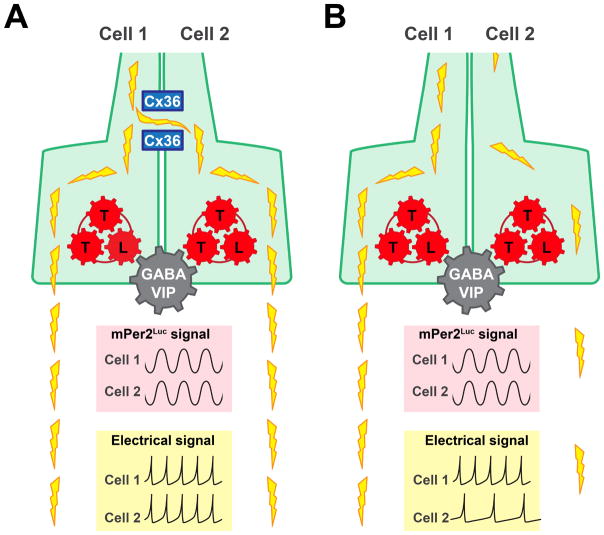
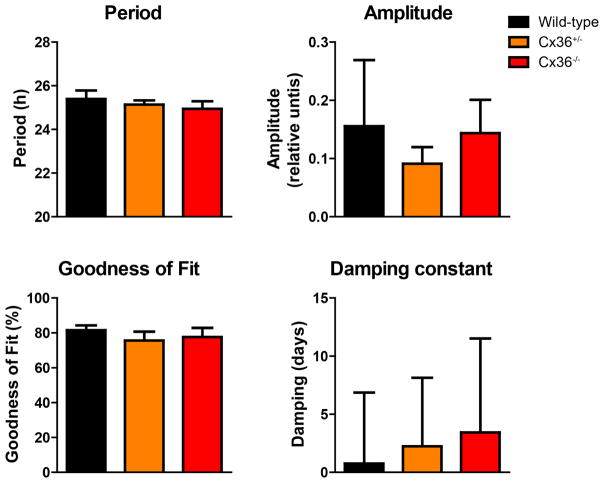
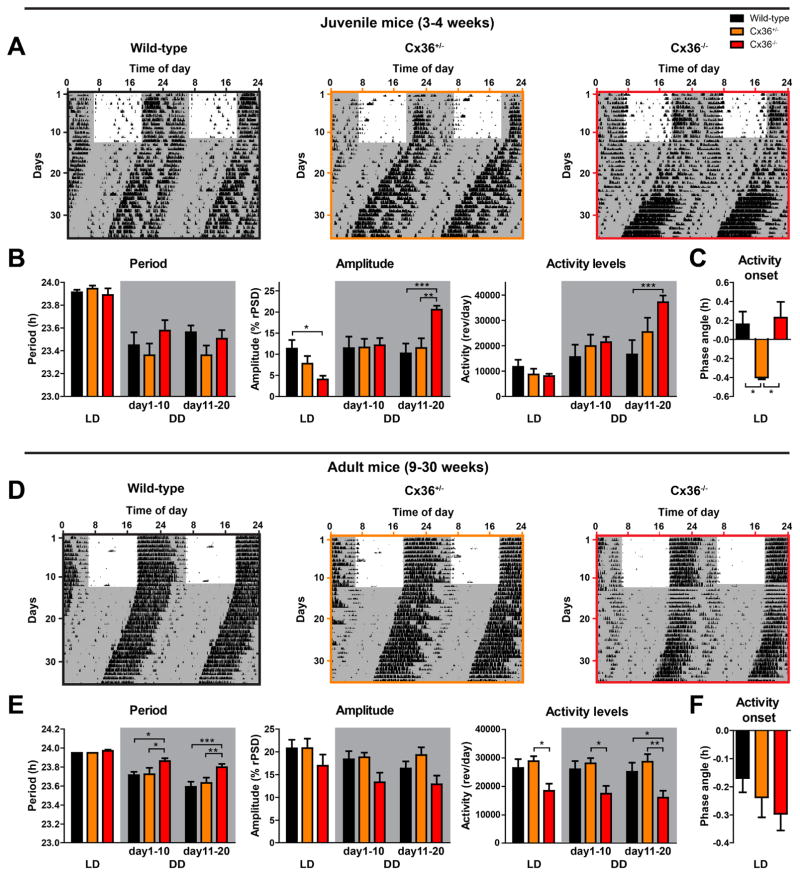
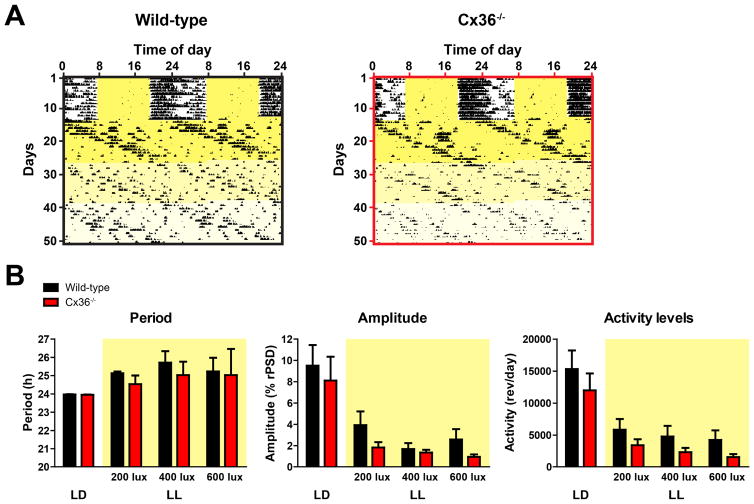
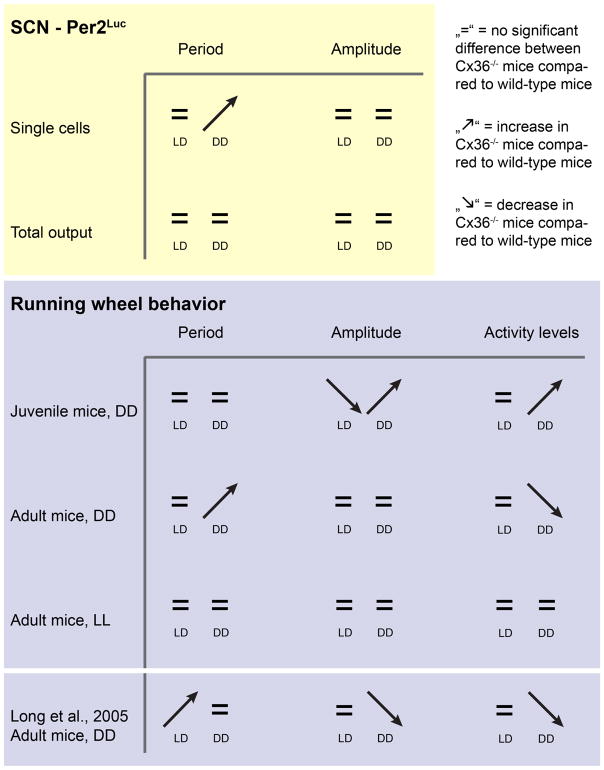
In mammals, the master circadian clock resides in the suprachiasmatic nucleus (SCN). The SCN is characterized by robust circadian oscillations of clock gene expression and neuronal firing. The synchronization of circadian oscillations among individual cells in the SCN is attributed to intercellular coupling. Previous studies have shown that gap junctions, specifically those composed of connexin-36 (Cx36) subunits, are required for coupling of electrical firing among SCN neurons at a time scale of milliseconds. However, it remains unknown whether Cx36 gap junctions also contribute to coupling of circadian (∼24h) rhythms of clock gene expression. Here, we investigated circadian expression patterns of the clock gene Period 2 (Per2) in the SCN of Cx36-deficient mice using luminometry and single-cell bioluminescence imaging. Surprisingly, we found that synchronization of circadian PER2 expression rhythms is maintained in SCN explants from Cx36-deficient mice. Since Cx36 expression levels change with age, we also tested circadian running-wheel behavior of juvenile (3-4weeks old) and adult (9-30weeks old) Cx36-deficient mice. We found that impact of connexin-36 expression on circadian behavior changes greatly during postnatal development. However, consistent with the intact synchrony among SCN cells in cultured explants, Cx36-deficient mice had intact locomotor circadian rhythms, although adults displayed a lengthened period in constant darkness. Our data indicate that even though Cx36 may be required for electrical coupling of SCN cells, it does not affect coupling of molecular clock gene rhythms. Thus, electrical coupling of neurons and coupling of circadian clock gene oscillations can be regulated independently in the SCN.
在哺乳动物中,主生物钟位于视交叉上核(SCN)。SCN 的特征是时钟基因表达和神经元放电的强大昼夜节律振荡。SCN 中单个细胞的昼夜节律振荡的同步性归因于细胞间耦合。先前的研究表明,缝隙连接,特别是由连接蛋白 36(Cx36)亚基组成的缝隙连接,是 SCN 神经元电放电耦合所必需的,时间尺度为毫秒。然而,目前尚不清楚 Cx36 缝隙连接是否也有助于时钟基因表达的昼夜(约 24 小时)节律的耦合。在这里,我们使用发光计和单细胞生物发光成像研究了 Cx36 缺陷小鼠 SCN 中时钟基因 Period 2(Per2)的昼夜表达模式。令人惊讶的是,我们发现 Cx36 缺陷小鼠 SCN 中昼夜 PER2 表达节律的同步性得以维持。由于 Cx36 表达水平随年龄而变化,我们还测试了幼年(3-4 周龄)和成年(9-30 周龄)Cx36 缺陷小鼠的昼夜跑步轮行为。我们发现,连接蛋白 36 表达对昼夜行为的影响在出生后发育过程中变化很大。然而,与培养的外植体中 SCN 细胞之间的同步性一致,Cx36 缺陷小鼠具有完整的运动昼夜节律,尽管成年小鼠在持续黑暗中表现出周期延长。我们的数据表明,尽管 Cx36 可能是 SCN 细胞电耦合所必需的,但它不会影响分子时钟基因节律的耦合。因此,SCN 中神经元的电耦合和昼夜时钟基因振荡的耦合可以独立调节。