Yeşilbağ Kadir, Alpay Gizem, Becher Paul
Department of Virology, Faculty of Veterinary Medicine, Uludag University, TR-16059 Bursa, Turkey.
Institute for Virology, Department of Infectious Diseases, University of Veterinary Medicine, D-30559 Hannover, Germany.
Viruses. 2017 May 26;9(6):128. doi: 10.3390/v9060128.
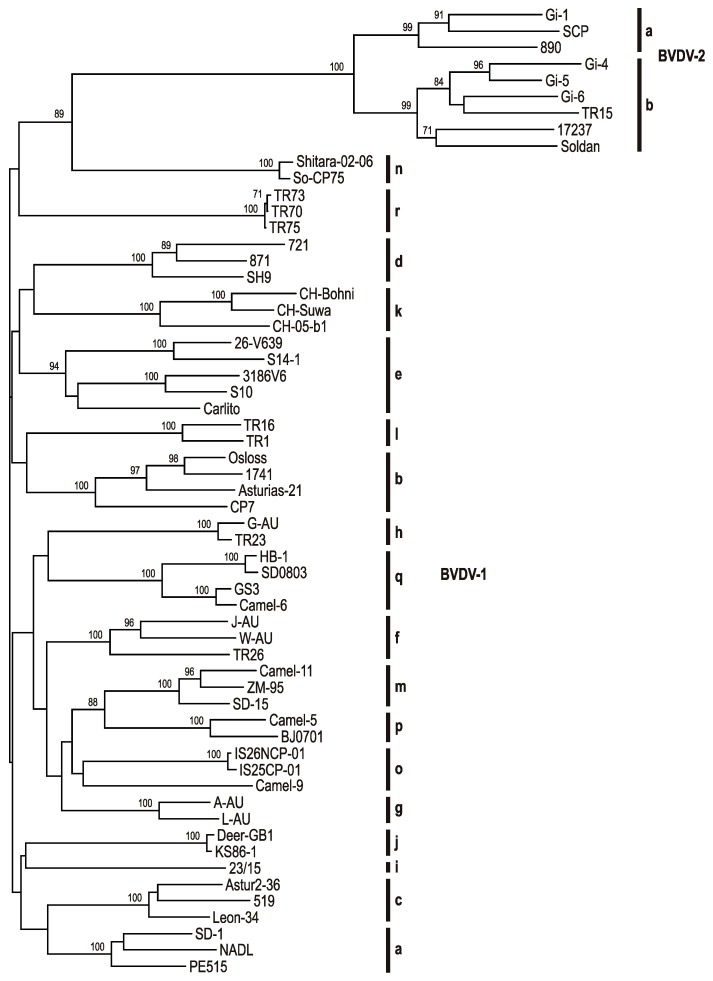
Bovine viral diarrhea virus (BVDV) is a globally-distributed agent responsible for numerous clinical syndromes that lead to major economic losses. Two species, BVDV-1 and BVDV-2, discriminated on the basis of genetic and antigenic differences, are classified in the genus within the family and distributed on all of the continents. BVDV-1 can be segregated into at least twenty-one subgenotypes (1a-1u), while four subgenotypes have been described for BVDV-2 (2a-2d). With respect to published sequences, the number of virus isolates described for BVDV-1 (88.2%) is considerably higher than for BVDV-2 (11.8%). The most frequently-reported BVDV-1 subgenotype are 1b, followed by 1a and 1c. The highest number of various BVDV subgenotypes has been documented in European countries, indicating greater genetic diversity of the virus on this continent. Current segregation of BVDV field isolates and the designation of subgenotypes are not harmonized. While the species BVDV-1 and BVDV-2 can be clearly differentiated independently from the portion of the genome being compared, analysis of different genomic regions can result in inconsistent assignment of some BVDV isolates to defined subgenotypes. To avoid non-conformities the authors recommend the development of a harmonized system for subdivision of BVDV isolates into defined subgenotypes.
牛病毒性腹泻病毒(BVDV)是一种全球分布的病原体,可引发多种临床综合征,导致重大经济损失。根据基因和抗原差异区分的两个种,即BVDV-1和BVDV-2,被归类于黄病毒科瘟病毒属,分布于各大洲。BVDV-1可至少分为21个亚型(1a - 1u),而BVDV-2已描述有4个亚型(2a - 2d)。就已发表的序列而言,所描述的BVDV-1病毒分离株数量(88.2%)远高于BVDV-2(11.8%)。最常报道的BVDV-1亚型是1b,其次是1a和1c。欧洲国家记录的各种BVDV亚型数量最多,表明该大陆病毒的遗传多样性更高。目前BVDV野外分离株的分类和亚型的指定并不统一。虽然BVDV-1和BVDV-2种可以根据所比较的基因组部分清楚地区分,但对不同基因组区域的分析可能导致一些BVDV分离株被不一致地指定到特定亚型。为避免不一致,作者建议开发一个统一的系统,将BVDV分离株细分为特定亚型。