Huet Catherine, Ford James D, Edge Victoria L, Shirley Jamal, King Nia, Harper Sherilee L
Department of Geography, McGill University, Montreal, QC, H3A OB9, Canada.
Office of the Chief Science Officer, Public Health Agency of Canada, Guelph, ON, N1G 5B2, Canada.
BMC Public Health. 2017 Jun 15;17(1):578. doi: 10.1186/s12889-017-4393-6.
High rates of food insecurity are documented among Inuit households in Canada; however, data on food insecurity prevalence and seasonality for Inuit households with children are lacking, especially in city centres. This project: (1) compared food consumption patterns for households with and without children, (2) compared the prevalence of food insecurity for households with and without children, (3) compared food consumption patterns and food insecurity prevalence between seasons, and (4) identified factors associated with food insecurity in households with children in Iqaluit, Nunavut, Canada.
Randomly selected households were surveyed in Iqaluit in September 2012 and May 2013. Household food security status was determined using an adapted United States Department of Agriculture Household Food Security Survey Module. Univariable logistic regressions were used to examine unconditional associations between food security status and demographics, socioeconomics, frequency of food consumption, and method of food preparation in households with children by season.
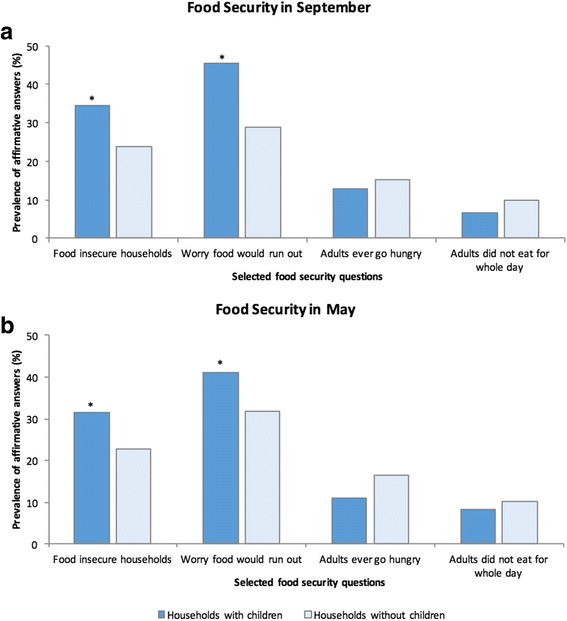
Households with children (n = 431) and without children (n = 468) participated in the survey. Food insecurity was identified in 32.9% (95% CI: 28.5-37.4%) of households with children; this was significantly higher than in households without children (23.2%, 95% CI: 19.4-27.1%). The prevalence of household food insecurity did not significantly differ by season. Demographic and socioeconomic characteristics of the person responsible for food preparation, including low formal education attainment (OR = 4.3, 95% CI: 2.3-8.0; OR = 3.2, 95% CI: 1.8-5.8), unemployment (OR = 1.1, 95% CI: 1.1-1.3; OR = 1.3, 95% CI: 1.1-1.5), and Inuit identity (OR = 8.9, 95% CI: 3.4-23.5; OR = 21.8, 95% CI: 6.6-72.4), were associated with increased odds of food insecurity in households with children. Fruit and vegetable consumption (OR = 0.4, 95% CI: 0.2-0.8; OR = 0.5, 95% CI: 0.2-0.9), as well as eating cooked (OR = 0.5, 95% CI: 0.3-1.0; OR = 0.5, 95% CI: 0.3-0.9) and raw (OR = 1.7, 95% CI: 0.9-3.0; OR = 1.8, 95% CI: 1.0-3.1) fish were associated with decreased odds of food insecurity among households with children, while eating frozen meat and/or fish (OR = 2.6, 95% CI: 1.4-5.0; OR = 2.0, 95% CI: 1.1-3.7) was associated with increased odds of food insecurity.
Food insecurity is high among households with children in Iqaluit. Despite the partial subsistence livelihoods of many Inuit in the city, we found no seasonal differences in food security and food consumption for households with children. Interventions aiming to decrease food insecurity in these households should consider food consumption habits, and the reported demographic and socioeconomic determinants of food insecurity.
加拿大因纽特家庭中粮食不安全率很高;然而,有关有孩子的因纽特家庭粮食不安全患病率和季节性的数据匮乏,尤其是在市中心地区。本项目:(1)比较了有孩子家庭和无孩子家庭的食物消费模式,(2)比较了有孩子家庭和无孩子家庭的粮食不安全患病率,(3)比较了不同季节之间的食物消费模式和粮食不安全患病率,以及(4)确定了加拿大努纳武特地区伊卡卢伊特市有孩子家庭中与粮食不安全相关的因素。
2012年9月和2013年5月在伊卡卢伊特对随机选择的家庭进行了调查。使用改编后的美国农业部家庭粮食安全调查模块确定家庭粮食安全状况。采用单变量逻辑回归分析按季节研究有孩子家庭中粮食安全状况与人口统计学、社会经济学、食物消费频率和食物制备方法之间的无条件关联。
有孩子的家庭(n = 431)和无孩子的家庭(n = 468)参与了调查。有孩子的家庭中32.9%(95%置信区间:28.5 - 37.4%)被确定为粮食不安全;这显著高于无孩子的家庭(23.2%,95%置信区间:19.4 - 27.1%)。家庭粮食不安全患病率在不同季节之间没有显著差异。负责食物制备的人员的人口统计学和社会经济特征,包括低学历(比值比 = 4.3,95%置信区间:2.3 - 8.0;比值比 = 3.2,95%置信区间:1.8 - 5.8)、失业(比值比 = 1.1,95%置信区间:1.1 - 1.3;比值比 = 1.3,95%置信区间:1.1 - 1.5)和因纽特身份(比值比 = 8.9,95%置信区间:3.4 - 23.5;比值比 = 21.8,95%置信区间:6.6 - 72.4),与有孩子家庭中粮食不安全几率增加相关。水果和蔬菜消费(比值比 = 0.4,95%置信区间:0.2 - 0.8;比值比 = 0.5,95%置信区间:0.2 - 0.9),以及食用煮熟的(比值比 = 0.5,95%置信区间:0.3 - 1.0;比值比 = 0.5,95%置信区间:0.3 - 0.9)和生的(比值比 = 1.7,95%置信区间:0.9 - 3.0;比值比 = 1.8,95%置信区间:1.0 - 3.1)鱼与有孩子家庭中粮食不安全几率降低相关,而食用冷冻肉和/或鱼(比值比 = 2.6,95%置信区间:1.4 - 5.0;比值比 = 2.0,95%置信区间:1.1 - 3.7)与粮食不安全几率增加相关。
伊卡卢伊特有孩子的家庭中粮食不安全情况严重。尽管该市许多因纽特人有部分自给自足的生计,但我们发现有孩子家庭在粮食安全和食物消费方面没有季节性差异。旨在减少这些家庭粮食不安全状况的干预措施应考虑食物消费习惯以及报告的粮食不安全的人口统计学和社会经济决定因素。