Wang Yi-Feng, Liu Lu, Xue Xue, Liang Xing-Jie
Laboratory of Controllable Nanopharmaceuticals, CAS Key Laboratory for Biomedical Effects of Nanomaterials and Nanosafety, CAS Center for Excellence in Nanoscience, National Center for Nanoscience and Technology, Beijing, 100190, China.
University of Chinese Academy of Sciences, Beijing, 100049, China.
F1000Res. 2017 May 16;6:681. doi: 10.12688/f1000research.9690.1. eCollection 2017.
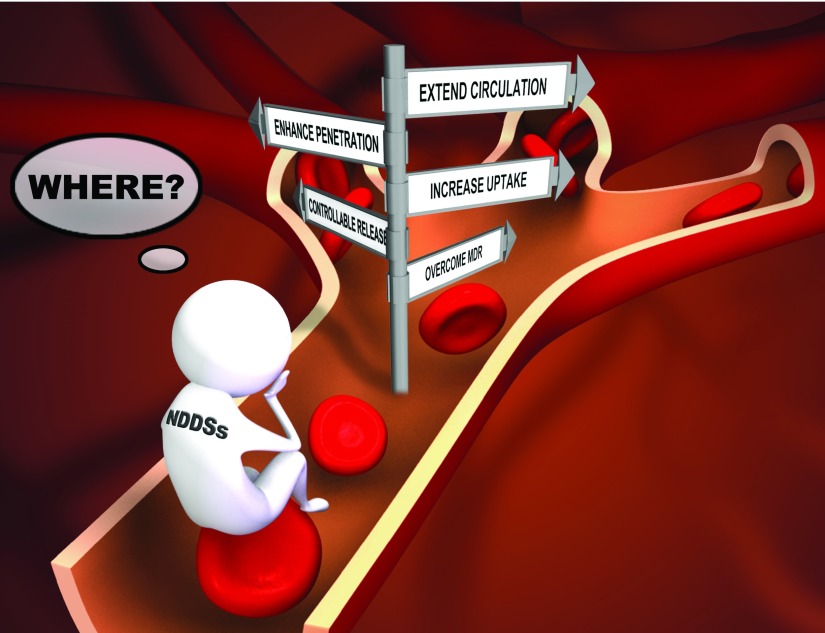
In the past few decades, there has been explosive growth in the construction of nanoparticle-based drug delivery systems (NDDSs), namely nanomedicines, owing to their unique properties compared with traditional drug formulations. However, because of a variety of challenges, few nanomedicines are on sale in the market or undergoing clinical trial at present. Thus, it is essential to look back and re-evaluate what these NDDSs can really do , why nanomedicines are regarded as potential candidates for next-generation drugs, and what the future of nanomedicine is. Here, we focus mainly on the properties of NDDSs that extend blood circulation, enhance penetration into deep tumor tissue, enable controllable release of the payload into the cytoplasm, and overcome multi-drug resistance. We further discuss how to promote the translation of nanomedicines into reality. This review may help to identify the functions of NDDSs that are really necessary before they are designed and to reduce the gap between basic research and clinical application.
在过去几十年中,基于纳米颗粒的药物递送系统(NDDSs),即纳米药物,其构建呈爆发式增长,这是因为与传统药物制剂相比,它们具有独特的性质。然而,由于各种挑战,目前市场上在售或正在进行临床试验的纳米药物很少。因此,回顾并重新评估这些NDDSs究竟能发挥什么作用、为什么纳米药物被视为下一代药物的潜在候选者以及纳米医学的未来是什么至关重要。在此,我们主要关注NDDSs的特性,这些特性包括延长血液循环时间、增强对深部肿瘤组织的渗透、使有效载荷可控地释放到细胞质中以及克服多药耐药性。我们还进一步讨论了如何推动纳米药物转化为实际应用。这篇综述可能有助于在设计NDDSs之前确定真正必要的功能,并缩小基础研究与临床应用之间的差距。