Ferezou Isabelle, Deneux Thomas
Unité de Neurosciences, Information et Complexité, Centre National de la Recherche Scientifique, Gif-sur-Yvette, France.
Neurophotonics. 2017 Jul;4(3):031221. doi: 10.1117/1.NPh.4.3.031221. Epub 2017 Jun 13.
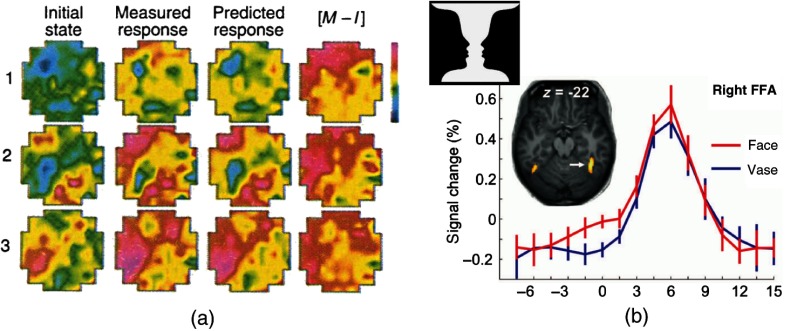
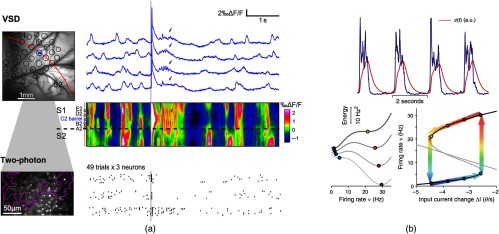
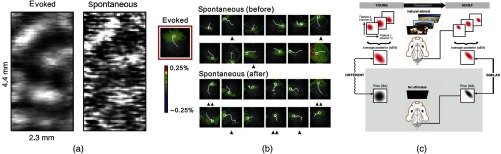
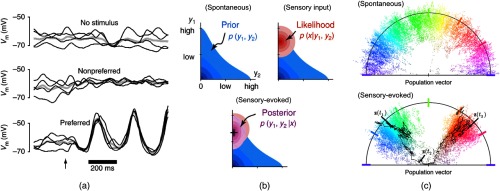
Twenty years ago, the seminal work of Grinvald et al. revolutionized the view cast on spontaneous cortical activity by showing how, instead of being a mere measure of noise, it profoundly impacts cortical responses to a sensory input and therefore could play a role in sensory processing. This paved the way for a number of studies on the interactions between spontaneous and sensory-evoked activities. Spontaneous activity has subsequently been found to be highly structured and to participate in high cognitive functions, such as influencing conscious perception in humans. However, its functional role remains poorly understood, and only a few speculations exist, from the maintenance of the cortical network to the internal representation of an knowledge of the environment. Furthermore, elucidation of this functional role could stem from studying the opposite relationship between spontaneous and sensory-evoked activities, namely, how a sensory input influences subsequent internal activities. Indeed, this question has remained largely unexplored, but a recent study by the Grinvald laboratory shows that a brief sensory input largely dampens spontaneous rhythms, suggesting a more sophisticated view where some spontaneous rhythms might relate to sensory processing and some others not.
二十年前,格林瓦尔德等人的开创性工作彻底改变了人们对自发皮层活动的看法,他们展示了自发皮层活动并非仅仅是一种噪声测量,而是深刻影响皮层对感觉输入的反应,因此可能在感觉处理中发挥作用。这为一系列关于自发活动与感觉诱发活动之间相互作用的研究铺平了道路。随后人们发现,自发活动具有高度的结构性,并参与高级认知功能,比如影响人类的意识感知。然而,其功能作用仍知之甚少,仅存在一些猜测,从皮层网络的维持到对环境知识的内部表征。此外,阐明这一功能作用可能源于研究自发活动与感觉诱发活动之间的相反关系,即感觉输入如何影响随后的内部活动。的确,这个问题在很大程度上仍未得到探索,但格林瓦尔德实验室最近的一项研究表明,短暂的感觉输入会大幅抑制自发节律,这表明了一种更为复杂的观点,即一些自发节律可能与感觉处理有关,而另一些则无关。