Fuetterer Maximilian, Busch Julia, Peereboom Sophie M, von Deuster Constantin, Wissmann Lukas, Lipiski Miriam, Fleischmann Thea, Cesarovic Nikola, Stoeck Christian T, Kozerke Sebastian
Institute for Biomedical Engineering, University and ETH Zurich, Gloriastrasse 35, 8092, Zurich, Switzerland.
Division of Surgical Research, University Hospital Zurich, Sternwartstrasse 14, 8091, Zurich, Switzerland.
J Cardiovasc Magn Reson. 2017 Jun 21;19(1):46. doi: 10.1186/s12968-017-0364-4.
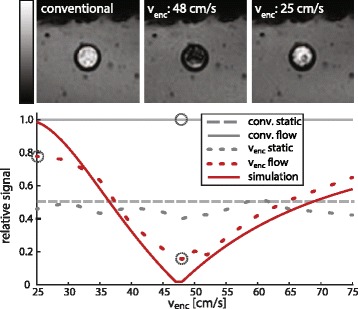
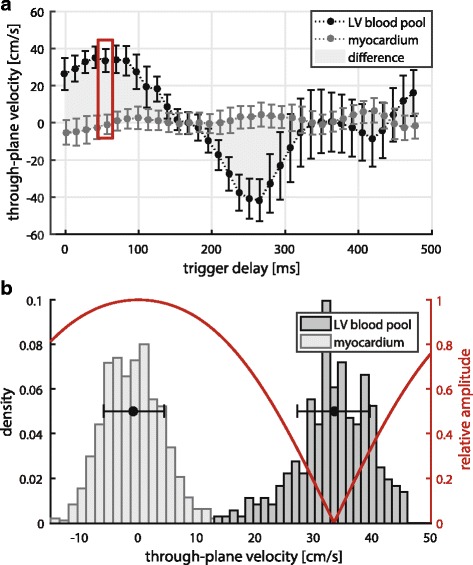
A velocity-selective binomial excitation scheme for myocardial first-pass perfusion measurements with hyperpolarized C substrates, which preserves bolus magnetization inside the blood pool, is presented. The proposed method is evaluated against gadolinium-enhanced H measurements in-vivo.
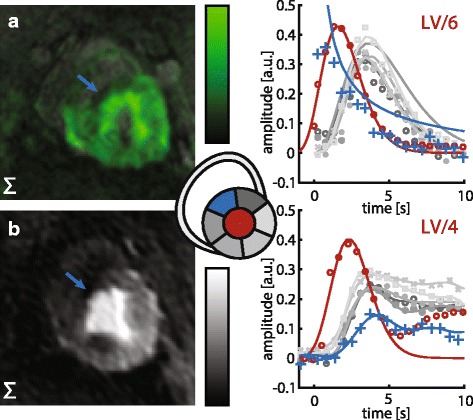
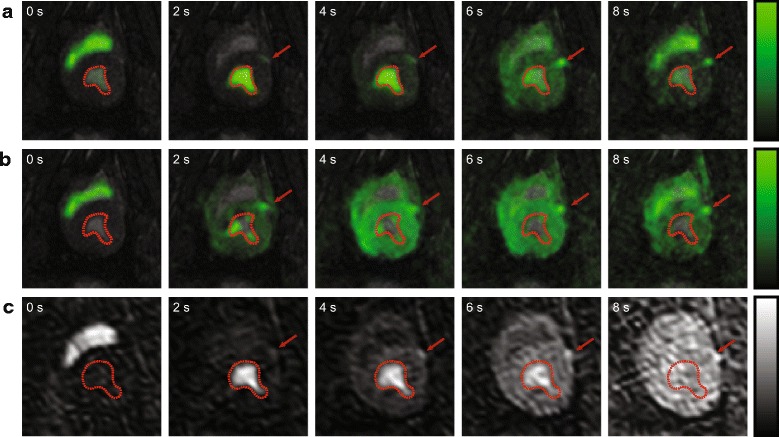
The proposed excitation with an echo-planar imaging readout was implemented on a clinical CMR system. Dynamic myocardial stress perfusion images were acquired in six healthy pigs after bolus injection of hyperpolarized C urea with the velocity-selective vs. conventional excitation, as well as standard H gadolinium-enhanced images. Signal-to-noise, contrast-to-noise (CNR) and homogeneity of semi-quantitative perfusion measures were compared between methods based on first-pass signal-intensity time curves extracted from a mid-ventricular slice. Diagnostic feasibility is demonstrated in a case of septal infarction.
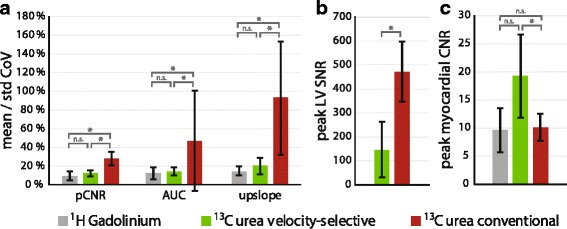
Velocity-selective excitation provides over three-fold reduction in blood pool signal with a two-fold increase in myocardial CNR. Extracted first-pass perfusion curves reveal a significantly reduced variability of semi-quantitative first-pass perfusion measures (12-20%) for velocity-selective excitation compared to conventional excitation (28-93%), comparable to that of reference H gadolinium data (9-15%). Overall image quality appears comparable between the velocity-selective hyperpolarized and gadolinium-enhanced imaging.
The feasibility of hyperpolarized C first-pass perfusion CMR has been demonstrated in swine. Comparison with reference H gadolinium data revealed sufficient data quality and indicates the potential of hyperpolarized perfusion imaging for human applications.
提出了一种用于超极化碳底物心肌首过灌注测量的速度选择性二项式激发方案,该方案可保留血池内的团注磁化强度。将该方法与体内钆增强氢测量进行了对比评估。
在临床CMR系统上实现了带有回波平面成像读出的所提出的激发。在六只健康猪中,在团注超极化碳尿素后,分别采用速度选择性激发与传统激发获取动态心肌应力灌注图像,以及标准的氢钆增强图像。基于从中心室切片提取的首过信号强度时间曲线,比较了两种方法之间的信噪比、对比噪声比(CNR)和半定量灌注测量的均匀性。在一例室间隔梗死病例中证明了诊断可行性。
速度选择性激发可使血池信号降低三倍以上,同时心肌CNR提高两倍。提取的首过灌注曲线显示,与传统激发(28 - 93%)相比,速度选择性激发的半定量首过灌注测量的变异性显著降低(12 - 20%),与参考氢钆数据(9 - 15%)相当。速度选择性超极化成像和钆增强成像的整体图像质量看起来相当。
已在猪身上证明了超极化碳首过灌注CMR的可行性。与参考氢钆数据的比较显示了足够的数据质量,并表明了超极化灌注成像在人体应用中的潜力。