Jungerman M Robynne, Vonnahme Laura A, Washburn Faith, Alvarado-Ramy Francisco
Quarantine and Border Health Services, Division of Global Migration and Quarantine, US Centers for Disease Control and Prevention, Atlanta, GA, United States.
Quarantine and Border Health Services, Division of Global Migration and Quarantine, US Centers for Disease Control and Prevention, Atlanta, GA, United States; United States Public Health Service, Washington, DC, United States.
Travel Med Infect Dis. 2017 Jul-Aug;18:30-35. doi: 10.1016/j.tmaid.2017.06.007. Epub 2017 Jun 23.
Individuals with certain communicable diseases may pose risks to the health of the traveling public; there has been documented transmission on commercial aircraft of tuberculosis (TB), measles, and severe acute respiratory syndrome (SARS). Federal public health travel restrictions (PHTR) prevent commercial air or international travel of persons with communicable diseases that pose a public health threat.
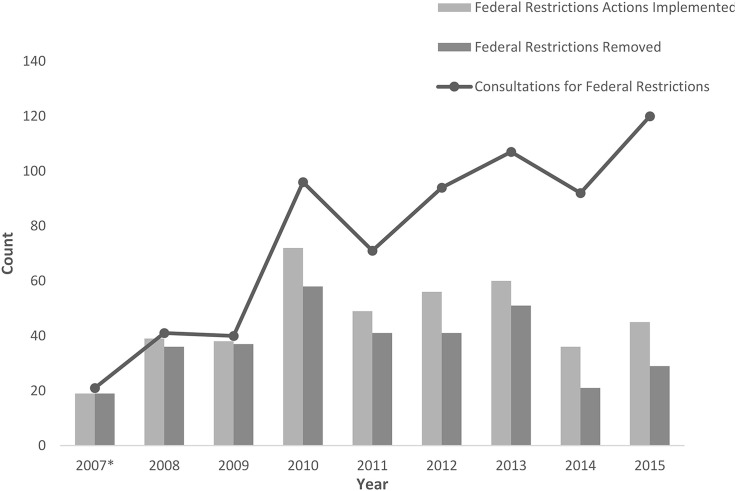
We described demographics and clinical characteristics of all cases considered for PHTR because of suspected or confirmed communicable disease from May 22, 2007, to December 31, 2015.
We reviewed 682 requests for PHTR; 414 (61%) actions were completed to place 396 individuals on PHTR. The majority (>99%) had suspected (n = 27) or confirmed (n = 367) infectious pulmonary TB; 58 (16%) had multidrug-resistant-TB. There were 128 (85%) interceptions that prevented the initiation or continuation of travel. PHTR were removed for 310 (78%) individuals after attaining noninfectious status and 86 (22%) remained on PHTR at the end of the analysis period.
PHTR effectively prevent exposure during commercial air travel to persons with potentially infectious diseases. In addition, they are effective tools available to public health agencies to prevent commercial travel of individuals with certain communicable diseases and possibly reconnect them with public health authorities.
患有某些传染病的个体可能会对出行公众的健康构成风险;已有文件证明结核病、麻疹和严重急性呼吸综合征(SARS)在商业航班上发生了传播。联邦公共卫生旅行限制(PHTR)禁止患有构成公共卫生威胁的传染病的人员乘坐商业航班或进行国际旅行。
我们描述了2007年5月22日至2015年12月31日期间因疑似或确诊传染病而被考虑实施PHTR的所有病例的人口统计学和临床特征。
我们审查了682份PHTR申请;完成了414项(61%)行动,将396人列入PHTR。大多数(>99%)患有疑似(n = 27)或确诊(n = 367)的传染性肺结核;58人(16%)患有耐多药结核病。有128次(85%)拦截阻止了旅行的开始或继续。310名(78%)个体在达到非感染状态后被解除了PHTR,86名(22%)个体在分析期结束时仍在PHTR名单上。
PHTR有效地防止了在商业航空旅行期间接触潜在传染病患者。此外,它们是公共卫生机构可利用的有效工具,可防止患有某些传染病的个体进行商业旅行,并可能使他们重新与公共卫生当局取得联系。