Gao Shimin, Kang Yinfeng, Yuan Runyu, Ma Haili, Xiang Bin, Wang Zhaoxiong, Dai Xu, Wang Fumin, Xiao Jiajie, Liao Ming, Ren Tao
College of Animal Science and Veterinary Medicine, Shanxi Agriculture UniversityTaigu, China.
College of Veterinary Medicine, Key Laboratory of Zoonosis Prevention and Control of Guangdong Province, South China Agricultural UniversityGuangzhou, China.
Front Microbiol. 2017 Jun 20;8:1081. doi: 10.3389/fmicb.2017.01081. eCollection 2017.
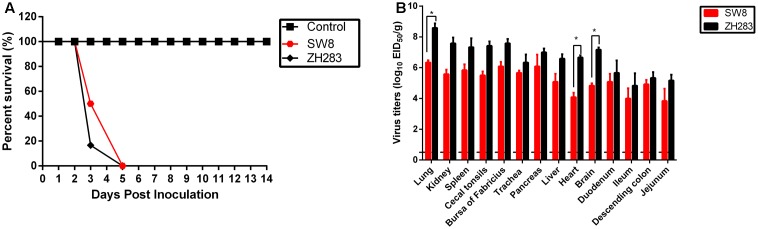
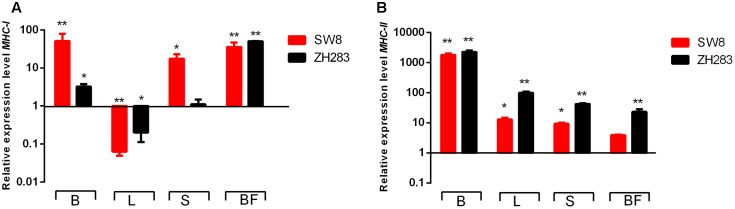
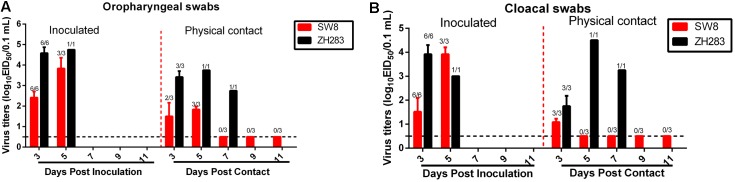
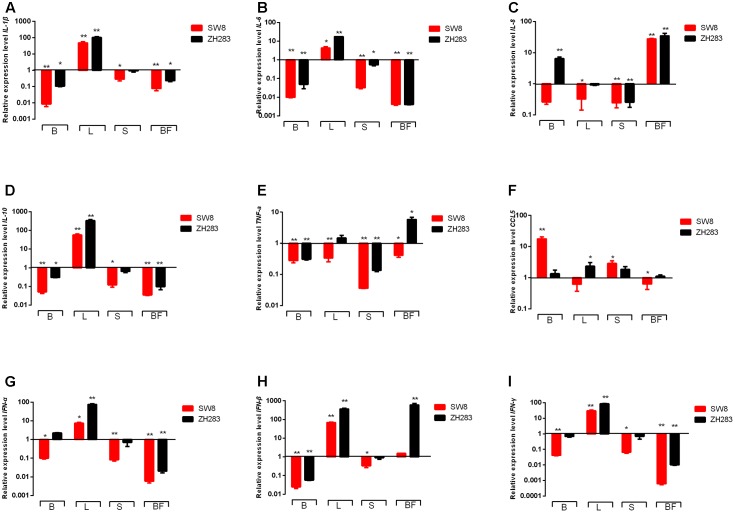
Since April 2014, new infections of H5N6 avian influenza virus (AIV) in humans and domestic poultry have caused considerable economic losses in the poultry industry and posed an enormous threat to human health worldwide. In previous research using gene sequence and phylogenetic analysis, we reported that H5N6 AIV isolated in February 2015 (ZH283) in Pallas's sandgrouse was highly similar to that isolated in a human in December 2015 (A/Guangdong/ZQ874/2015), whereas a virus (i.e., SW8) isolated in oriental magpie-robin in 2014 was highly similar to that of A/chicken/Dongguan/2690/2013 (H5N6). However, the pathogenicity, transmissibility, and host immune-related response of chickens infected by those wild bird-origin H5N6 AIVs remain unknown. In response, we examined the viral distribution and mRNA expression profiles of immune-related genes in chickens infected with both viruses. Results showed that the H5N6 AIVs were highly pathogenic to chickens and caused not only systemic infection in multiple tissues, but also 100% mortality within 3-5 days post-infection. Additionally, ZH283 efficiently replicated in all tested tissues and transmitted among chickens more rapidly than SW8. Moreover, quantitative real-time polymerase chain reaction analysis showed that following infection with H5N6, AIVs immune-related genes remained active in a tissue-dependent manner, as well as that ZH283 induced mRNA expression profiles such as , , , -α, β, , , and to a greater extent than SW8 in the tested tissues of infected chickens. Altogether, our findings help to illuminate the pathogenesis and immunologic mechanisms of H5N6 AIVs in chickens.
自2014年4月以来,人类和家禽中出现的新型H5N6禽流感病毒(AIV)感染给家禽业造成了相当大的经济损失,并对全球人类健康构成了巨大威胁。在先前利用基因序列和系统发育分析的研究中,我们报告称,2015年2月在毛腿沙鸡中分离出的H5N6 AIV(ZH283)与2015年12月在一名人类中分离出的病毒(A/Guangdong/ZQ874/2015)高度相似,而2014年在鹊鸲中分离出的一种病毒(即SW8)与A/鸡/东莞/2690/2013(H5N6)高度相似。然而,这些源自野生鸟类的H5N6 AIV感染鸡后的致病性、传播性和宿主免疫相关反应仍不清楚。对此,我们检测了感染这两种病毒的鸡体内的病毒分布以及免疫相关基因的mRNA表达谱。结果表明,H5N6 AIV对鸡具有高致病性,不仅导致多个组织发生全身感染,还在感染后3至5天内造成100%的死亡率。此外,ZH283在所有测试组织中均能高效复制,并且在鸡之间的传播速度比SW8更快。此外,定量实时聚合酶链反应分析表明,感染H5N6 AIV后,免疫相关基因在组织依赖性的方式下保持活跃,并且在感染鸡的测试组织中,ZH283诱导的mRNA表达谱如 、 、 、 -α、β、 、 和 比SW8的程度更大。总之,我们的研究结果有助于阐明H5N6 AIV在鸡体内的发病机制和免疫机制。