Amland Robert C, Sutariya Bharat B
1 Cerner Corporation, Kansas City, MO.
Am J Med Qual. 2018 Jan/Feb;33(1):50-57. doi: 10.1177/1062860617692034. Epub 2017 Feb 1.
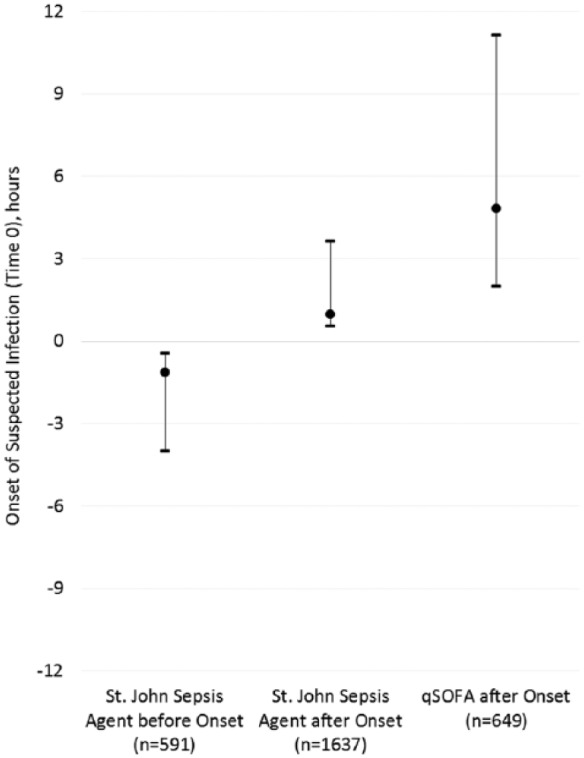
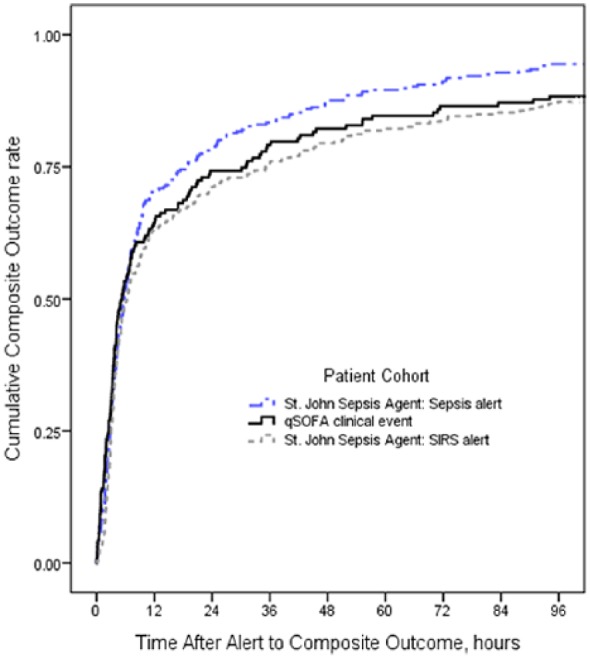
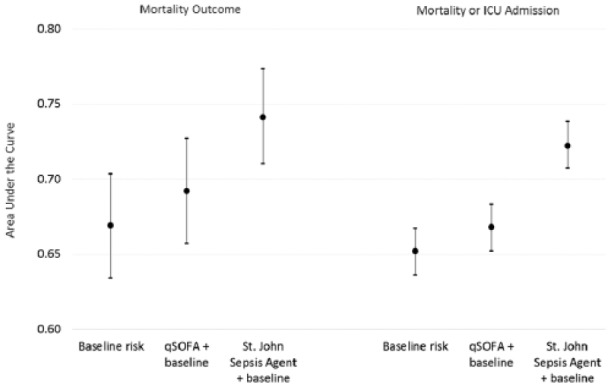
The 2016 Sepsis-3 guidelines included the Quick Sequential [Sepsis-related] Organ Failure Assessment (qSOFA) tool to identify patients at risk of sepsis. The objective was to compare the utility of qSOFA to the St. John Sepsis Surveillance Agent among patients with suspected infection. The primary outcomes were in-hospital mortality or admission to the intensive care unit. A multiple center observational cohort study design was used. The study population comprised 17 044 hospitalized patients between January and March 2016. For the primary analysis, receiver operator characteristic curves were constructed for patient outcomes using qSOFA and the St. John Sepsis Surveillance Agent, and the areas under the curve were compared against a baseline risk model. Time-to-event clinical process modeling also was applied. The St. John Sepsis Surveillance Agent, when compared to qSOFA, activated earlier and was more accurate in predicting patient outcomes; in this regard, qSOFA fell far behind on both objectives.
2016年脓毒症-3指南纳入了快速序贯[脓毒症相关]器官功能衰竭评估(qSOFA)工具,以识别有脓毒症风险的患者。目的是比较qSOFA与圣约翰脓毒症监测工具在疑似感染患者中的效用。主要结局为住院死亡率或入住重症监护病房。采用多中心观察性队列研究设计。研究人群包括2016年1月至3月期间住院的17044例患者。对于主要分析,使用qSOFA和圣约翰脓毒症监测工具构建患者结局的受试者工作特征曲线,并将曲线下面积与基线风险模型进行比较。还应用了事件发生时间临床过程建模。与qSOFA相比,圣约翰脓毒症监测工具更早启动,在预测患者结局方面更准确;在这方面,qSOFA在两个目标上都远远落后。