Yang Xueyan, Feldman Marcus W
Institute for Population and Development Studies, School of Public Policy and Administration, Xi'an Jiaotong University, #28 Xianning Xi Road, Xi'an, Shaanxi Province, 710049, People's Republic of China.
Morrison Institute for Population and Resource Studies, Stanford University, Stanford, CA, USA.
BMC Public Health. 2017 Jul 28;18(1):66. doi: 10.1186/s12889-017-4614-z.
A reversed gender pattern has been observed in the suicide rate in China compared to elsewhere. Like suicidal behaviour, non-suicidal self-injurious (NSSI) behaviour is a health-risk behaviour. We examined whether a reversed gender pattern existed in the prevalence of NSSI.
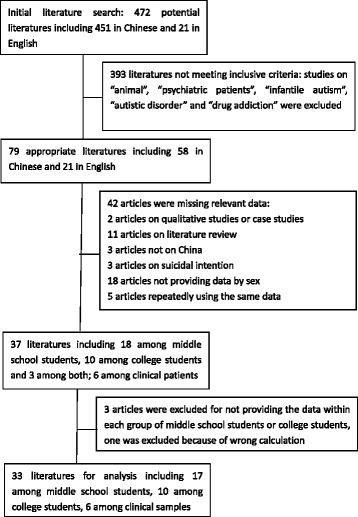
Online literature databases were searched for English and Chinese articles on NSSI behaviours among the Chinese. A meta-analysis with a random-effects model and a subgroup analysis were used to estimate the odds ratios of gender differences in NSSI prevalence among Chinese adolescents including college students, middle school students, and clinical samples, as well as rural, urban, and Hong Kong middle school students.
There was a male bias in NSSI prevalence among college students (OR = 1.56, 95% CI = [1.30, 1.87], p < 0.001), and a female bias among middle school students (OR = 0.83, 95% CI = [0.73, 0.94], p < 0.01), but there was no gender difference among clinical samples (OR = 0.88, 95% CI = [0.41, 1.89], p > 0.1). The NSSI prevalence among middle school students had a female bias in the rural (OR = 0.58, 95% CI = [0.47, 0.72], p < 0.001) and Hong Kong areas (OR = 0.91, 95% CI = [0.86, 0.96], p < 0.001), with the gender difference in NSSI prevalence in the Hong Kong areas being greater than in rural areas. No gender difference in NSSI prevalence was found in urban areas (OR = 1.01, 95% CI = [0.84, 1.22], p > 0.1) among middle school students.
Our analysis indicated the existence of specific gender and age patterns in NSSI prevalence among Chinese adolescents. The sample type, age, and the areas that have different gender norms and culture could partly explain this pattern.
与其他地区相比,中国的自杀率呈现出性别模式逆转的现象。与自杀行为一样,非自杀性自伤(NSSI)行为也是一种健康风险行为。我们研究了NSSI的患病率是否存在性别模式逆转。
在在线文献数据库中搜索关于中国人NSSI行为的英文和中文文章。采用随机效应模型的荟萃分析和亚组分析来估计中国青少年(包括大学生、中学生和临床样本)以及农村、城市和香港中学生中NSSI患病率性别差异的比值比。
大学生中NSSI患病率存在男性偏倚(OR = 1.56,95%CI = [1.30, 1.87],p < 0.001),中学生中存在女性偏倚(OR = 0.83,95%CI = [0.73, 0.94],p < 0.01),但临床样本中不存在性别差异(OR = 0.88,95%CI = [0.41, 1.89],p > 0.1)。农村(OR = 0.58,95%CI = [0.47, 0.72],p < 0.001)和香港地区(OR = 0.91,95%CI = [0.86, 0.96],p < 0.001)的中学生中NSSI患病率存在女性偏倚,香港地区NSSI患病率的性别差异大于农村地区。城市中学生中NSSI患病率不存在性别差异(OR = 1.01,95%CI = [0.84, 1.22],p > 0.1)。
我们的分析表明,中国青少年NSSI患病率存在特定的性别和年龄模式。样本类型、年龄以及具有不同性别规范和文化的地区可能部分解释了这种模式。